Digital Electronic Colposcope Market Set to Reach US$ 2.54 Billion by 2034
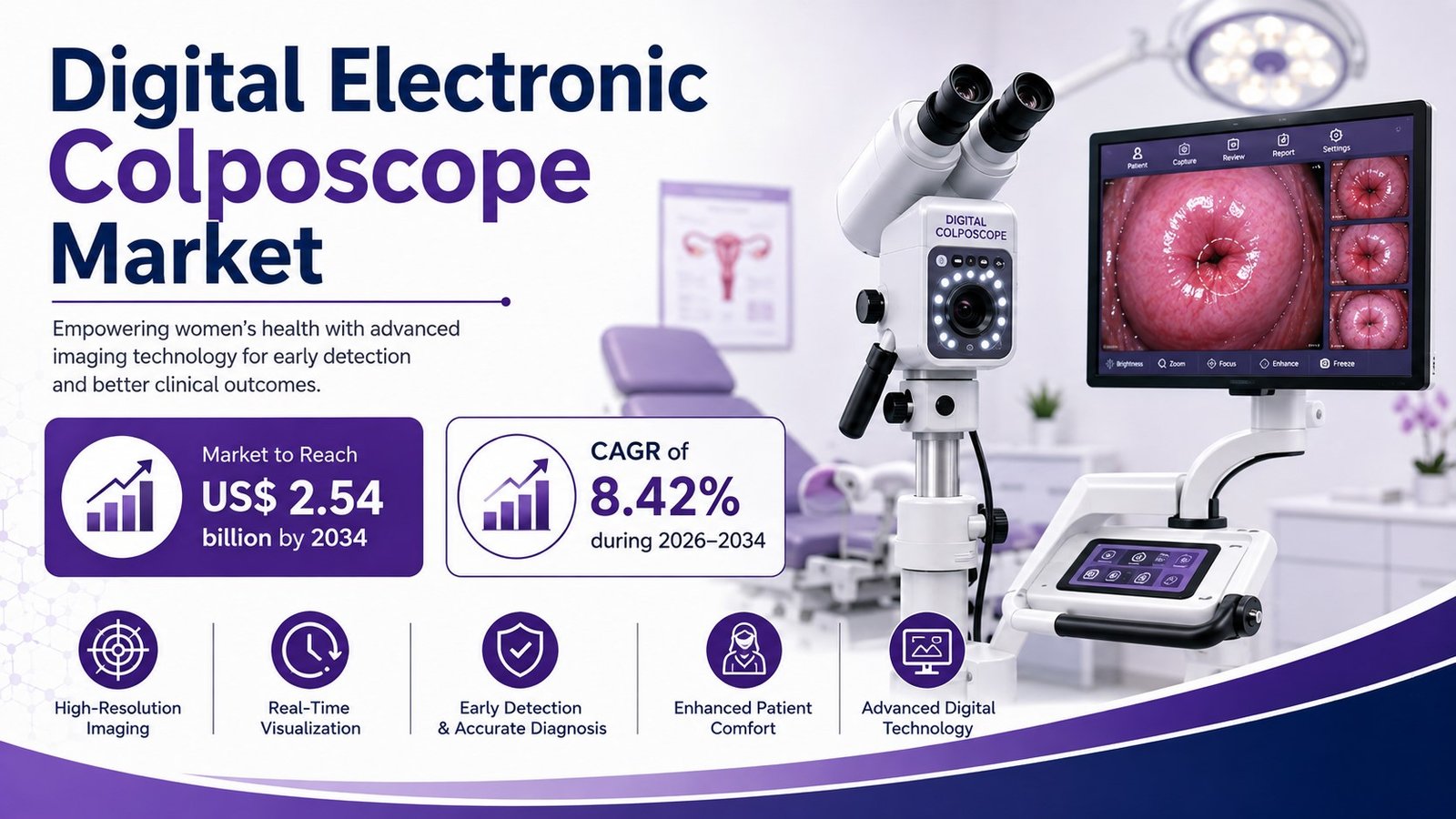
The Digital Electronic Colposcope Market is estimated at approximately US$ 1.33 billion in 2025 and is projected to reach US$ 2.54 billion by 2034, growing at an 8.42% CAGR during 2026–2034. The market is expanding as healthcare providers increasingly adopt digital visualization technologies for cervical examination, screening, diagnosis, and follow-up of cervical abnormalities. Rising awareness of cervical cancer screening, expanding women’s healthcare services, technological improvements in digital imaging, and efforts to improve access to screening in underserved settings support growth.
Digital electronic colposcopes provide magnified visualization of the cervix and surrounding tissues and can integrate high-resolution cameras, digital image capture, video recording, image enhancement, and documentation capabilities. The transition from conventional optical examination toward digitally enabled workflows is creating opportunities for equipment manufacturers, healthcare facilities, and telemedicine-enabled screening programs.
What is driving the market?
Increasing cervical cancer screening, growing awareness of early detection, and the adoption of digital diagnostic technologies are the principal growth drivers. Colposcopy is an important diagnostic procedure following abnormal cervical screening results, allowing healthcare professionals to examine cervical tissue under magnification and identify areas requiring further evaluation or biopsy.
The expansion of organized cervical cancer screening programs is increasing demand for colposcopy equipment in hospitals, gynecology clinics, diagnostic centers, and specialized women’s health facilities. The World Health Organization’s cervical cancer elimination strategy has also placed greater emphasis on screening and treatment of precancerous lesions, supporting long-term demand for diagnostic infrastructure.
Digital systems are gaining attention because they can simplify image capture, documentation, and communication. Instead of relying solely on the clinician’s direct optical view, digital colposcopes can capture images and videos that can be stored with patient records, reviewed during follow-up examinations, and used for clinical education.
Download Sample PDF: https://www.theinsightpartners.com/sample/TIPRE00021567
Which region leads?
North America represents a significant market for digital electronic colposcopy, supported by established women’s healthcare infrastructure, widespread availability of cervical screening, and adoption of advanced medical imaging technologies. Demand is also supported by replacement of conventional equipment and the increasing use of digitally integrated diagnostic systems.
Europe is another important market, benefiting from established cervical cancer screening programs, healthcare infrastructure, and increasing emphasis on early detection and standardized diagnostic pathways. Countries with well-developed gynecological services provide a substantial installed base for colposcopy equipment while technological upgrades create opportunities for digital systems.
Asia Pacific is expected to experience strong growth through 2034, driven by the expansion of healthcare infrastructure, increasing awareness of cervical cancer, rising screening requirements, and improving access to women’s healthcare services. China and India represent significant opportunities because of their large populations and expanding hospital and diagnostic networks.
Emerging markets across Asia, Latin America, and other developing regions also present opportunities as governments, healthcare organizations, and non-governmental programs expand cervical cancer screening. Portable and digitally connected systems may be particularly relevant where healthcare facilities have limited specialist resources.
Which segment leads?
Digital video and camera-integrated colposcopy systems represent an important growth segment, supported by the increasing requirement for high-resolution documentation, image storage, and digital sharing. Compared with conventional optical systems, electronic colposcopes can provide greater flexibility for capturing and reviewing clinical images.
By end user, hospitals and gynecology clinics account for a substantial share of demand, reflecting the concentration of cervical screening, diagnostic evaluation, and follow-up procedures in these facilities. Diagnostic centers and specialized women’s health clinics are also adopting digital systems as screening volumes increase.
Portable and compact electronic colposcopes represent a high-growth opportunity because they can support screening in community clinics, outreach programs, primary-care settings, and locations where access to specialist gynecological facilities is limited. Digital connectivity can further extend their utility by allowing captured images to be shared with specialists for consultation.
Which companies are prominent?
The competitive landscape includes Lutech Industries S.r.l.; MedGyn Products, Inc.; CooperSurgical, Inc.; Wallach Surgical Devices; MobileODT Ltd.; Karl Kaps GmbH & Co. KG; Leisegang Feinmechanik-Optik GmbH; GYNIUS Plus AB; Optomic España S.A.; OPTOPOL Technology Sp. z o.o.; NTL Healthcare Ltd.; Perlong Medical Equipment Co., Ltd.; Xuzhou Kejian Hi-tech Co., Ltd.; Edan Instruments, Inc.; and Alltion (Wuzhou) Co., Ltd.
These companies compete across digital colposcopy systems, optical and video colposcopes, portable devices, imaging technologies, and related gynecological diagnostic equipment. Competitive differentiation increasingly depends on image quality, optical magnification, digital recording, ergonomics, portability, software capabilities, connectivity, and service support.
Manufacturers are also targeting different healthcare environments. Full-featured systems are designed for hospitals and specialist clinics, while compact and portable systems can address primary-care facilities and screening programs with limited infrastructure.
The competitive landscape therefore extends beyond equipment specifications to include affordability, ease of use, interoperability, training, and the ability to support broader cervical cancer screening workflows.
What is changing in 2026?
The digital colposcopy market is moving from standalone visualization toward connected, data-enabled cervical screening workflows. Modern systems increasingly combine high-definition imaging with digital documentation, image management, video recording, and connectivity.
One important development is the growing interest in AI-assisted cervical image assessment. Artificial intelligence and computer-vision technologies are being investigated and developed to assist clinicians in identifying potentially abnormal cervical areas. These technologies are intended to support clinical decision-making rather than replace diagnostic evaluation, and their adoption depends on validation, regulatory requirements, clinical workflows, and data quality.
The increasing availability of portable digital devices is another important change. Compact systems can capture cervical images and transmit them electronically, creating possibilities for telecolposcopy and remote specialist consultation. This can be particularly relevant in areas where trained colposcopists are concentrated in major hospitals rather than primary or community healthcare facilities.
Purchase a Copy of this report: https://www.theinsightpartners.com/buy/TIPRE00021567
What are the major investment opportunities?
The major opportunities lie in portable digital colposcopy, AI-enabled image analysis, telecolposcopy, connected screening platforms, and expansion of cervical cancer diagnostic infrastructure.
Portable and affordable systems can address significant unmet demand in emerging markets where conventional colposcopy infrastructure and specialist availability remain limited. Devices designed for ease of transportation, rapid image acquisition, and remote consultation can support community-based and decentralized screening programs.
AI-assisted cervical imaging represents another developing investment area. Software capable of analyzing cervical images and highlighting potentially suspicious regions could support clinicians, particularly in settings where specialist expertise is limited. However, commercial opportunities will depend on clinical validation, regulatory clearance, interoperability, and integration into existing screening pathways.
Telemedicine-enabled colposcopy also offers potential for recurring service models. Healthcare providers can combine digital imaging hardware with secure image management, remote interpretation, training, and specialist consultation, creating integrated screening platforms rather than relying solely on one-time equipment sales.
Additional opportunities exist in image-management software, cloud-based clinical documentation, equipment servicing, and training solutions. As digital colposcopy adoption increases, healthcare organizations will require systems that can manage patient images securely and integrate diagnostic information into existing workflows.
Also Available in: Korean | German | Japanese | French | Chinese | Italian | Spanish
Related Reports:
Mammography Detectors Market Size, Share & Demand by 2034
GCC Mass Spectrometry Market Size, Share & Trends by 2034
About Us
The Insight Partners is a one-stop provider of actionable industry research and intelligence. We help our clients get solutions to their research requirements through our syndicated and consulting research services. We specialize in industries such as Semiconductor and Electronics, Aerospace and Defense, Automotive and Transportation, Healthcare IT, Manufacturing and Construction, Medical Devices, Technology, Media and Telecommunications, Food and Beverages, Consumer Goods, and Chemicals and Materials.
Contact Us
Contact Person: Ankit Mathur
Phone: +1-646-491-9876
E-mail : sales@theinsightpartners.com