Digital Subtraction Angiography Equipment Market Worth US$ 780.68 million by 2034
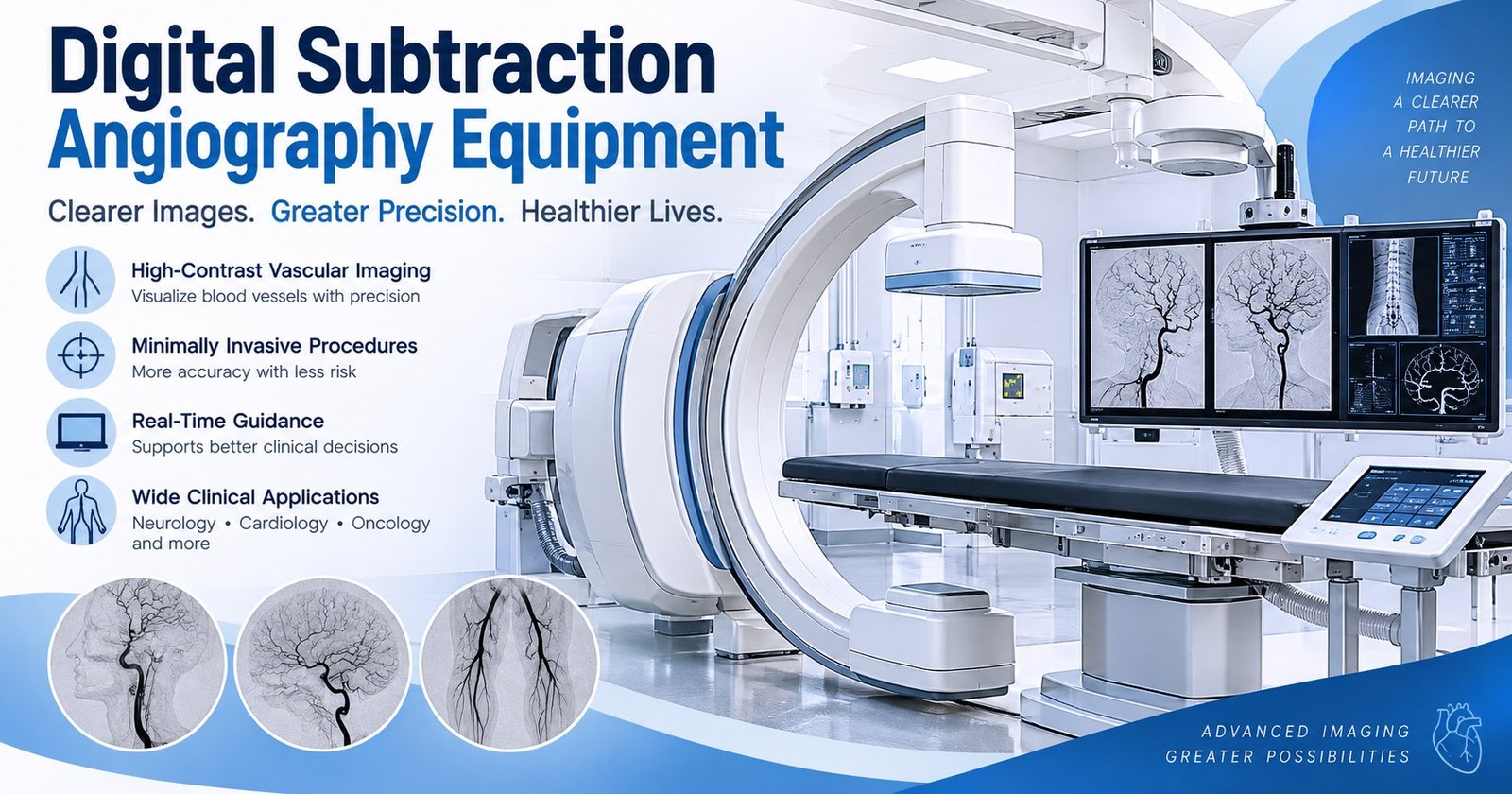
The Digital Subtraction Angiography (DSA) Equipment Market is projected to reach US$ 780.68 million by 2034, advancing at a CAGR of 7.07% during 2026–2034. The market is expanding as hospitals, interventional radiology centers, and cardiovascular facilities increase investment in advanced image-guided systems for vascular diagnosis and minimally invasive procedures. Demand is being supported by the growing burden of cardiovascular and vascular diseases, increasing adoption of minimally invasive interventions, replacement of aging imaging systems, and continued advances in digital imaging technology.
Digital subtraction angiography combines X-ray imaging with computerized image processing to enhance visualization of contrast-filled blood vessels by digitally removing overlapping anatomical structures. The technology is widely used in interventional radiology and endovascular procedures, including imaging of abdominal, cardiac, pulmonary, carotid, intracerebral, and peripheral vessels.
What is driving the market?
The rising volume of minimally invasive vascular procedures, increasing cardiovascular disease burden, and technological advances in image-guided intervention are the principal growth drivers. Healthcare providers are increasingly adopting advanced angiography systems that support precise vascular visualization and procedural guidance while integrating digital imaging, workflow optimization, and dose-management capabilities.
The growing use of endovascular procedures is increasing the requirement for high-performance imaging equipment in cardiovascular, neurovascular, peripheral vascular, and interventional radiology departments. DSA provides enhanced visualization of blood vessels by subtracting background anatomy from contrast-enhanced images, making it particularly useful for procedures involving small or complex vessels.
Technological development is also changing equipment purchasing decisions. Modern systems increasingly incorporate flat-panel digital detectors, advanced image processing, three-dimensional imaging, automated image optimization, and software designed to support procedural workflows. Flat-panel detectors have progressively replaced older image-intensifier technologies in modern DSA systems.
Download Sample PDF: https://www.theinsightpartners.com/sample/TIPRE00023275
Which region leads?
North America remains a key revenue-generating region for the digital subtraction angiography equipment market, supported by established interventional healthcare infrastructure, high adoption of image-guided procedures, and continued investment in cardiovascular and neurovascular care. The region is projected to expand at a CAGR of approximately 6.8% through 2034.
Europe represents another significant market, accounting for approximately 25%–30% of global DSA equipment revenue, with growth supported by advanced public healthcare systems, established interventional radiology networks, and ongoing hospital equipment modernization. Germany, the United Kingdom, and France are important markets within the region.
Asia Pacific is the fastest-growing regional market, with an estimated 24%–28% share in 2025 and a projected CAGR of approximately 8.2%–8.8% during 2026–2034. China, Japan, and India are contributing to regional expansion through hospital infrastructure investment, increasing healthcare capacity, and growing demand for advanced diagnostic and interventional technologies.
The expansion of hospital networks and interventional facilities in emerging economies is creating additional opportunities for manufacturers. In India, for example, growth in tertiary-care capacity and expansion of cardiac and stroke-care infrastructure are contributing to demand for advanced angiography systems.
Which segment leads?
Floor-mounted systems represent the leading type segment, supported by their widespread use in high-volume interventional suites requiring procedural flexibility, imaging performance, and efficient clinical workflows. The segment is expected to register a CAGR of approximately 6.8%–7.3% during 2026–2034.
By end user, hospitals represent a major growth segment, with the segment projected to expand at a CAGR of approximately 7.3%–7.8% during 2026–2034. Demand is being supported by investment in hybrid operating rooms, cardiovascular centers, comprehensive stroke facilities, and dedicated interventional radiology departments.
The clinical application of DSA continues to extend across cardiovascular, cerebrovascular, peripheral vascular, and oncology-related interventions. The ability to visualize contrast-filled vessels while reducing interference from bones and other anatomical structures makes DSA an important component of image-guided intervention.
Which companies are prominent?
The market includes Neusoft Medical Systems Co., Ltd.; Beijing Wandong Medical Technology Co., Ltd.; GE HealthCare Technologies Inc.; Siemens Healthineers AG; Koninklijke Philips N.V.; Canon Medical Systems Corporation; Medtronic plc; Boston Scientific Corporation; Abbott Laboratories; Shimadzu Corporation; Shenzhen Mindray Bio-Medical Electronics Co., Ltd.; Terumo Corporation; B. Braun Melsungen AG; AngioDynamics, Inc.; and Merit Medical Systems, Inc.
These companies participate across medical imaging systems, interventional technologies, vascular devices, and supporting procedural solutions. Competition increasingly centers on image quality, system ergonomics, radiation-management capabilities, workflow integration, software functionality, service support, and the ability to address specialized cardiovascular and neurovascular procedures.
Major imaging manufacturers are also expanding integrated technology platforms rather than competing solely on the hardware itself. Advanced image processing, 3D visualization, AI-supported optimization, multimodality imaging, and integration with interventional workflows are becoming increasingly important areas of product differentiation.
What is changing in 2026?
The DSA equipment market is moving toward intelligent, integrated, and workflow-oriented interventional imaging platforms. Manufacturers are increasingly combining advanced detectors, software-based image processing, AI-supported optimization, and procedural guidance technologies to improve image quality and workflow efficiency.
A notable development in 2026 is the expansion of AI-enabled angiography technology. Siemens Healthineers received U.S. FDA clearance for six new Artis interventional imaging systems featuring its Optiq AI imaging chain, covering floor-mounted, ceiling-mounted, biplane, and robotic configurations. The development illustrates the industry’s shift toward AI-assisted imaging optimization across different interventional configurations.
Manufacturing localization is also becoming strategically important. In April 2026, Siemens Healthineers announced local production of its Artis One Edition X angiography system in Bengaluru, India, expanding its manufacturing presence in a market where healthcare infrastructure and interventional capabilities are growing.
Another area of development is multimodality imaging. Canon Medical Systems introduced a hybrid Angio-CT platform combining angiography and CT capabilities, reflecting efforts to integrate complementary imaging technologies into interventional workflows.
These developments indicate that purchasing decisions are increasingly influenced not only by basic angiographic imaging performance but also by software capabilities, workflow integration, AI functionality, radiation management, system flexibility, and lifecycle support.
Purchase a Copy of this report: https://www.theinsightpartners.com/buy/TIPRE00023275
What are the major investment opportunities?
The principal opportunities lie in advanced angiography systems, AI-enabled imaging, hybrid interventional platforms, equipment replacement, and expansion of cardiovascular and neurovascular infrastructure.
Hospitals and healthcare networks in emerging markets are upgrading diagnostic and interventional capabilities, creating opportunities for manufacturers that can provide scalable systems with appropriate performance and lifecycle economics. Asia Pacific is particularly relevant as hospital infrastructure expands and demand for minimally invasive cardiovascular and neurovascular procedures increases.
Investment opportunities also extend beyond equipment sales. Service contracts, software upgrades, imaging-system modernization, workflow integration, and replacement of aging installed equipment can generate recurring revenue opportunities for manufacturers and service providers.
AI-supported image optimization and advanced 3D visualization represent another important area of development. These technologies can support more efficient image interpretation and procedural workflows, while improvements in detector technology and image processing continue to enhance the capabilities of DSA systems.
Also Available in: Korean | German | Japanese | French | Chinese | Italian | Spanish
Related Reports:
Endomyocardial Biopsy Devices Market Share, Size & Demand by 2034
Embolization Coils Market Size, Share, and Forecast 2025-2031
About Us
The Insight Partners is a one-stop provider of actionable industry research and intelligence. We help our clients get solutions to their research requirements through our syndicated and consulting research services. We specialize in industries such as Semiconductor and Electronics, Aerospace and Defense, Automotive and Transportation, Healthcare IT, Manufacturing and Construction, Medical Devices, Technology, Media and Telecommunications, Food and Beverages, Consumer Goods, and Chemicals and Materials.
Contact Us
Contact Person: Ankit Mathur
Phone: +1-646-491-9876
E-mail : sales@theinsightpartners.com