Tetrahydrogeraniol Market growing at a CAGR of 5.2% from 2025 to 2033
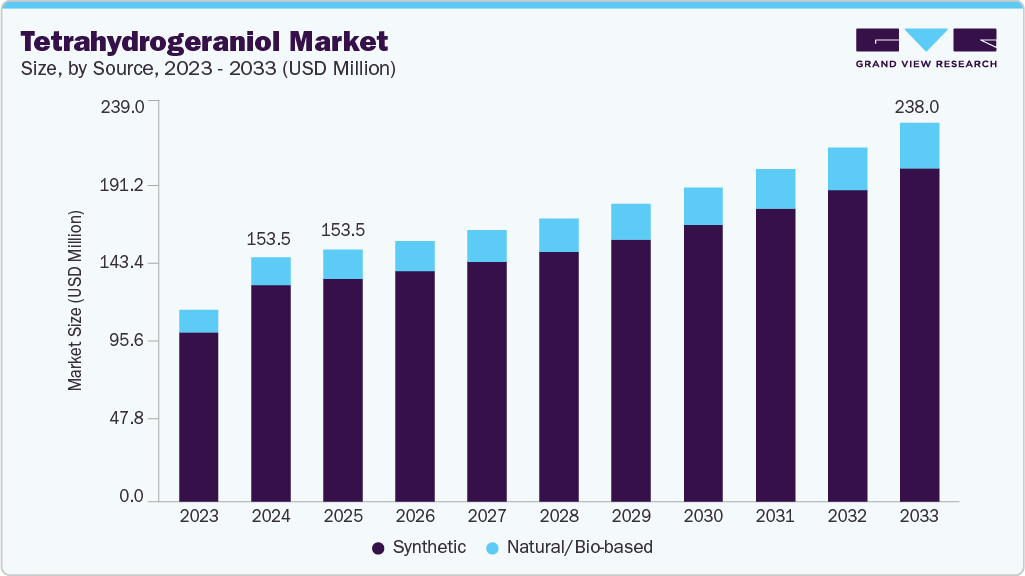
The global tetrahydrogeraniol market size was estimated at USD 153.5 million in 2024 and is projected to reach at USD 238.0 million by 2033, growing at a CAGR of 5.2% from 2025 to 2033. The market is primarily driven by the growing demand for high-stability, long-lasting fragrance ingredients across fine fragrances, personal care, and household & fabric care applications.
Key Market Trends & Insights
- Europe dominated the tetrahydrogeraniol market with the largest revenue share of 36.7% in 2024.
- Germany remains one of Europe’s key demand hubs due to its robust chemical manufacturing base, strong presence of global FMCG companies, and advanced fragrance formulation ecosystem.
- By source, natural/bio-based segment is expected to grow at the fastest CAGR of 5.7% from 2025 to 2033 in terms of revenue.
- By application, fragrances & perfumes segment held the largest revenue share of 38.5% in 2024 in terms of value.
Market Size & Forecast
- 2024 Market Size: USD 153.5 million
- 2033 Projected Market Size: USD 238.0 million
- CAGR (2025-2033): 5.2%
- Europe: Largest market in 2024
Request Free Sample Report: https://www.grandviewresearch.com/industry-analysis/tetrahydrogeraniol-market-report/request/rs1
Manufacturers increasingly prefer tetrahydrogeraniol over traditional rose alcohols such as geraniol due to its superior oxidative stability, compatibility with surfactant-rich formulations, and ability to maintain olfactory performance under harsh processing conditions. Additional momentum comes from rising consumption of premium personal care products in Asia Pacific and sustained innovation in functional fragrances for detergents and homecare categories.
Significant opportunities exist in the development of bio-based or renewable-carbon grades, aligned with growing clean-label and sustainability requirements from global fragrance houses and consumer brands. Suppliers can also unlock value by offering high-purity, customizable aroma profiles, enabling tailored solutions for niche perfumery, fabric conditioners, and high-performance personal care formulations. Rapid growth in emerging markets, especially India, Southeast Asia, and Latin America, creates further prospects for market penetration due to expanding middle-class consumption and growing investments in local manufacturing of home & personal care products. Strategic partnerships with fragrance houses and contract manufacturers can also accelerate adoption and strengthen long-term offtake agreements.
Despite robust demand, the market faces challenges related to feedstock price volatility, as tetrahydrogeraniol production depends on geraniol and other terpene derivatives that are sensitive to agricultural output and global supply chain disruptions. Regulatory scrutiny on fragrance ingredients, including IFRA updates and region-specific restrictions on allergen declarations, can create compliance burdens and increase product reformulation costs. In addition, rising competition from low-cost regional manufacturers in China and India intensifies pricing pressure for global players, making differentiation through quality assurance, purity consistency, and sustainability certifications increasingly critical for maintaining market share.
Market Concentration & Characteristics
The market features a competitive landscape dominated by a mix of large integrated aroma-chemical producers and agile regional manufacturers. Leading players such as BASF and DSM-Firmenich compete on high product consistency, technical support, and sustainability-aligned offerings, making them preferred suppliers for multinational fragrance houses and major home & personal care brands. In parallel, mid-sized companies such as DRT and Privi, along with Chinese producers such as NHU, strengthen market fragmentation by offering competitive pricing, flexible packaging, and faster regional lead times, positioning themselves strongly in the value-driven and volume-centric segments.
Competition is further intensified by the role of global distributors, including Vigon and others, who provide regulatory documentation, small-pack formats, and rapid delivery to R&D and contract manufacturing customers. As a result, differentiation in this market hinges on three pillars: reliability of supply, sustainability and purity certifications, and commercial flexibility. Companies that combine high-quality production with responsive customer service and cost-efficient sourcing are best positioned to capture share across both premium fragrance applications and high-volume household care formulations.
Global Tetrahydrogeraniol Market Report Scope
|
Report Attribute |
Details |
|
Market size value in 2025 |
USD 158.1 million |
|
Revenue forecast in 2033 |
USD 238.0 million |
|
Growth rate |
CAGR of 5.2% from 2025 to 2033 |
|
Base year for estimation |
2024 |
|
Historical data |
2018 – 2023 |
|
Forecast period |
2025 – 2033 |
|
Quantitative units |
Revenue in USD million, volume in kilotons, and CAGR from 2025 to 2033 |
|
Report coverage |
Revenue forecast, company ranking, competitive landscape, growth factors, and trends |
|
Segments covered |
Source, application, region |
|
Regional scope |
North America; Europe; Asia Pacific; Middle East & Africa; Latin America |
|
Country scope |
U.S.; Canada; Mexico; Germany; UK; France; Italy; Spain; China; India; Japan; South Korea; Brazil; Argentina; South Africa; Saudi Arabia |
|
Key companies profiled |
Givaudan; Symrise; dsm-firmenich; BASF SE; Privi Speciality Chemicals Limited; Vigon International; DRT; NHU Zhejiang; MANE SA, The Good Scents Company |
|
Customization scope |
Free report customization (equivalent up to 8 analysts’ working days) with purchase. Addition or alteration to country, regional & segment scope. |
|
Pricing and purchase options |
Avail customized purchase options to meet your exact research needs. Explore purchase options |