Ocean Energy Market (2026 – 2033)
Ocean Energy Market Summary
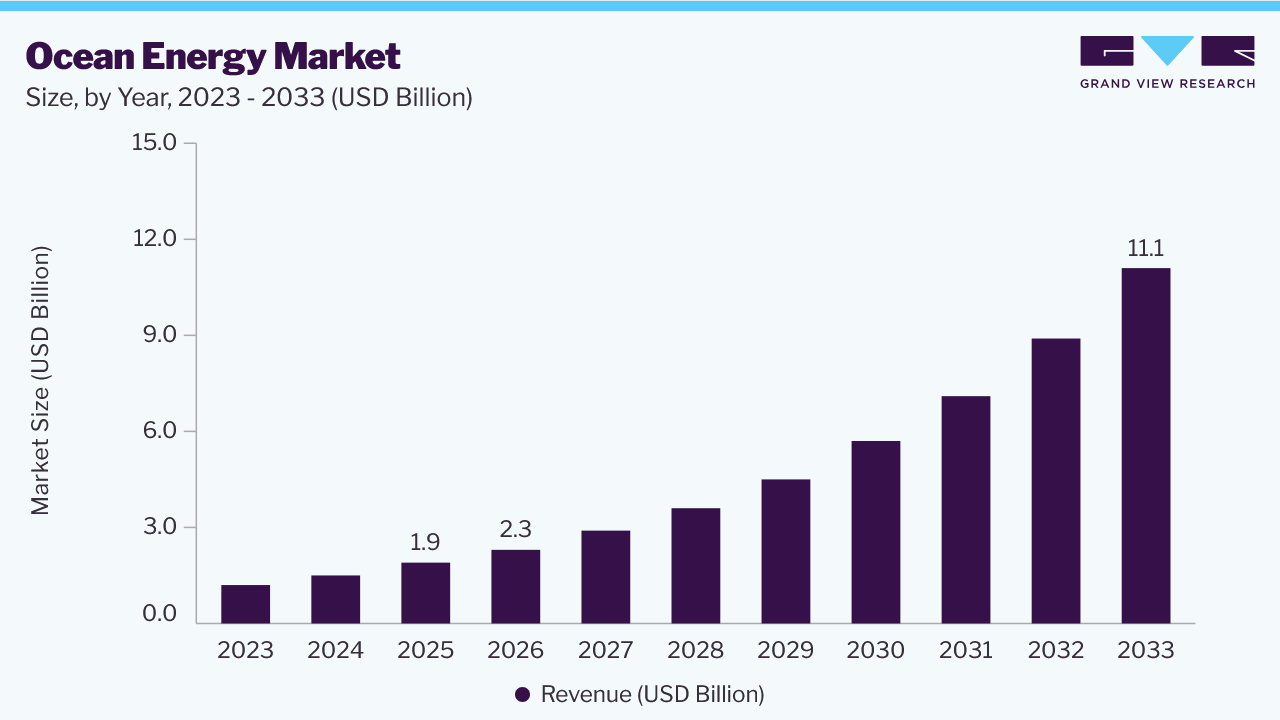
The global ocean energy market was valued at USD 1.9 billion in 2025 and is projected to grow from USD 2.3 billion in 2026 to USD 11.1 billion in 2033, at a CAGR of 25.0% from 2026 to 2033. Europe dominated the global market, accounting for the largest revenue share of 35.0% in 2025. Growing energy demand coupled with a shift in trends towards developing renewable energy is expected to drive the global ocean energy market growth.
Key Market Trends & Insights
- By technology: The tidal energy segment held the largest market share in 2025.
- By application: The power generation segment held the largest market share in 2025.
- By end user: The utilities & IPPsegment held the largest market share in 2025.
Regional Highlights
- Largest regional market: Europe (35.0% revenue share, 2025)
- Fastest-growing regional market: Asia Pacific (highest CAGR, 2026-2033)
Market Size & Forecast
- Market size in 2025: USD 1.9 Billion
- Estimated market size in 2026: USD 2.3 Billion
- Projected market size by 2033: USD 11.1 Billion
- CAGR (2026-2033): 25.0%
Request a free sample copy or view report summary: https://www.grandviewresearch.com/industry-analysis/ocean-energy-market/request/rs1
Rising concerns associated with energy security and dynamic crude oil prices are expected to further complement the market growth. Offshore oil and gas platforms typically operate in remote marine environments where access to onshore electricity grids is unavailable. These facilities have traditionally relied on diesel-powered generators to meet their continuous power requirements for various applications, including drilling operations, production equipment, lighting, communications, monitoring systems, and critical safety infrastructure. While diesel generators provide reliable power, they are considered as high fuel consuming and high-maintenance power sources. Besides frequent fuel transportation by support vessels, significant greenhouse gas emissions are the downside of using diesel generators.
Technology Insights
The tidal stream energy segment accounted for the largest revenue share of the ocean energy market in 2025, primarily due to its relatively high level of technological maturity and successful deployment in grid-connected commercial and demonstration projects. Compared with other marine energy technologies, tidal stream systems offer greater reliability owing to the predictable nature of tidal cycles, enabling stable and consistent renewable power generation. Large-scale projects, including Scotland’s MeyGen tidal array, along with continued government funding and private investments across Europe and Canada, have accelerated technology development and commercial deployment. In addition, the high energy density of tidal currents and the technology’s ability to deliver predictable electricity output make tidal stream energy an attractive solution for utilities seeking reliable, low-carbon power generation.
Application Insights
The power generation segment accounted for the highest revenue share in 2025. Driven by the fact that ocean energy solutions were initially created for the production of power and grid connections at the coastlines and offshore sites. Governments and utility companies are using wave and tidal technologies to expand their renewable energy portfolio and reduce the use of non-renewable resources. Grid-connected marine energy has proven viable through numerous pilot programs in Europe and the United Kingdom. The segment is further supported by the growing demand for clean baseload power in islands and remote coastal regions.
Desalination is projected to be the fastest-growing application segment during the forecasted period. Growth is driven by the growing demand for fresh water in the coastal and island regions, particularly in the Asia Pacific, the Middle East, and some parts of Europe. Desalination systems using energy generated from the oceans provide an eco-friendly solution through the use of wave and tidal energy in the water treatment process. Pilot projects on islands have shown benefits in cost and energy efficiency compared with diesel-powered desalination plants. For instance, in May 2025, Oneka Technologies’ wave-powered desalination project in Fort Bragg, California (USA), the project received full regulatory approvals from California agencies, including the State Lands Commission, to deploy pilot desalination buoys that convert seawater into freshwater using only wave energy.
Ocean Energy Market Report Scope
|
Report Attribute |
Details |
|
Market size in 2025 |
USD 1.9 billion |
|
Estimated market size in 2026 |
USD 2.3 billion |
|
Projected market size by 2033 |
USD 11.1 billion |
|
Growth rate |
CAGR of 25.0% from 2026 to 2033 |
|
Base year for estimation |
2025 |
|
Historical data |
2021 – 2024 |
|
Forecast period |
2026 – 2033 |
|
Quantitative units |
Revenue in USD billion, and CAGR from 2026 to 2033 |
|
Report coverage |
Revenue forecast, company ranking, competitive landscape, growth factors, and trends |
|
Segments covered |
technology, application, end user, region. |
|
Regional scope |
North America; Europe; Asia Pacific; Central & South America; Middle East & Africa |
|
Country scope |
U.S.; Canada; Mexico; Germany; UK; France; Italy; China; India; Japan; Brazil; Argentina; GCC Countries; South Africa |
|
Key companies profiled |
CorPower Ocean; Orbital Marine Power; SIMEC Atlantis Energy; Ocean Power Technologies (OPT); Minesto AB; AW-Energy; Eco Wave Power Global AB; Carnegie Clean Energy; Wave Swell Energy; Ocean Renewable Power Company (ORPC); NEMOS GmbH; Nova Innovation; Marine Current Turbines; AWS Ocean Energy; Trident Energy. |
|
Customization scope |
Free report customization (equivalent to up to 8 analysts working days) with purchase. Addition or alteration to country, regional & segment scope. |
|
Pricing and purchase options |
Avail of customized purchase options to meet your exact research needs. Explore purchase options |