Blockchain In Energy Market (2026 – 2033)
Blockchain In Energy Market Summary
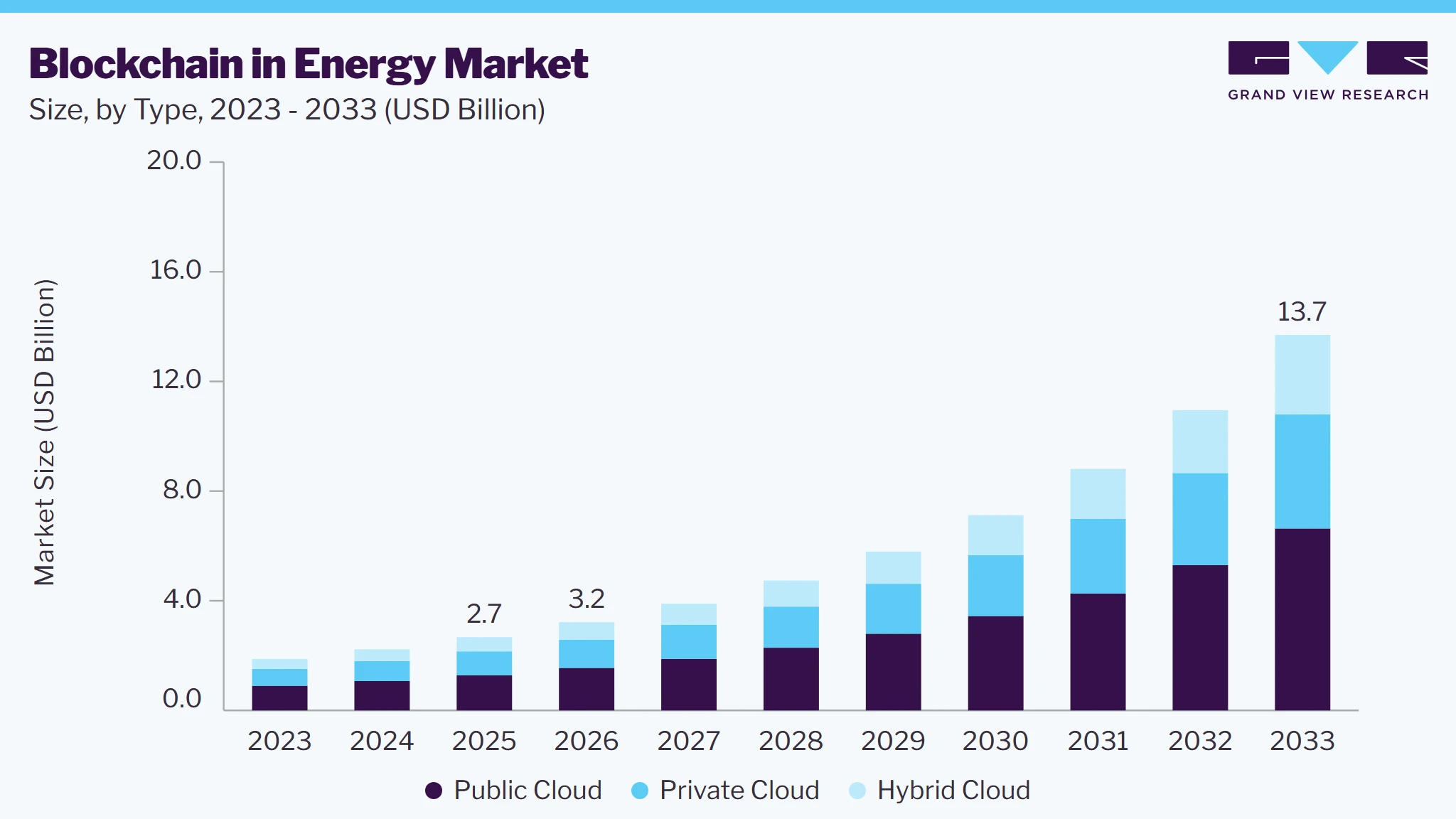
The global blockchain in energy market size was valued at USD 2.7 billion in 2025 and is projected to grow from USD 3.2 billion in 2026 to USD 13.7 billion by 2033, at a CAGR of 23.0% from 2026 to 2033. North America market dominated the market, accounting for a revenue share of 37.6% in 2025. The increasing demand for transparent and secure energy transactions is driving the growth of the market.
Key Market Trends & Insights
- By type: Public Cloud type segment led the market and accounted for 48.1% of the global revenue in 2025.
- By offering: Platform segment led the market and accounted for 57.8% of the global revenue in 2025.
- By application: Energy trading segment accounted for the largest share of 36.7% in 2025.
- By end user: Utilities and grid operator segment accounted for the largest revenue share of 35.7% in 2025.
Regional Highlights
- Largest regional market: North America (37.6% revenue share, 2025)
- Fastest growing regional market: Asia Pacific (highest CAGR, 2026-2033)
- By country: The U.S. held the largest market share in 2025.
Market Size & Forecast
- Market Size in 2025: USD 2.7 Billion
- Estimated market size in 2026: USD 3.2 Billion
- Projected Market Size by 2033: USD 13.7 Billion
- CAGR (2026-2033): 23.0%
Request a free sample copy or view report summary: https://www.grandviewresearch.com/industry-analysis/blockchain-energy-market-report/request/rs1
Rising electricity demand and the growing share of renewable power are creating a greater need for clear records of energy transactions. As more electricity is produced and traded across different sources, buyers and sellers need reliable information about the origin and movement of power. Blockchain can help maintain shared records, making transactions easier to track and verify. The regulator is also supporting the automatic issuance, tracking, and verification of renewable energy certificates. This growing focus on transparent energy records is supporting the use of blockchain across the energy sector.
Market Dynamics
The blockchain in energy market is being driven by the increasing digitalization of energy systems, the growth in renewable energy generation, the expansion of distributed energy resources, and the rising demand for transparent energy transactions. Energy markets are becoming more complex as utilities, generators, retailers, businesses, and consumers participate in multiple energy-related transactions. Blockchain is increasingly being considered to improve transaction records, renewable energy tracking, energy trading, grid coordination, and supply chain visibility.
Market Concentration & Characteristics
The blockchain in energy market is moderately fragmented, with participation spread across blockchain technology providers, energy companies, utilities, software developers, energy trading platforms, and specialized startups. The market does not have a small group of companies controlling a dominant share, as solutions are being developed for different applications such as peer-to-peer energy trading, renewable energy certificate management, energy transaction settlement, and decentralized energy management. The presence of both established technology and energy companies and smaller specialized providers creates a diverse competitive landscape. Companies are increasingly differentiating themselves through application-specific solutions, partnerships, platform capabilities, and integration with existing energy infrastructure.
The market characteristics indicate high innovation, strong regulatory influence, significant substitution pressure, and relatively low end-user adoption, reflecting the developing nature of blockchain applications in the energy sector. Innovation remains high as companies explore new applications for secure and transparent energy transactions, while collaborations between technology providers, utilities, energy companies, and other ecosystem participants remain important for developing and testing solutions. Regulations have a strong influence because blockchain-based energy transactions must operate within existing electricity market, data, consumer protection, and energy trading frameworks. Meanwhile, conventional centralized databases and digital energy-management systems provide alternatives to blockchain for several applications. End-user adoption remains comparatively low because many blockchain-based energy solutions are still progressing from pilot and demonstration projects toward wider commercial deployment, supporting the moderately fragmented market structure.
Type Insights
Based on type, the public cloud type segment accounted for 48.1% of the largest share of global revenue in 2025. The growing use of shared energy services is supporting public cloud adoption. As energy businesses manage more transactions, they need flexible systems to handle growing records. Public cloud solutions allow them to access these services without building their own systems. This is supporting wider adoption across the energy sector in this segment
Blockchain In Energy Market Report Scope
|
Report Attribute |
Details |
|
Market size in 2025 |
USD 2.7 billion |
|
Estimated market size in 2026 |
USD 3.2 billion |
|
Projected market size by 2033 |
USD 13.7 billion |
|
Growth rate |
CAGR of 23.0% from 2026 to 2033 |
|
Base year for estimation |
2025 |
|
Historical data |
2021 – 2024 |
|
Forecast period |
2026 – 2033 |
|
Quantitative units |
Revenue in USD billion and CAGR from 2026 to 2033 |
|
Report coverage |
Revenue forecast, company ranking, competitive landscape, growth factors, and trends |
|
Segments covered |
Type, offering, application, end user, region |
|
Regional scope |
North America; Europe; Asia Pacific; Latin America; MEA |
|
Country scope |
U.S.; Canada; Mexico; Germany; UK; France; China; Japan; India; South Korea; Australia; Brazil; KSA; UAE; South Africa |
|
Key companies profiled |
Powerledger; Energy Web; Flexidao; BigchainDB GmbH; IBM Corporation; SAP SE; Microsoft Corporation; Accenture.; Oracle; Infosys Limited |
|
Customization scope |
Free report customization (equivalent up to 8 analysts working days) with purchase. Addition or alteration to country, regional & segment scope. |
|
Pricing and purchase options |
Avail customized purchase options to meet your exact research needs. Explore purchase options |