Energy Transition Market (2026 – 2033)
Energy Transition Market Summary
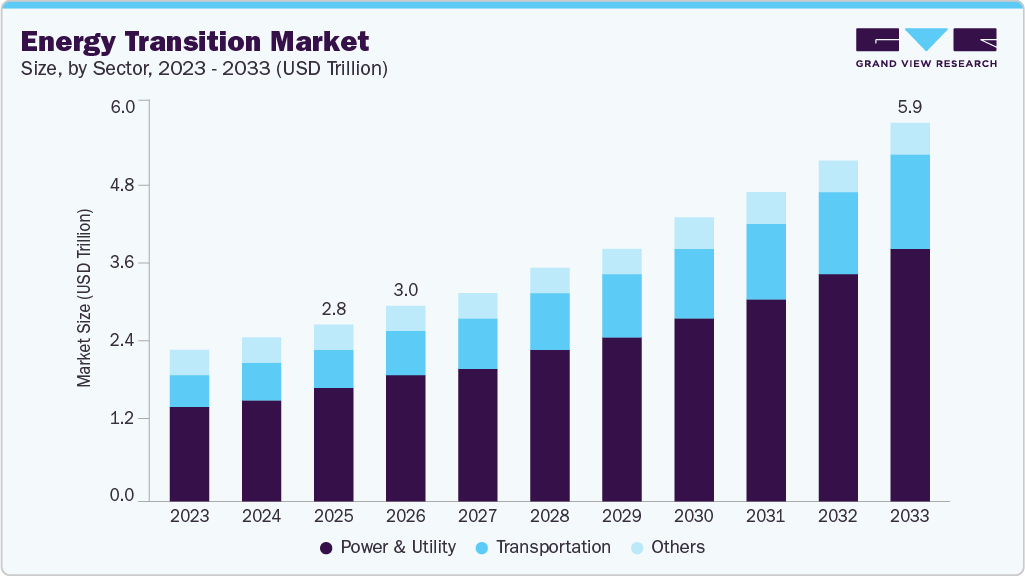
The global energy transition market size was valued at USD 2.8 trillion in 2025 and is projected to grow from USD 3.0 trillion in 2026 to USD 5.9 trillion by 2033, at a CAGR of 9.8% from 2026 to 2033. The Asia Pacific held the largest share of 44.6% of the global market in 2025. The industry is expanding rapidly due to rising global efforts to reduce emissions, combat climate change, and drive large-scale adoption of clean energy solutions.
Key Market Trends & Insights
- By type: Renewable energy segment accounted for the largest market share of 50.8% in 2025.
- By sector: Power & utility sub-segment held the largest revenue share of 63.2% in 2025.
Regional Highlights
- Largest regional market: Asia Pacific (44.6% revenue share, 2025)
- Fastest-growing regional market: Latin America (12.2% CAGR, 2026-2033)
- By country: China is expected to grow significantly over the forecast period.
Market Size & Forecast
- Market size in 2025: USD 2.8 Trillion
- Estimated market size in 2026: USD 3.0 Trillion
- Projected market size by 2033: USD 5.9 Trillion
- CAGR (2026-2033): 9.8%
Request a free sample copy or view report summary: https://www.grandviewresearch.com/industry-analysis/energy-transition-market-report/request/rs1
Sector Insights
Based on sector, the power & utility segment held the largest share of 63.2%. This segment is driven by the large-scale integration of renewable energy sources and the ongoing transformation of electricity systems. The rapid expansion of distributed solutions such as rooftop solar energy, battery storage, and smart meters is increasing the need for advanced grid management and optimization systems. Utilities are investing heavily in digital infrastructure and smart grid technologies to efficiently manage decentralized power generation. These developments, combined with rising electricity demand and grid modernization efforts, are reinforcing the central role of the power & utilities sector.
The transportation segment is projected to register the fastest CAGR of 11.2% over the forecast period, supported by the rapid adoption of electric mobility solutions across passenger, commercial, and heavy-duty vehicle segments. This growth is further supported by the large-scale deployment of charging infrastructure, which is essential to accommodate the rising number of EVs globally. The expansion of charging networks, along with supportive policies and technological advancements, is enabling a more reliable and accessible ecosystem for electric mobility.
Type Insights
Based on type, the renewable energy segment accounted for the largest market share of 50.8% in 2025, driven by strong regulatory and policy support promoting clean energy adoption. Stringent net-zero commitments, carbon pricing mechanisms, and government subsidies have significantly accelerated the deployment of renewable energies. Rising corporate sustainability initiatives and ESG commitments are increasing demand for renewable power through long-term Power Purchase Agreements (PPAs), ensuring stable revenue streams for developers. The scalability, declining costs, and policy-driven incentives associated with renewable energy continue to support its dominant position within the industry.
Regional Insights
Asia Pacific energy transition market accounted for the largest share of 44.6% in 2025, primarily driven by strong policy support and the region’s expanding industrial base. Governments across key economies are implementing regulatory measures such as carbon pricing mechanisms, along with incentives and grants, to encourage the adoption of clean energy solutions. These policies are accelerating investments in technologies such as solar energy and wind energy, particularly in energy-intensive industries. Growing collaboration between governments, industry bodies, and private enterprises is enhancing technology adoption and enabling the development of a structured energy transition across the region.
Energy Transition Market Report Scope
|
Report Attribute |
Details |
|
Market Definition |
The Energy Transition market refers to the global revenue generated from the deployment of technologies, infrastructure, and services that enable the shift from fossil fuel-based energy systems to low-carbon and renewable energy sources across power generation, transportation, industry, and end-use sectors. |
|
Market size in 2025 |
USD 2.8 trillion |
|
Estimated market size in 2026 |
USD 3.0 trillion |
|
Projected market size by 2033 |
USD 5.9 trillion |
|
Growth rate |
CAGR of 9.8% from 2026 to 2033 |
|
Base year for estimation |
2025 |
|
Historical data |
2021 – 2024 |
|
Forecast period |
2026 – 2033 |
|
Quantitative units |
Revenue in USD billion/trillion, and CAGR from 2026 to 2033 |
|
Report coverage |
Revenue forecast, competitive landscape, growth factors, and trends |
|
Segments covered |
Type, sector, region |
|
Regional scope |
North America; Europe; Asia Pacific; Latin America; Middle East & Africa |
|
Country scope |
U.S.; Canada; Mexico; Germany; UK; France; Italy; Spain; China; India; Australia; Japan; South Korea; Brazil; Argentina; Saudi Arabia; UAE; South Africa |
|
Key companies profiled |
NextEra Energy, Inc.; Iberdrola, S.A.; Ørsted A/S; ABB Ltd.; GE Vernova; Siemens AG; Enel S.p.A.; EDF Group; RWE AG; First Solar, Inc. |
|
Customization scope |
Free report customization (equivalent up to 8 analysts working days) with purchase. Addition or alteration to country, regional & segment scope. |
|
Pricing and purchase options |
Avail customized purchase options to meet your exact research needs. Explore purchase options |