Distributed Energy Generation Market (2026 – 2033)
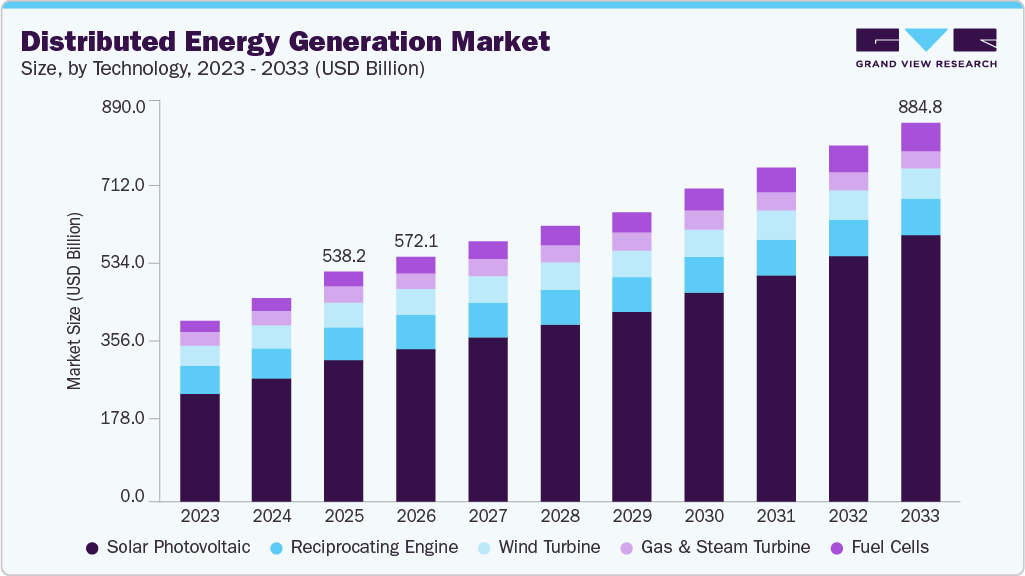
Distributed Energy Generation Market Summary
The global distributed energy generation market size was valued at USD 538.2 billion in 2025 and is projected to grow from USD 572.1 billion in 2026 to USD 884.8 billion by 2033, at a CAGR of 6.4% from 2026 to 2033. Asia Pacific dominated the global market, accounting for the largest revenue share of 34.9% in 2025. Distributed energy generation refers to decentralized power production systems such as solar PV, wind turbines, fuel cells, microturbines, and combined heat and power (CHP) units installed near the point of consumption.
Key Market Trends & Insights
- By technology: Solar photovoltaic segment held the highest market share of 61.3% in 2025.
Regional Highlights
- Largest regional market: Asia Pacific (34.9% revenue share, 2025)
- Fastest-growing regional market: Latin America (highest CAGR, 2026-2033)
- By country: The China distributed energy generation industry is a major contributor to the global market.
Market Size & Forecast
- Market size in 2025: USD 538.2 Billion
- Estimated market size in 2026: USD 572.1 Billion
- Projected market size by 2033: USD 884.8 Billion
- CAGR (2026-2033): 6.4%
Request a free sample copy or view report summary: https://www.grandviewresearch.com/industry-analysis/distributed-energy-generation-industry/request/rs1
These systems enhance grid resilience, reduce transmission losses, and support the integration of renewable energy sources. Growing global emphasis on energy transition, decarbonization strategies, and grid modernization initiatives is accelerating investments in distributed generation technologies across residential, commercial, and industrial sectors. The market is witnessing increased support from governments and utilities through net metering policies, feed-in tariffs, tax incentives, and renewable portfolio standards aimed at promoting decentralized power infrastructure.
In addition, the rising demand for reliable and uninterrupted power supply across data centers, healthcare facilities, manufacturing units, and commercial buildings is expected to support long-term market expansion. As organizations seek cost-competitive and low-carbon energy alternatives, distributed energy generation offers enhanced energy security, reduced electricity bills, and lower greenhouse gas emissions, reinforcing its strategic importance in the evolving global power landscape.
Drivers, Opportunities & Restraints
The primary driver of the distributed energy generation market is the accelerating global transition toward decarbonized and resilient energy systems. Governments and utilities are increasingly promoting decentralized renewable installations such as rooftop solar PV, wind turbines, and combined heat and power (CHP) units to reduce transmission losses and enhance grid stability. Supportive regulatory frameworks, including net metering, tax incentives, renewable portfolio standards, and feed-in tariffs, are strengthening investment confidence. In addition, the declining cost of solar modules and battery energy storage systems is making distributed generation economically attractive across residential, commercial, and industrial applications.
A major opportunity lies in the rapid expansion of smart grids, microgrids, and energy storage integration. Advancements in digital energy management platforms, AI-based load optimization, and virtual power plant (VPP) models are enabling more efficient coordination of decentralized assets. Emerging economies in the Asia Pacific, Latin America, and Africa present strong growth potential due to rising electricity demand and the need for reliable off-grid or hybrid power solutions. Furthermore, increasing corporate commitments to sustainability and onsite clean power procurement are expected to create long-term demand for distributed generation systems.
However, the market faces restraints related to high initial installation costs, grid interconnection complexities, and regulatory inconsistencies across regions. Variability in renewable power generation and challenges in integrating distributed assets into existing grid infrastructure may impact system stability without adequate storage or advanced grid management solutions. In addition, policy uncertainty and changing subsidy structures in certain markets could influence investment decisions and slow adoption rates in the short term.
Technology Insights
Based on technology, solar photovoltaic (PV) accounted for the largest market revenue share of 61.3% in 2025, driven by its cost competitiveness, scalability, and widespread adoption across residential, commercial, and industrial sectors. The declining prices of PV modules, coupled with supportive government incentives such as net metering and tax credits, have significantly accelerated installations globally. Solar PV systems offer modular deployment, low maintenance requirements, and seamless integration with battery energy storage systems, making them a preferred choice for decentralized power generation.
Regional Insights
Asia Pacific accounted for the largest revenue share of 34.9% in 2025, driven by rapid urbanization, rising electricity demand, and strong government support for renewable energy deployment. Countries across the region are actively promoting rooftop solar programs, distributed wind installations, and hybrid microgrid systems to improve energy access and reduce dependence on centralized coal-based generation. Expanding manufacturing capabilities for solar modules and batteries further enhances cost competitiveness and large-scale adoption.
Distributed Energy Generation Market Report Scope
|
Report Attribute |
Details |
|
Market definition |
The distributed energy generation market refers to the global revenue generated from the deployment, installation, and integration of decentralized power generation systems such as solar photovoltaic (PV), wind turbines, fuel cells, microturbines, and combined heat and power (CHP) units across residential, commercial, and industrial applications to enhance energy efficiency, grid resilience, and low-carbon electricity production. |
|
Market size in 2025 |
USD 538.2 billion |
|
Estimated Market size in 2026 |
USD 572.1 billion |
|
Projected Market size by 2033 |
USD 884.8 billion |
|
Growth rate |
CAGR of 6.4% from 2026 to 2033 |
|
Base year for estimation |
2025 |
|
Historical data |
2021 – 2024 |
|
Forecast period |
2026 – 2033 |
|
Quantitative units |
Volume in GW, revenue in USD million/billion, and CAGR from 2026 to 2033 |
|
Report coverage |
Revenue forecast, competitive landscape, growth factors, and trends |
|
Segments covered |
Technology and region |
|
Regional scope |
North America; Europe; Asia Pacific; Latin America; Middle East & Africa |
|
Country scope |
U.S.; Canada; Mexico; Germany; UK; France; China; India; Japan; South Korea; Brazil; Saudi Arabia; UAE |
|
Key companies profiled |
Tesla, Inc.; Siemens AG; Schneider Electric SE; General Electric; ABB Ltd.; Enel Green Power; SMA Solar Technology AG; Bloom Energy Corporation; NextEra Energy, Inc.; Honeywell International Inc. |
|
Customization scope |
Free report customization (equivalent up to 8 analysts working days) with purchase. Addition or alteration to country, regional & segment scope. |
|
Pricing and purchase options |
Avail customized purchase options to meet your exact research needs. Explore purchase options |