Underwater Wireless Optical Communication System Market (2026 – 2033)
Underwater Wireless Optical Communication System Market Summary
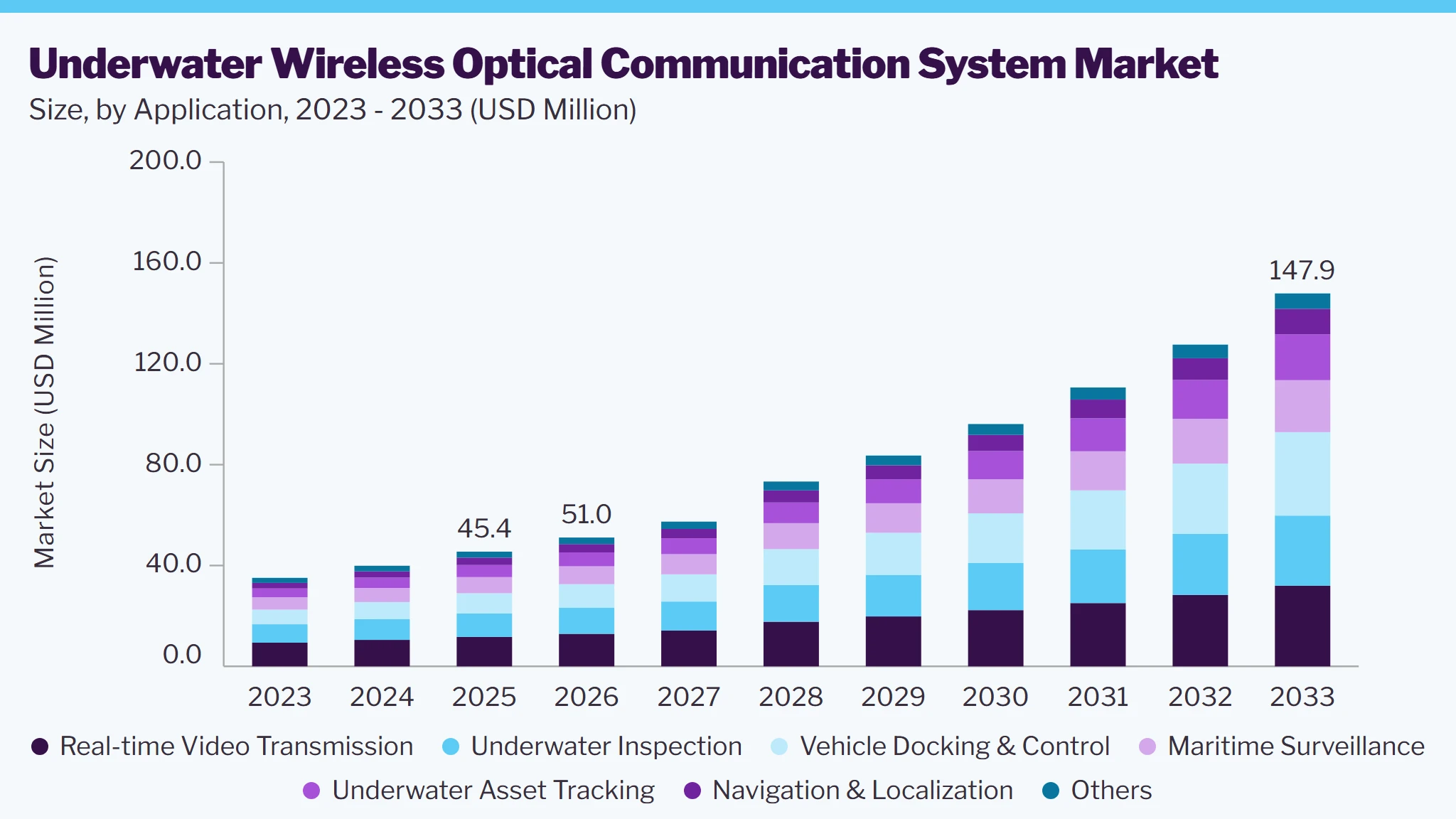
The global underwater wireless optical communication system market size was valued at USD 45.4 million in 2025 and is projected to grow from USD 51.0 million in 2026 to USD 147.9 million by 2033, at a CAGR of 16.4% from 2026 to 2033. North America dominated the market, accounting for a revenue share of 33.2% in 2025. The increasing adoption of autonomous underwater vehicles (AUVs) is fueling the growth of the underwater wireless optical communication system market.
Key Market Trends & Insights
- By application: Real-time video transmission segment dominated the market, with a revenue share of 25.8% in 2025.
- By end user: Defense & naval segment held the largest market share of 27.7% in 2025.
Regional Highlights
- Largest regional market: North America (33.2% revenue share, 2025)
- Fastest-growing regional market: Asia Pacific (highest CAGR, 2026-2033)
- By country: The U.S. held the largest market share in 2025.
Market Size & Forecast
- Market size in 2025: USD 45.4 Million
- Estimated market size in 2026: USD 51.0 Million
- Projected market size by 2033: USD 147.9 Million
- CAGR (2026-2033): 16.4%
The increasing deployment of autonomous underwater vehicles (AUVs) for ocean exploration, seabed mapping, environmental monitoring, and subsea inspection is driving demand for efficient underwater communication technologies. These vehicles use high-resolution cameras, sonar, and environmental sensors that generate large volumes of data, increasing the need for high-speed wireless data transfer. Furthermore, the growing adoption of small, low-cost AUVs and multi-vehicle operations is creating opportunities for Underwater Wireless Optical Communication (UWOC) between nearby vehicles, sensors, and docking stations. Continued investments in uncrewed underwater technologies by government agencies and research organizations are further supporting potential UWOC applications.
Market Dynamics
The underwater wireless optical communication system market is influenced by the increasing need for high-speed underwater data transmission, growing deployment of autonomous underwater systems, and rising requirements for real-time marine operations. Advances in optical transmitters, receivers, compact communication modules, and underwater networking technologies are supporting the development of faster and more efficient communication systems. However, limited optical transmission range, water turbidity, and alignment requirements continue to restrict deployment under certain underwater conditions. Market development is expected to depend on improvements in optical link reliability, system integration, and the adoption of underwater communication technologies across defense, offshore energy, and ocean research applications.
Market Concentration & Characteristics
The underwater wireless optical communication system market is fragmented, as the industry comprises multiple companies, research institutions, and specialized technology developers working on underwater optical communication solutions. The market has not yet reached a stage where a few major players dominate the industry through extensive commercial deployments. Participants focus on developing high-speed underwater data transmission systems, optical transmitters and receivers, laser-based communication technologies, and solutions for autonomous underwater vehicles (AUVs), underwater sensor networks, and offshore infrastructure monitoring. Differences in technology capabilities, transmission range, data rates, and application requirements create opportunities for specialized companies to serve specific customer needs. The presence of research-driven organizations and emerging technology providers also contributes to the fragmented competitive structure. As a result, competition is influenced by technological expertise, product performance, research and development capabilities, and the ability to establish partnerships with maritime, defense, offshore, and underwater robotics organizations.
The market is characterized by high innovation, moderate partnership activity, and relatively low end-user adoption, reflecting the developing nature of UWOC technology. Companies continue to improve communication speed, reliability, and performance under challenging underwater conditions, where water turbidity, light scattering, and limited transmission distances remain important technical constraints. Partnerships among technology developers, research institutions, defense organizations, and marine equipment manufacturers support technology validation and the development of application-specific solutions. Regulatory requirements related to optical radiation safety, equipment testing, and defense-related technology controls may influence product development and deployment, although their impact varies by application and jurisdiction.
Application Insights
Based on application, the real-time video transmission segment accounted 25.8%, for the largest share of global revenue in 2025. This segment is driven by the demand for high-speed underwater data transmission across defense, scientific research, and subsea infrastructure monitoring applications. Underwater wireless optical communication facilitate the transmission of live video feeds and high-resolution images between remotely operated vehicles (ROVs), autonomous underwater vehicles (AUVs), underwater cameras, and control stations. The technology supports real-time visual monitoring, underwater inspections, and operational decision-making by enabling high-bandwidth, low-latency data transfer over short distances. Moreover, segment adoption remains influenced by water turbidity, optical alignment, transmission distance, and variations in underwater environmental conditions, which affect signal quality and communication reliability.
The vehicle docking & control segment is expected to grow at a fastest CAGR over the forecast period. This segment can be attributed to the increasing use of autonomous underwater vehicles (AUVs) and unmanned underwater platforms in subsea operations. Underwater wireless optical communication enable high-speed data exchange between underwater vehicles and docking stations, supporting positioning, maneuvering, docking coordination, and operational control. These systems facilitate the transfer of commands and vehicle status information during docking, recovery, and underwater charging activities, supporting operational accuracy and reducing communication delays over short distances. Moreover, adoption is influenced by optical alignment requirements, water clarity, transmission range, and the reliability of communication links under varying underwater conditions.
End User Insights
Based on end user, the defense & naval segment held the largest market revenue share of 27.7% in 2025. Defense & naval segment utilizes underwater wireless optical communications for secure, high-speed data exchange between submarines, autonomous underwater vehicles (AUVs), unmanned underwater vehicles (UUVs), and naval equipment. These systems support military operations that require real-time communication, underwater surveillance, tactical information sharing, and coordination among underwater platforms. The demand for optical communication solutions is supported by the need for high-bandwidth data transmission over short underwater distances, particularly in applications where conventional acoustic communication offers limited data rates or higher transmission delays.
Underwater Wireless Optical Communication System Market Report Scope
|
Report Attribute |
Details |
|
Market size in 2025 |
USD 45.4 million |
|
Estimated Market size in 2026 |
USD 51.0 million |
|
Projected Market size by 2033 |
USD 147.9 million |
|
Growth Rate |
CAGR of 16.4% from 2026 to 2033 |
|
Base year for estimation |
2025 |
|
Historical data |
2021 – 2024 |
|
Forecast period |
2026 – 2033 |
|
Quantitative units |
Revenue in USD million and CAGR from 2026 to 2033 |
|
Report coverage |
Revenue forecast, company ranking, competitive landscape, growth factors, and trends |
|
Segments covered |
Application, end user, region |
|
Regional scope |
North America, Europe, Asia Pacific, Latin America, MEA |
|
Country scope |
U.S., Canada, Mexico, Germany, U.K., France, China, Japan, India, South Korea, Australia, Brazil, KSA, UAE, and South Africa |
|
Key companies profiled |
Sonardyne, Hydromea, Shimadzu Corporation., Aquatec, Lumasys, Inc., KYOCERA Corporation, Trimatiz Ltd., UON Technologies Inc., Seaward Technologies Co., Ltd., and Oceanit. |
|
Customization scope |
Free report customization (equivalent up to 8 analysts working days) with purchase. Addition or alteration to country, regional & segment scope. |
|
Pricing and purchase options |
Avail customized purchase options to meet your exact research needs. Explore purchase options |