Male Infertility Market (2026 – 2033)
Male Infertility Market Summary
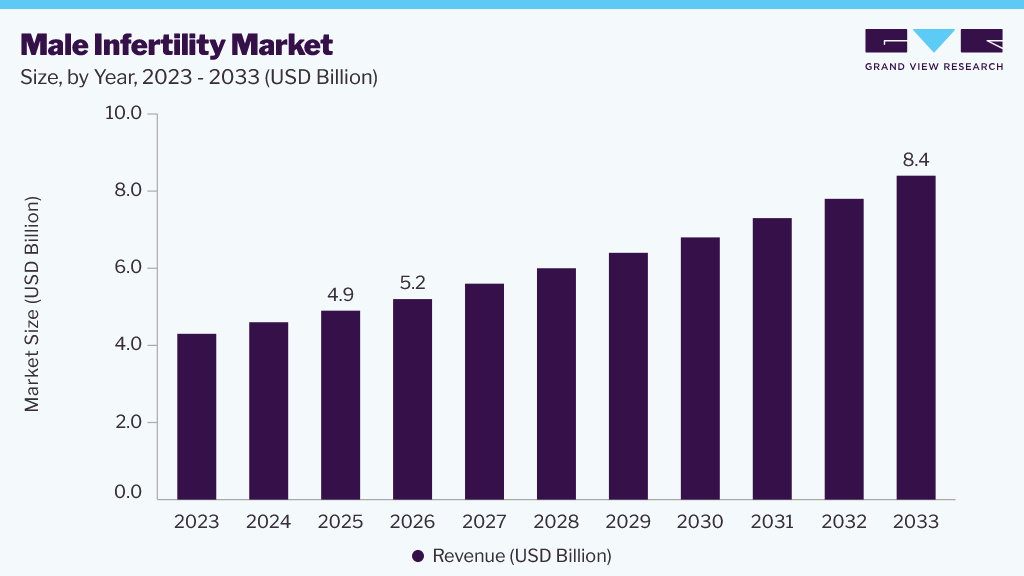
The global male infertility market size was valued at USD 4.9 billion in 2025 and is projected to grow from USD 5.2 billion in 2026 to USD 8.4 billion in 2033, at a CAGR of 7.1% from 2026 to 2033. Europe dominated the market, accounting for a revenue share of 37.0% in 2025. Increasing infertility rates across the globe and the adoption of assisted reproductive technologies (ARTs) are expected to drive the market for male infertility in the forthcoming years.
Key Market Trends & Insights
- By test: The DNA fragmentation segment accounted for the largest revenue share of approximately 22.0% in 2025.
- By treatment: The ART and varicocele surgery segment dominated the market, accounting for over 70.5% of revenue in 2025.
Regional Highlights
- Largest regional market: Europe (37.0% revenue share, 2025)
- Fastest-growing regional market: Asia Pacific (highest CAGR, 2026-2033)
Market Size & Forecast
- Market size in 2025: USD 4.9 Billion
- Estimated market size in 2026: USD 5.2 Billion
- Projected market size by 2033: USD 8.4 Billion
- CAGR (2026-2033): 7.1%
Three ways to get this report
Buy it, customize it, or ask a question.
Ask an Analyst
A direct answer, usually in 1 working day
- AccessReport author, directly
- Reply timeWithin 1 working day
- No sales callDirect answer only
- FormatEmail reply
- CostFree, no cost
What the study covers
- FormatsPDF · Excel · Dashboard
- Timeline2026–2033 annual, 2025 base
- Coverage20+ countries, 5 regions
- Companies10+ key players profiled
Customize the Report
20% free customization
- IncludeCountries, segments, points
- TailorTo your product definition
- ExtendDeeper competitor detail
- OrA fully bespoke study
- Turnaround5–10 working days
ARTs cover a wide spectrum of infertility treatments and offer solutions for males facing problems, such as low sperm count, abnormal sperm quality, and poor motility. Moreover, ARTs offer a higher success rate than medications. The market for male infertility is expected to witness significant growth in the future, owing to technological advancements in the field of assisted reproductive technologies. The integration of artificial intelligence, robotics, and advanced sperm selection technologies into assisted reproductive procedures is improving treatment precision and increasing the likelihood of successful fertilization. For instance, in April 2026, BAIBYS Fertility Ltd. announced the first confirmed pregnancy achieved using its autonomous AI-based robotic sperm selection system for IVF procedures. The technology uses artificial intelligence and robotics to identify and isolate high-quality sperm cells based on morphology and motility, highlighting the increasing integration of advanced technologies into assisted reproductive treatments.
Given the increasing emphasis on early and accurate diagnosis of male infertility, the adoption of advanced semen analysis and sperm quality assessment technologies is expected to grow steadily over the forecast period. Conventional semen analysis remains the primary diagnostic tool for evaluating male reproductive health, while emerging tests provide deeper insights into sperm function and fertility potential. For instance, in April 2026, Legacy launched its Basic Semen Analysis service at a price of USD 145, aiming to improve access to clinical-grade male fertility testing. The company also expanded access to sperm DNA fragmentation testing through its Advanced Semen Analysis offering, enabling a more comprehensive assessment of sperm quality beyond conventional parameters. Such developments are expected to enhance access to male infertility diagnostics, enable earlier intervention, and drive growth in the diagnostic segment.
An increase in the global prevalence of infertility is a significant clinical problem. Around 48 million couples suffer from infertility worldwide. Of all cases, about 20% to 30% of cases are due to male factor infertility. This may be due to one or more factors, such as abnormal morphology, low sperm concentration, and poor sperm motility. Hence, increasing male infertility and growing awareness regarding the same have further prompted the use of drugs, hormonal therapy, and ART. Alcohol intake, smoking, obesity, stress, and lifestyle changes are some of the major factors that can be attributed to infertility in males.
Continuous efforts in R&D are carried out for a better understanding of the idiopathic world of infertility. Hence, companies are investing in developing devices to identify the root cause and enable targeted treatment. Furthermore, the development and commercialization of hormonal therapy are likely to drive the market for male infertility during the forecast period. Governments in various countries have taken initiatives to improve reimbursement for infertility-related treatments. In addition, improved patient data safety resulting from standardized regulations is expected to increase patients’ preference for infertility treatments.
Analyst Perspective
The market is expected to witness steady growth over the forecast period, driven by the rising prevalence of infertility, increasing awareness of male reproductive health, and the growing adoption of assisted reproductive technologies (ART). Lifestyle-related factors such as obesity, smoking, alcohol consumption, stress, delayed parenthood, and chronic health conditions continue to contribute to declining male fertility rates worldwide. As male-factor infertility accounts for a significant proportion of infertility cases, healthcare providers are increasingly emphasizing early diagnosis and targeted treatment approaches. In addition, supportive reimbursement policies, expanding fertility clinic networks, and improving access to reproductive healthcare services are encouraging more patients to seek professional fertility evaluation and treatment.
Test Insights
The DNA fragmentation segment accounted for the largest revenue share, at approximately 22.0% in 2025, owing to diagnostic techniques’ ability to provide reliable analysis of sperm DNA integrity. Adoption of this technique is increasing in the market as sperm DNA fragmentation is a leading cause of infertility in males. Based on the test, the market is segmented into DNA fragmentation technique, oxidative stress analysis, microscopic examination, sperm agglutination, computer-assisted semen analysis, sperm penetration assay, and others. DNA fragmentation testing offers valuable insights beyond conventional semen analysis by evaluating the genetic integrity of sperm, a critical factor in fertilization, embryonic development, and pregnancy outcomes. The growing prevalence of unexplained male infertility, recurrent pregnancy loss, and failed assisted reproductive procedures has increased the demand for advanced diagnostic tools capable of identifying underlying sperm abnormalities.
Computer-assisted semen analysis is expected to witness significant growth in the coming years due to technological advancements. The growing demand for rapid, accurate, and reproducible male fertility testing is accelerating the adoption of computer-assisted semen analysis platforms across fertility clinics and diagnostic laboratories. For instance, in May 2025, the FDA granted 510(k) clearance to the LensHooke X3 PRO Semen Quality Analyzer, an automated semen analysis platform that integrates optical imaging, image-analysis algorithms, and artificial intelligence-based processing to assess sperm concentration, motility, morphology, and pH. Such innovations are improving the accuracy, standardization, and efficiency of semen analysis procedures, thereby supporting the adoption of advanced male infertility diagnostic technologies.
Treatment Insights
The ART and varicocele surgery segment dominated the market, accounting for over 70.5% of revenue in 2025. The most preferred technique for the treatment of male infertility is enhancing spermatogenesis with the help of hormonal therapy for a natural pregnancy, especially among males with a low sperm count. Based on treatment, the market for male fertility is segmented into ART, varicocele surgery, and medication.
ARTs are used to treat major factors responsible for male infertility, such as sperm autoantibodies, viral orchitis, epididymal dysfunction, accessory gland infection, chemotherapy, heat, trauma, and other idiopathic factors. Continuous advancements in sperm selection technologies are improving the effectiveness of assisted reproductive procedures by enabling the identification of higher-quality sperm cells for fertilization. For instance, in June 2025, a review published in the Journal of Assisted Reproduction and Genetics highlighted the growing adoption of advanced sperm selection techniques in ART, including microfluidics-based and AI-assisted approaches designed to improve fertilization rates, embryo quality, and overall reproductive outcomes for patients with male infertility. The high cost of treatment and the need for additional therapy cycles are major factors driving segment growth. Rising healthcare expenditure in developing countries, growing awareness of male infertility, and increasing adoption in middle- and low-income countries are key factors anticipated to drive the ART segment over the forecast period.
Regional Insights
Europe dominated the market, accounting for over 37.0% of revenue in 2025. This is attributed to the availability of well-equipped, advanced fertility clinics, greater adoption of costlier treatments, improved coverage for diagnosis and treatment, and high levels of awareness. Furthermore, healthcare spending and the availability of well-established healthcare infrastructure are contributing significantly to the regional market growth. For instance, in February 2025, Poland restored public funding for IVF treatment, resulting in the birth of the country’s first baby conceived under the renewed government-funded fertility program. The policy strengthened access to infertility diagnosis and treatment and contributed to the broader trend of public support for assisted reproductive technologies across Europe.