Anti-pollution Hair Care Products Market (2026 – 2033)
Anti-pollution Hair Care Products Market Summary
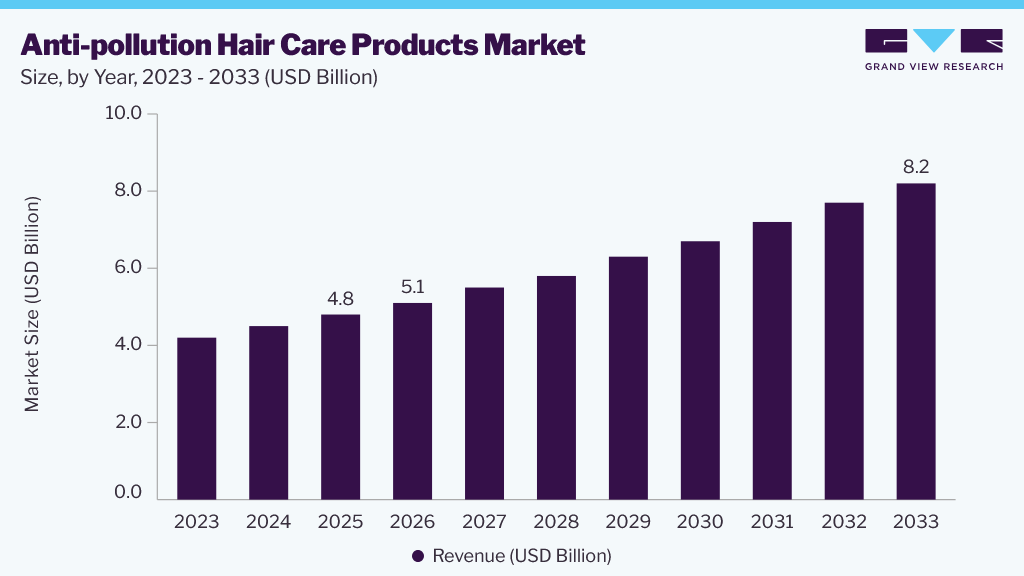
The global anti-pollution hair care products market size was valued at USD 4.8 billion in 2025 and is projected to grow from USD 5.1 billion in 2026 to USD 8.2 billion by 2033, growing at a CAGR of 6.9% from 2026 to 2033. Asia Pacific dominated the market, accounting for a revenue share of 38.0% in 2025. The growth is primarily driven by increasing awareness regarding the adverse effects of environmental pollution on hair health. Rising pollution levels, exposure to pollutants, and urban lifestyles contribute to various hair-related issues, such as damage, dullness, and loss of vitality. Consumers are seeking specialized hair care solutions formulated with anti-pollution ingredients to help protect and rejuvenate hair from the harmful effects of pollutants, likely driving market growth.
Key Market Trends & Insights
- By product type: The anti-pollution shampoo segment dominated the market, with a revenue share of about 38.0% in 2025.
- By end-user: The women segment held the largest revenue share of over 62.0% in 2025.
- By distribution channel: The hypermarkets and supermarkets segment held the largest revenue share of over 48.0% in 2025.
Regional Highlights
- Largest regional market: Asia Pacific (38.0% revenue share, 2025)
- Fastest-growing regional market: North America (Highest CAGR, 2026-2033)
Market Size & Forecast
- Market size in 2025: USD 4.8 Billion
- Estimated market size in 2026: USD 5.1 Billion
- Projected market size by 2033: USD 8.2 Billion
- CAGR (2026-2033): 6.9%
Three ways to get this report
Buy it, customize it, or ask a question.
Ask an Analyst
A direct answer, usually in 1 working day
- AccessReport author, directly
- Reply timeWithin 1 working day
- No sales callDirect answer only
- FormatEmail reply
- CostFree, no cost
What the study covers
- FormatsPDF · Excel · Dashboard
- Timeline2026–2033 annual, 2025 base
- Coverage20+ countries, 5 regions
- Companies10+ key players profiled
Customize the Report
20% free customization
- IncludeCountries, segments, points
- TailorTo your product definition
- ExtendDeeper competitor detail
- OrA fully bespoke study
- Turnaround5–10 working days
The growing emphasis on personal grooming, wellness, and the desire for effective preventive measures against environmental stressors is further driving demand. With growing awareness of the importance of hair health, consumers are more willing to invest in premium and luxury products that claim to offer advanced solutions for issues such as anti-pollution, hair damage, aging, and scalp health.
Advancements in beauty and skincare technology have enabled the development of innovative formulations in the anti-pollution hair care segment. Consumers are seeking innovative and effective solutions for their unique hair care needs. The evolution of consumer hair care routines from basic shampoos and conditioners to a more comprehensive approach is reflected in the growing trend of skinfication of hair. Consumers are now prioritizing the health of their hair, similar to their skincare routines. This shift is driven by a growing understanding of how environmental factors affect the scalp, leading to demand for innovative, effective solutions.
Changing lifestyle patterns, particularly in urban settings, contributes to the need for targeted hair care solutions, including anti-pollution. Urbanization exposes individuals to higher levels of pollution, making them more susceptible to adverse hair effects. The demand for anti-pollution hair care products is therefore driven by changing environmental conditions and a desire to counteract the impact of pollutants on hair quality.
Analyst Perspective
The anti-pollution hair care products market is poised for steady growth, driven by increasing exposure to environmental pollutants, rising consumer awareness regarding scalp and hair health, and growing demand for preventive personal care solutions. Rapid urbanization, worsening air quality, and changing lifestyles are accelerating the adoption of products designed to protect hair and scalp from particulate matter, dust, smoke, UV radiation, and oxidative stress. Technological advancements in ingredient formulations, including antioxidants, activated charcoal, botanical extracts, and microbiome-friendly compounds, are enhancing product efficacy and consumer appeal. The market is also benefiting from growing demand for inclusive solutions catering to diverse hair types, textures, and scalp conditions. In addition, increasing preference for clean-label, sulfate-free, vegan, and sustainable products is further supporting market expansion. The growing influence of premium beauty trends, e-commerce platforms, and personalized hair care solutions is also contributing to market growth. As consumers increasingly prioritize holistic scalp wellness and daily protection against environmental stressors, the market is expected to witness sustained growth over the forecast period.
Product Insights
The anti-pollution shampoo segment accounted for approximately 38.0% of revenue in 2025. Shampoos are an essential part of the personal care routine. The rising demand for shampoos is attributed to the increasing prevalence of hair-related problems. Environmental challenges, such as rising pollution levels that harm hair and scalp health, are also bolstering segment growth. As a result, key manufacturers are innovating their product offerings to meet consumer demand. For instance, BASF developed its Chom Chom Shampoo formulation featuring Rambuvital, a rambutan seed extract that helps protect hair and scalp against pollution-induced oxidative stress and improves scalp hydration. In addition, it highlights the growing emphasis on scalp detoxification and premium anti-pollution hair care solutions.
The demand for anti-pollution conditioners is expected to grow at a significant CAGR from 2026 to 2033. Conditioners play an important role in maintaining hair health by restoring moisture, improving texture, and protecting hair fibers from environmental damage. Rising exposure to pollution, dust, and UV stress is driving consumer demand for conditioners that offer both hydration and protection. Consumers increasingly associate smooth, healthy-looking hair with overall scalp and hair wellness, further supporting segment growth. Manufacturers are focusing on advanced formulations enriched with antioxidants, botanical extracts, and protective ingredients to address pollution-induced hair damage. For instance, Kérastase offers the Specifique Divalent Conditioner, formulated to balance scalp health, nourish hair fibers, and help protect hair from external environmental stressors. Additionally, rising demand for multifunctional and premium hair care products is further supporting the adoption of anti-pollution conditioners.
End-user Insights
The women segment accounted for approximately 62.0% of the market share in 2025. Growing awareness regarding personal grooming, hair health, and overall appearance is driving demand for anti-pollution hair care products among women. Increased exposure to environmental pollutants and rising concerns over hair damage, dryness, and scalp-related issues are further supporting segment growth. Women are more likely to adopt preventive and treatment-based hair care routines, contributing to higher demand for premium and specialized products. According to YouGov’s August 2025 Hair Care Trends survey, in the U.S. 93% of women use shampoo or conditioner, compared to 79% of men, highlighting significantly higher engagement in structured hair care routines among female consumers. In addition, women are substantially more likely to adopt advanced routines, with 31% using serums, leave-ins, or masks, compared to only 4% of men, reflecting stronger penetration of treatment-based and premium hair care products in the female segment.
The men segment is projected to grow at a significant CAGR from 2026 to 2033. This growth can be attributed to increasing awareness regarding the impact of environmental pollutants on hair and scalp health. As men become more conscious of grooming and overall well-being, they are increasingly seeking specialized solutions to address concerns such as hair damage, scalp buildup, and pollution-related dullness. The desire for a healthy, well-maintained appearance, coupled with shifting societal norms that encourage men to prioritize self-care, has led to a rising demand for anti-pollution hair care products. In addition, the growing influence of social media, celebrity endorsements, and digital grooming trends is encouraging greater adoption of premium and specialized hair care products among male consumers. The expansion of men-specific grooming product portfolios and increasing availability through e-commerce platforms are further supporting segment growth.
Distribution Channel Insights
The supermarkets and hypermarkets segment accounted for approximately 48.0% of the market share in 2025. The growth of this segment is driven by the convenience, accessibility, and wide product availability offered by large-format retail channels. Supermarkets and hypermarkets serve as one-stop shopping destinations for personal care products, enabling consumers to conveniently purchase anti-pollution hair care products alongside their regular household essentials. These channels also support product visibility and impulse purchases, further contributing to segment growth. For instance, in March 2026, Henkel expanded the distribution of its Schwarzkopf portfolio with the launch of KERATÎME Care & Styling products exclusively at Walmart stores across the U.S. This highlights the growing importance of supermarkets and hypermarkets in improving consumer reach and driving product adoption.
The sales of anti-pollution hair care products through online channels are expected to grow at a significant CAGR from 2026 to 2033. Growth in this segment is driven by the convenience, accessibility, and wider product selection offered by e-commerce platforms. Online channels allow consumers to compare products, access detailed ingredient information, read reviews, and purchase specialized anti-pollution hair care solutions from the comfort of their homes. The increasing adoption of digital shopping and growing preference for personalized beauty recommendations are further supporting segment growth. For instance, in June 2026, L’Oréal S.A. announced the acquisition of a majority stake in Innovist, a leading digital-first Indian personal care company whose portfolio includes Bare Anatomy, a science-backed hair care brand. This acquisition highlights the growing importance of e-commerce and direct-to-consumer channels in expanding the reach of premium hair care products.