CD28 Market to Reach US$ 2.90 Billion by 2034 as Targeted T-Cell Modulation Advances
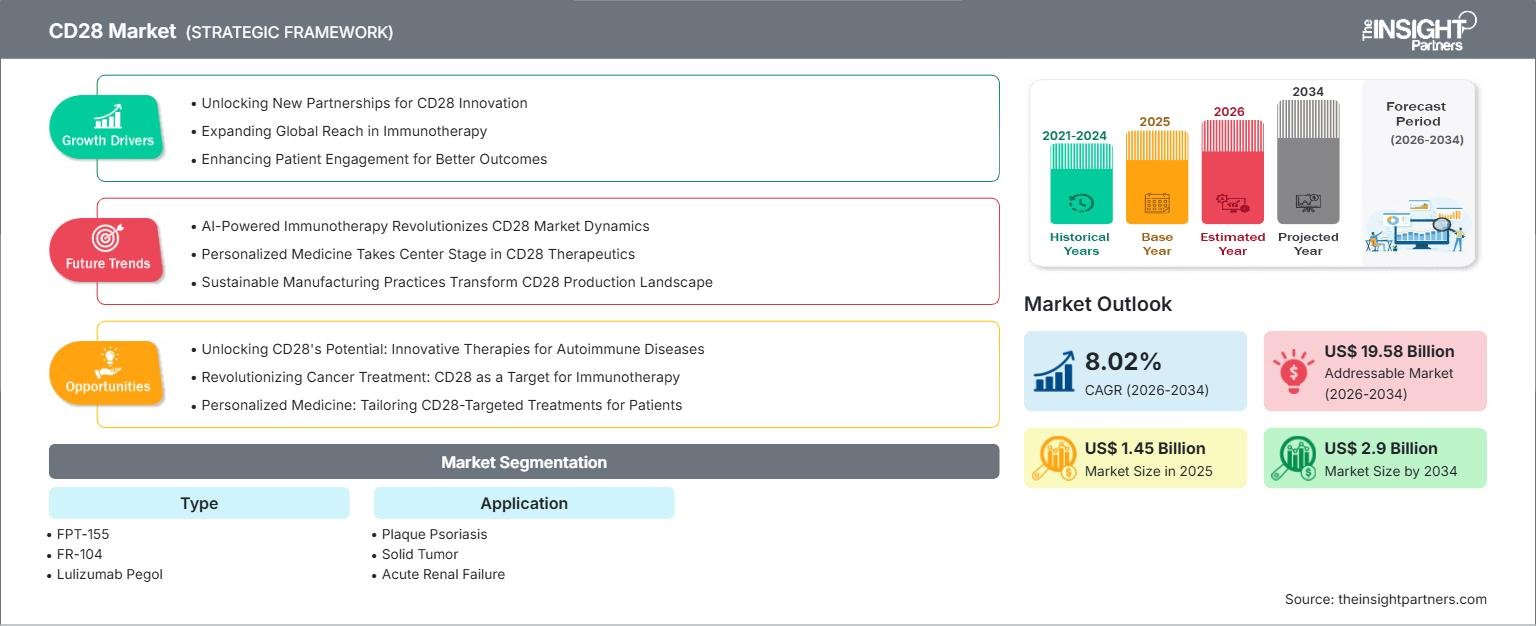
The CD28 market was valued at US$ 1.45 billion in 2025 and is projected to reach US$ 2.90 billion by 2034, registering a CAGR of 8.02% from 2026 to 2034, according to The Insight Partners.
The CD28 market is entering a period of expansion as pharmaceutical companies, biotechnology firms, clinical research organizations, and academic laboratories increase their focus on selective T-cell costimulation and immune pathway modulation. CD28 plays an important role in T-cell proliferation, cytokine release, survival, and cytotoxicity, making the pathway relevant to therapeutic discovery, immuno-oncology, transplantation research, and functional immune testing.
The market encompasses selective CD28 agonists and antagonists, fusion proteins, antibodies, and research reagents. According to The Insight Partners, commercial and research activity increasingly emphasizes controlled immune activation, functional selectivity, reproducible manufacturing, and safety assessment. The addressable market during 2026-2034 is estimated at US$ 19.58 billion.
Download Sample PDF @ https://www.theinsightpartners.com/sample/TIPRE00021838
Growing Immuno-Oncology Research Supports CD28 Market Growth
The expansion of immuno-oncology research is a major factor supporting demand for CD28-related products and technologies. Researchers are investigating how controlled CD28 costimulation can influence T-cell responses against tumors while addressing the challenges associated with systemic immune activation.
Solid tumors represented the largest application segment, accounting for an estimated 48-54% market share in 2025. The segment is projected to grow at a CAGR of 8.4-9.2% through 2034. Development programs are examining CD28 costimulation alongside checkpoint inhibition and tumor-targeting T-cell engagement.
The development landscape is also moving toward tumor-restricted and signaling-dependent approaches. These strategies seek to improve specificity by linking CD28 activity more closely to tumor-associated antigens, antigen density, or appropriate T-cell receptor signaling.
Selective Immune Modulation Expands Application Opportunities
Beyond oncology, CD28 modulation is being explored in autoimmune diseases, transplantation, and acute immune dysregulation. Selective blockade approaches are intended to reduce pathogenic T-cell costimulation while maintaining other regulatory immune mechanisms.
Plaque psoriasis and acute renal failure represent additional application areas covered by the market. In transplantation research, CD28-targeting approaches are being evaluated as potential alternatives or complements to conventional immunosuppression. However, clinical translation remains dependent on demonstrating consistent efficacy, appropriate patient selection, manageable safety profiles, and measurable clinical outcomes.
Research Reagents Generate Recurring Demand
The CD28 ecosystem extends beyond therapeutic development. Pharmaceutical companies, biotechnology organizations, contract research organizations, hospitals, and academic laboratories require antibodies, recombinant proteins, assay components, and other research materials for T-cell activation and functional immune analysis.
Demand is supported by applications such as flow cytometry, immunoprecipitation, tissue analysis, cell-culture stimulation, and translational biomarker research. Suppliers are increasingly differentiating products through functional validation, species cross-reactivity, reproducibility, rapid delivery, and support for antibody engineering projects.
Manufacturing requirements are also becoming more stringent. Recombinant proteins and therapeutic-grade materials require careful control of purity, potency, endotoxin levels, lot-to-lot consistency, and documentation. These requirements create opportunities for specialized suppliers with validated production and characterization capabilities.
Multispecific and Tumor-Targeted Technologies Shape Market Trends
A significant trend in the CD28 market is the movement from generalized T-cell activation toward context-specific immune modulation. Market participants are exploring Fc fusion proteins, domain antibodies, bispecific constructs, and other engineered formats intended to provide greater control over receptor signaling.
The development of tumor-specific agonists is particularly important because uncontrolled systemic CD28 activation has raised safety concerns in earlier development efforts. Current research therefore places greater emphasis on receptor architecture, dose selection, antigen-dependent activation, biomarker evaluation, and tissue-specific signaling.
These developments are expected to encourage investment in platforms capable of demonstrating selective activation and reproducible biological activity.
Biomarker-Based Development Creates New Opportunities
Biomarker-driven development is becoming increasingly important as CD28 therapies and research tools become more sophisticated. Researchers can evaluate receptor occupancy, antigen expression, T-cell phenotype, cytokine responses, and other biological indicators to understand treatment activity and potential safety risks.
The integration of multiparameter flow cytometry, functional potency testing, digital pathology, and other analytical technologies can support more detailed characterization of CD28-mediated immune responses. This creates opportunities for companies providing integrated research reagents, assay services, and translational development platforms.
North America Remains a Major CD28 Development Center
North America accounted for an estimated 36-40% of the CD28 market in 2025 and is projected to register a CAGR of 7.6-8.4% between 2026 and 2034. The region benefits from established immuno-oncology infrastructure, biotechnology investment, specialized clinical centers, biologics manufacturing capabilities, and advanced flow-cytometry technologies.
The US represents the largest portion of North American demand, accounting for an estimated 82-86% of the regional market in 2025. Pharmaceutical companies, academic medical centers, contract laboratories, and research institutions contribute to demand for therapeutic development programs and validated CD28 antibodies and proteins.
Asia Pacific Registers Strong Growth Potential
Asia Pacific represented an estimated 21-25% market share in 2025 and is forecast to expand at a CAGR of 8.8-9.8% during 2026-2034. China, Japan, and South Korea are identified as important contributors to regional development, supported by antibody engineering, oncology trials, cell therapy research, biologics manufacturing, and biotechnology investment.
India is gaining importance in recombinant protein manufacturing and contract research, while Australia provides infrastructure for early-stage clinical research. Increasing investment in biotechnology and localization of high-value research reagents could further improve accessibility across the region.
Europe Strengthens Immunology and Biologics Research
Europe accounted for an estimated 27-31% of the market in 2025 and is expected to grow at a CAGR of 7.2-8.0% through 2034. Germany, the UK, and France represent important markets, supported by immunology institutions, biotechnology clusters, translational oncology programs, and biologics research capabilities.
The region’s experience with safety assessment of CD28-related immune activation is also influencing development strategies. Developers are increasingly emphasizing lower initial doses, tumor targeting, improved preclinical models, and signaling-dependent constructs.
Get Full Copy @ https://www.theinsightpartners.com/buy/TIPRE00021838
Segmentation Analysis
The CD28 market is segmented by Type and Application. By type, the market includes FPT-155, FR-104, and Lulizumab Pegol. The type segment is expected to record a CAGR of 7.8-8.6% from 2026 to 2034. FPT-155 represented an estimated 28-32% market share in 2025 and is identified as a high-growth segment, although its Phase 1 program was terminated.
By application, the market includes Plaque Psoriasis, Solid Tumor, and Acute Renal Failure. The application segment is projected to grow at a CAGR of 8.0-8.8% during 2026-2034, with solid tumors representing the leading area of development activity.
Competitive Landscape
The CD28 market includes pharmaceutical companies, biotechnology organizations, specialized antibody and protein suppliers, and research reagent providers. Key companies analyzed by The Insight Partners include Atox Bio Ltd., Bristol-Myers Squibb Company, Five Prime Therapeutics, Inc., Johnson & Johnson, TheraMAB LLC, Boster Biological Technology, Aviva Systems Biology Corporation, Biobyt Ltd., GeneTex, Inc., and ProteoGenix SAS.
Competitive differentiation increasingly depends on functional validation, manufacturing consistency, antibody engineering capabilities, species cross-reactivity, delivery speed, and the ability to support complex immunology research.
Future Outlook
The CD28 market is expected to continue developing alongside advances in immuno-oncology, antibody engineering, transplantation research, and functional immune profiling. The market is projected to increase from US$ 1.45 billion in 2025 to US$ 2.90 billion by 2034, reflecting an 8.02% CAGR during 2026-2034.
Future development is likely to emphasize conditionally active and multispecific antibody architectures, tumor-restricted costimulation, biomarker-guided clinical programs, and validated research reagent platforms. Greater integration of receptor occupancy testing, cytokine monitoring, T-cell phenotyping, and functional potency assays could also improve the characterization of CD28-targeting approaches.
As developers seek greater control over immune activation, the ability to demonstrate selective biological activity, reproducible manufacturing, and appropriate safety characteristics will remain important factors shaping the evolution of CD28-related products and technologies.
About Us
The Insight Partners, we provide comprehensive analysis and insights into market trends that empower businesses to make informed decisions. Our reports are designed to equip stakeholders with the necessary information to navigate the complexities of various industries, including healthcare, technology, and finance. We are dedicated to delivering high-quality research that enables our clients to achieve their strategic objectives.
Contact Us:
Contact Person: Ankit Mathur
E-mail: ankit.mathur@theinsightpartners.com
Phone: +1-646-491-9876
Also Available in :Korean German Japanese French Chinese Italian Spanish