Arterial Blood Collection Devices Market to Reach US$ 1.93 Billion by 2034 as Point-of-Care Testing and Minimally Invasive Technologies Advance
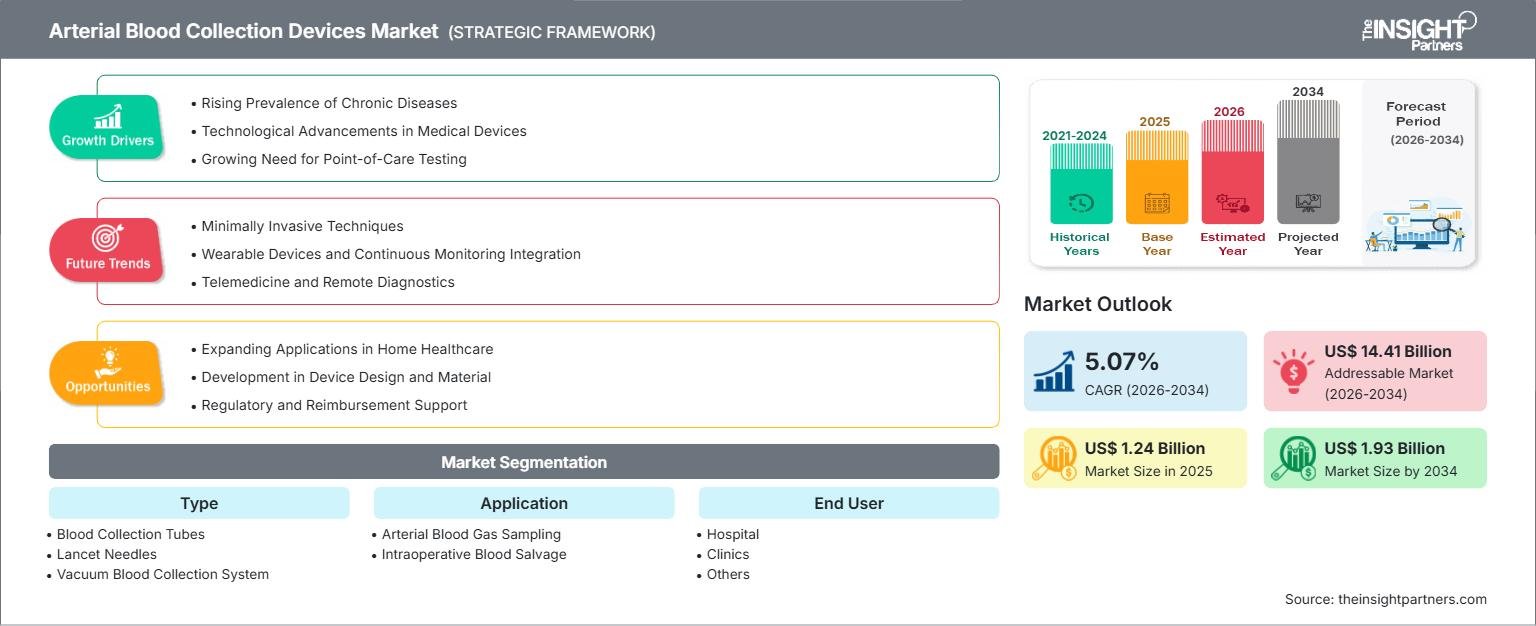
The global arterial blood collection devices market was valued at US$ 1.24 billion in 2025 and is projected to reach US$ 1.93 billion by 2034, registering a CAGR of 5.07% from 2026 to 2034.
The arterial blood collection devices market is expanding as healthcare providers increasingly require rapid, accurate, and reliable blood gas analysis across critical care, emergency medicine, surgical settings, and chronic disease management. Growing demand for point-of-care testing, advances in medical device technology, and the increasing prevalence of chronic diseases are supporting the adoption of arterial blood collection products worldwide.
Arterial blood collection devices are used to obtain blood samples for arterial blood gas analysis and other clinical applications. The market includes blood collection tubes, lancet needles, vacuum blood collection systems, microfluidic systems, and other related devices. Hospitals represent a major end-user group, while clinics and other healthcare settings also contribute to demand.
Download Sample PDF @ https://www.theinsightpartners.com/sample/TIPRE00018021
Rising Prevalence of Chronic Diseases Supports Market Expansion
The growing prevalence of chronic diseases is an important factor driving demand for arterial blood collection devices. Cardiovascular diseases, diabetes, respiratory disorders, and kidney diseases frequently require close monitoring of physiological parameters and blood gases.
Arterial blood gas analysis is particularly relevant in the management of conditions such as chronic obstructive pulmonary disease, heart failure, and complications associated with diabetes. As healthcare systems focus on timely diagnosis and continuous monitoring of patients with complex conditions, demand for devices that facilitate accurate arterial sampling is expected to increase.
Growing Adoption of Point-of-Care Testing Drives Demand
The increasing use of point-of-care testing is another important growth factor for the arterial blood collection devices market. Emergency departments, intensive care units, and other critical care environments require rapid diagnostic information to support clinical decision-making.
Point-of-care blood gas testing can provide results within a short timeframe, helping healthcare professionals evaluate oxygenation, ventilation, and acid-base status. The demand for convenient and efficient sample collection solutions is consequently encouraging the development of devices that are easier to handle and compatible with rapid diagnostic workflows.
Technological Advancements Improve Collection Efficiency
Advances in medical device technology are creating opportunities for improvements in arterial blood collection. Manufacturers are focusing on precision, safety, usability, and patient comfort through developments in needle technology, integrated sensors, and computerized systems.
These innovations are intended to simplify sample collection while reducing procedural difficulties and potential complications. Improved device design can also support broader use across inpatient and outpatient environments where reliable blood sampling is required.
Minimally Invasive Techniques Shape Market Trends
Minimally invasive blood collection is emerging as an important trend within the market. Conventional arterial blood collection can be technically demanding and uncomfortable, particularly when healthcare professionals need to access small or difficult-to-reach arteries.
Newer approaches are focusing on reducing patient discomfort and trauma while improving ease of use for clinicians. Developments involving microneedles, automated collection technologies, and other advanced sampling approaches could contribute to the evolution of arterial blood collection systems.
The increasing emphasis on patient-centric care is expected to encourage manufacturers to develop smaller, ergonomic, and more user-friendly products.
Wearable and Continuous Monitoring Technologies Create New Possibilities
The integration of blood monitoring with wearable and continuous monitoring technologies represents another emerging area. Continuous monitoring approaches could reduce the need for repeated conventional blood draws in selected applications and support real-time monitoring of patients requiring close observation.
This trend is consistent with the broader movement toward personalized and preventive healthcare. Connected monitoring technologies can also facilitate data sharing between patients and healthcare professionals, creating opportunities for more integrated diagnostic workflows.
Telemedicine and Remote Diagnostics Expand Application Potential
The expansion of telemedicine and remote healthcare services is creating new possibilities for diagnostic devices that can support care outside conventional hospital environments. Arterial blood collection technologies adapted for remote or home-based use could support monitoring of selected chronic conditions and reduce the need for repeated hospital visits.
Future product development is likely to focus on ease of use, sample quality, safety, connectivity, and compatibility with remote diagnostic workflows.
Home Healthcare Presents a Significant Opportunity
The expansion of home healthcare is identified as an important opportunity for the arterial blood collection devices market. Patient-centric care models are encouraging the development of diagnostic solutions that can be used outside hospitals and clinics.
Devices designed for safe and convenient sample collection could help patients and caregivers manage long-term monitoring requirements. Connectivity with healthcare providers may further support remote assessment and follow-up.
Manufacturers that focus on ergonomic design, simplified operation, biocompatible materials, and reliable sample collection may find opportunities in this developing area.
Product Design and Material Innovation Support Future Development
Device design and material innovation are expected to remain important areas of development. Lightweight and ergonomic products can improve handling and potentially reduce patient discomfort during blood collection.
Advances in needle and tube materials may also contribute to improved safety and reduced infection risks. These developments can help manufacturers differentiate their products while responding to healthcare providers’ requirements for efficient and reliable collection procedures.
North America Leads the Global Market
North America dominated the arterial blood collection devices market in 2025. The region benefits from advanced healthcare infrastructure, widespread adoption of diagnostic technologies, established hospital systems, and significant demand for point-of-care testing.
The US, Canada, and Mexico are covered in the regional analysis, with the US representing a major market supported by sophisticated critical care facilities and continued investment in healthcare technologies.
Asia Pacific Offers Expansion Opportunities
Asia Pacific represents an important growth region for arterial blood collection devices, supported by expanding healthcare infrastructure, increasing healthcare expenditure, and rising demand for advanced diagnostic technologies.
China, India, Japan, Australia, and other Asian markets are covered in the regional assessment. The increasing adoption of point-of-care diagnostics and the expansion of hospitals and specialty healthcare facilities can create additional opportunities for arterial blood collection device manufacturers.
Europe Maintains Demand Through Advanced Healthcare Infrastructure
Europe represents another significant market supported by established healthcare systems and the adoption of advanced diagnostic technologies. The regional market includes the UK, Germany, France, Russia, Italy, and other European countries.
Demand for reliable blood collection and diagnostic solutions is expected to remain connected to chronic disease management, critical care requirements, and the continued modernization of healthcare facilities.
Get Full Copy @ https://www.theinsightpartners.com/buy/TIPRE00018021
Market Segmentation
The arterial blood collection devices market is segmented by type, application, end user, and geography.
By type, the market includes blood collection tubes, lancet needles, vacuum blood collection systems, microfluidic systems, and others. Blood collection tubes dominated the market by revenue in 2025.
By application, the market is divided into arterial blood gas sampling and intraoperative blood salvage.
By end user, the market includes hospitals, clinics, and others.
Geographically, the market covers North America, Europe, Asia Pacific, South and Central America, and the Middle East and Africa, with country-level analysis including the US, Canada, Mexico, the UK, Germany, France, China, India, Japan, Australia, Brazil, Argentina, South Africa, Saudi Arabia, and the UAE.
Competitive Landscape
The arterial blood collection devices market includes medical device manufacturers, diagnostic technology companies, laboratory equipment providers, and healthcare product suppliers. Key companies analyzed in the market include Bio-Rad Laboratories, Inc.; NIPRO Medical Corporation; QIAGEN; F. Hoffmann-La Roche Ltd.; Terumo Medical Corporation; Thermo Fisher Scientific, Inc.; BD; Medtronic plc.; Greiner Bio-One; and Narang Medical Ltd.
Competition is influenced by product reliability, sample collection efficiency, patient comfort, technological capabilities, product availability, and the ability to meet healthcare providers’ evolving diagnostic requirements.
Future Outlook
The global arterial blood collection devices market is projected to grow from US$ 1.24 billion in 2025 to US$ 1.93 billion by 2034, representing a 5.07% CAGR during 2026-2034.
Future market development is expected to be influenced by the rising prevalence of chronic diseases, greater adoption of point-of-care testing, minimally invasive collection technologies, wearable monitoring, remote diagnostics, and expansion of home healthcare.
Manufacturers are likely to focus on improving patient comfort, sample collection accuracy, device usability, material safety, and connectivity with diagnostic systems. As healthcare delivery increasingly moves toward rapid and patient-centric diagnostics, arterial blood collection devices are positioned to remain an important component of blood gas testing and clinical monitoring workflows.
About Us
The Insight Partners, we provide comprehensive analysis and insights into market trends that empower businesses to make informed decisions. Our reports are designed to equip stakeholders with the necessary information to navigate the complexities of various industries, including healthcare, technology, and finance. We are dedicated to delivering high-quality research that enables our clients to achieve their strategic objectives.
Contact Us:
Contact Person: Ankit Mathur
E-mail: ankit.mathur@theinsightpartners.com
Phone: +1-646-491-9876
Also Available in : Korean German Japanese French Chinese Italian Spanish