Capsule Endoscopes Market Size to Reach US$ 1.39 Billion by 2031, Driven by Rising Demand for Non-Invasive Diagnostics
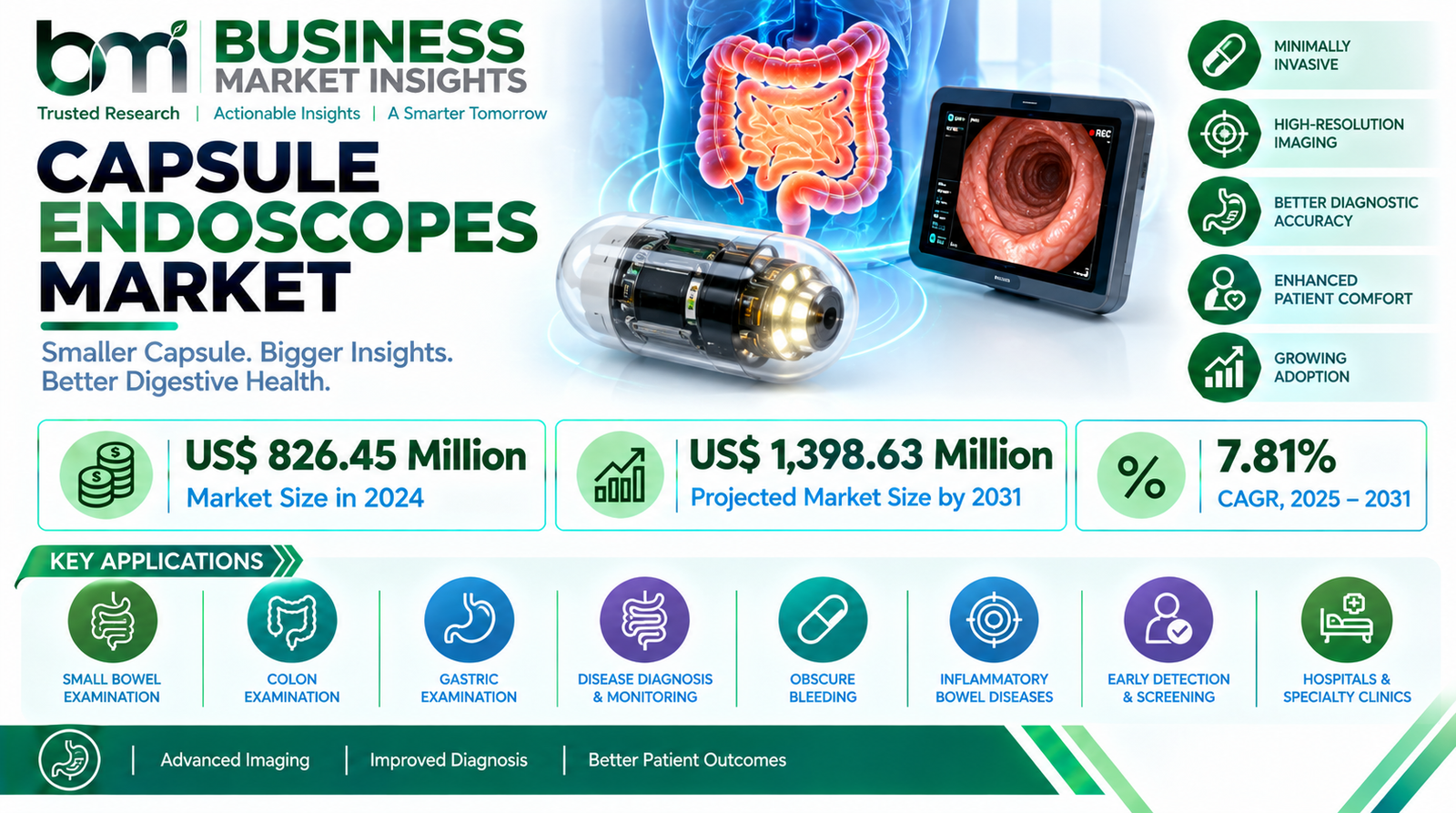
The Capsule Endoscopes Market size was valued at US$ 826.45 million in 2024 and is projected to reach US$ 1,398.63 million by 2031, growing at a CAGR of 7.81% during 2025–2031. Increasing prevalence of gastrointestinal diseases, rising demand for non-invasive diagnostic procedures, growing awareness of early disease detection, and advancements in medical imaging technologies are supporting market growth. Expanding applications in Crohn’s disease, gastrointestinal tumors, celiac disease, and anemia are creating opportunities for capsule endoscope manufacturers and healthcare technology providers.
Market Overview
The Capsule Endoscopes Market is evolving as healthcare providers increasingly adopt non-invasive technologies to examine the gastrointestinal tract. Capsule endoscopy involves swallowing a small capsule containing a camera that captures images as it travels through the digestive system. This technology can help clinicians examine areas, particularly the small intestine, that may be difficult to access using conventional endoscopic procedures.
The market is segmented by Product Type into Small Bowel Capsule, Esophageal Capsule, and Colon Capsule; by Application into Crohn’s Disease, Tumor, Celiac Disease, Anemia, and Others; and by End User into Hospitals, Specialty Clinics, Diagnostic Centers, and Others.
The small bowel capsule segment dominated the market in 2024 because it enables visualization of the small intestine, while Crohn’s disease represented a leading application due to the need to examine intestinal inflammation and related abnormalities. Hospitals held the largest share among end users, supported by specialized diagnostic infrastructure and access to trained healthcare professionals.
Check valuable insights in the Capsule Endoscopes Market report. You can easily get a sample PDF of the report – https://www.businessmarketinsights.com/sample/BMIPUB00031682
Key Market Trends
Growing Adoption of Non-Invasive Diagnostic Procedures
Capsule endoscopy offers a patient-friendly approach to examining the gastrointestinal tract without inserting a conventional endoscope through the mouth or rectum. The procedure can be particularly useful for evaluating parts of the small intestine that are difficult to reach using standard techniques. Increasing preference for less invasive diagnostic options is supporting demand for capsule endoscopy systems.
Advancements in Imaging and Capsule Technology
Manufacturers are improving image resolution, battery performance, wireless data transmission, and capsule design to support more effective gastrointestinal examinations. These developments can help clinicians obtain detailed images and improve the evaluation of digestive tract abnormalities. Continued technological innovation is creating opportunities for next-generation capsule endoscopes.
Increasing Use in Gastrointestinal Disease Diagnosis
Capsule endoscopes are increasingly used to investigate conditions such as Crohn’s disease, gastrointestinal bleeding, celiac disease, and small intestine tumors. The ability to visualize difficult-to-access areas of the digestive system supports their role in diagnostic assessment and disease monitoring.
Integration of Artificial Intelligence and Remote Diagnostic Solutions
Artificial intelligence-assisted image analysis and digital diagnostic workflows are creating opportunities to improve the review of images collected during capsule endoscopy. Automated image assessment may help clinicians identify suspicious findings more efficiently, while remote data access can support collaboration between healthcare professionals and diagnostic centers.
Global Market Insights
The market is being shaped by increasing gastrointestinal disease prevalence, growing demand for early diagnosis, and the development of non-invasive medical imaging technologies. Capsule endoscopes provide a method for examining the digestive tract and identifying abnormalities that may require additional clinical evaluation.
The industry ecosystem includes medical device manufacturers, healthcare providers, diagnostic centers, gastroenterologists, software developers, and medical imaging technology companies. Market participants are focusing on image quality, battery life, patient comfort, reliable data transmission, and software-assisted image interpretation.
Small bowel capsules remain an important product category because of their ability to visualize areas that are difficult to reach with conventional endoscopes. Hospitals represent a major end-user group because they have specialized diagnostic facilities and clinical expertise. Meanwhile, specialty clinics and diagnostic centers offer additional opportunities as access to capsule-based gastrointestinal examinations expands.
Explore the Capsule Endoscopes industry overview for additional market insights: https://www.businessmarketinsights.com/industry-overview/capsule-endoscopes-market
Regional Analysis
North America
North America represents an important market for capsule endoscopes, supported by established healthcare infrastructure, access to advanced diagnostic technologies, and growing emphasis on early disease detection. Hospitals and specialty centers are adopting innovative diagnostic tools to evaluate gastrointestinal disorders and improve clinical assessment.
The United States offers opportunities through its established medical device industry, availability of specialist healthcare services, and adoption of advanced gastrointestinal diagnostic technologies. Continued improvements in capsule design, image analysis, and remote diagnostic workflows may further support market development.
Europe
Europe represents an established market supported by developed healthcare systems, specialist diagnostic services, and growing interest in minimally invasive examination techniques. Healthcare providers are increasingly focused on diagnostic accuracy, patient comfort, and efficient assessment of gastrointestinal disorders.
Germany, the United Kingdom, France, Italy, and other European countries offer opportunities for capsule endoscope manufacturers through established healthcare infrastructure and demand for advanced diagnostic equipment. Clinical evidence, device safety, affordability, and healthcare procurement requirements remain important factors influencing adoption.
Asia Pacific
Asia Pacific is expected to experience significant growth during the forecast period, driven by rising gastrointestinal disease prevalence, increasing awareness of non-invasive diagnostic procedures, and investments in healthcare infrastructure. Improvements in access to advanced medical technologies are supporting opportunities for capsule endoscopy providers.
China, India, Japan, South Korea, Australia, and other regional markets offer opportunities as healthcare facilities expand diagnostic capabilities and adopt modern medical technologies. Growing demand for early diagnosis, increasing patient populations, and wider access to specialist gastrointestinal services may further support market growth.
Rest of the World
South and Central America, the Middle East, and Africa offer opportunities as healthcare infrastructure develops and access to advanced diagnostic services expands. Investments in hospitals, specialist clinics, and diagnostic facilities may support greater adoption of capsule endoscopy technologies.
Market development across these regions will depend on equipment and procedure costs, access to trained healthcare professionals, reimbursement conditions, technology availability, and the ability of healthcare facilities to integrate capsule endoscopy into diagnostic workflows.
Market Forecast by 2031
The Capsule Endoscopes Market is projected to increase from US$ 826.45 million in 2024 to US$ 1,398.63 million by 2031, reflecting a CAGR of 7.81% during 2025–2031.
Small bowel, esophageal, and colon capsules are expected to remain important product categories, while demand from Crohn’s disease, tumors, celiac disease, and anemia applications creates opportunities for manufacturers. Improvements in imaging, battery life, wireless data transmission, and AI-assisted image analysis may further support market development.
Strategic Analysis
Companies operating in the capsule endoscopes market are focusing on product innovation, imaging performance, patient comfort, and software-enabled diagnostic capabilities. Improvements in capsule design and image analysis can help manufacturers address the needs of healthcare providers seeking effective methods for evaluating gastrointestinal conditions.
Strategic priorities include strengthening relationships with hospitals and specialty clinics, expanding distribution networks, investing in research and development, and improving the efficiency of diagnostic workflows. Manufacturers that combine reliable imaging technology, user-friendly systems, and effective clinical support can strengthen their competitive positions.
Market Drivers
Rising Prevalence of Gastrointestinal Diseases
The growing burden of gastrointestinal conditions, including Crohn’s disease, gastrointestinal bleeding, celiac disease, and small intestine tumors, is supporting demand for advanced diagnostic technologies. Capsule endoscopes help clinicians examine parts of the digestive tract that may be difficult to access with conventional endoscopy, supporting diagnostic evaluation and disease monitoring.
Growing Preference for Non-Invasive Diagnostic Procedures
Patients and healthcare providers are increasingly interested in diagnostic approaches that reduce procedural discomfort and avoid the need for conventional endoscope insertion in suitable cases. Capsule endoscopy offers a swallowable camera-based approach that can improve patient convenience and expand diagnostic options for gastrointestinal assessment.
Technological Advancements in Medical Imaging
Improvements in image resolution, battery life, wireless communication, and digital image processing are supporting the development of advanced capsule endoscopy systems. These technologies can help clinicians review gastrointestinal images and identify abnormalities more efficiently, creating opportunities for manufacturers.
Market Opportunities
Integration of Artificial Intelligence in Image Analysis
AI-assisted image analysis offers opportunities to support the review of large volumes of images generated during capsule endoscopy. Tools designed to flag suspicious findings may help clinicians prioritize image review and improve workflow efficiency, subject to clinical validation and appropriate oversight.
Expansion Across Emerging Healthcare Markets
Healthcare infrastructure development and growing access to diagnostic services create opportunities for capsule endoscope manufacturers in emerging economies. Companies can expand their reach through distribution partnerships, clinician education, and solutions that address local healthcare budgets and diagnostic requirements.
Development of Advanced Capsule Imaging Technologies
Innovations in image quality, battery performance, capsule navigation, and data transmission offer opportunities to improve diagnostic capabilities. Manufacturers that develop reliable technologies and effective software integration may be better positioned to address evolving clinical needs.
Market Restraints
High Costs of Capsule Endoscopy Systems and Procedures
Capsule endoscopy can involve costs associated with the capsule, recording equipment, software, and clinical interpretation. These expenses may limit adoption in healthcare facilities with constrained budgets and in markets where reimbursement or patient affordability is limited.
Limitations in Therapeutic Intervention
Capsule endoscopes primarily support visualization and diagnosis rather than direct treatment. When abnormalities are detected, patients may require additional procedures using conventional endoscopy or other clinical methods. This limitation can affect the role of capsule endoscopy in certain diagnostic pathways.
Competitive Landscape
The competitive environment includes medical device manufacturers and specialized companies developing capsule-based gastrointestinal imaging technologies. Competition increasingly depends on image quality, product reliability, software capabilities, clinical usability, innovation, and relationships with healthcare providers.
Key players profiled in the report include:
· Medtronic Plc
· CapsoVision, Inc.
· Biocam AI
· Olympus Corporation
· Shangxian Minimal Invasive Inc.
· AnX Robotica
· JINSHAN Science & Technology
· RF Co., Ltd.
Get Premium Research Report of Capsule Endoscopes Market Size and Growth Report by 2031 at: https://www.businessmarketinsights.com/buy/BMIPUB00031682
Conclusion
The Capsule Endoscopes Market is positioned for continued growth through 2031 as healthcare providers increasingly adopt non-invasive gastrointestinal diagnostic technologies. Rising demand for early disease detection, increasing gastrointestinal disease prevalence, and advances in capsule imaging and AI-assisted analysis are creating opportunities for industry participants.
Asia Pacific is expected to experience significant growth, while North America and Europe remain important markets for advanced diagnostic technologies. Companies that prioritize image quality, patient convenience, clinical usability, and effective digital integration are well positioned to address evolving gastrointestinal diagnostic needs.
Related Reading / Reports
1. Endoscopes Market: Analysis of endoscope product categories, applications, usability, end users, and global market growth.
2. Medical Endoscopes Market: Analysis of medical endoscope technologies, diagnostic and surgical applications, end-user segments, and industry developments.
3. Endoscopy Device Market: Analysis of endoscopy devices, visualization equipment, applications, usability, and competitive developments.
4. Smart Pill Technology Market: Analysis of smart pill technologies, capsule endoscopy applications, gastrointestinal monitoring, and emerging opportunities.
About Us
Business Market Insights is a market research platform that provides subscription service for industry and company reports. Our research team has extensive professional expertise in domains such as Electronics & Semiconductor; Aerospace & Defense; Automotive & Transportation; Energy & Power; Healthcare; Manufacturing & Construction; Food & Beverages; Chemicals & Materials; and Technology, Media, & Telecommunications.
Contact us:
· If you have any questions about this report or would like further information, please contact us:
· Contact person: Ankit Mathur
· Email: sales@businessmarketinsights.com
· Phone: +16467917070