Material Handling Equipment Market Size to Reach US$ 92.63 Billion by 2031, Driven by Warehouse Automation and E-Commerce Growth
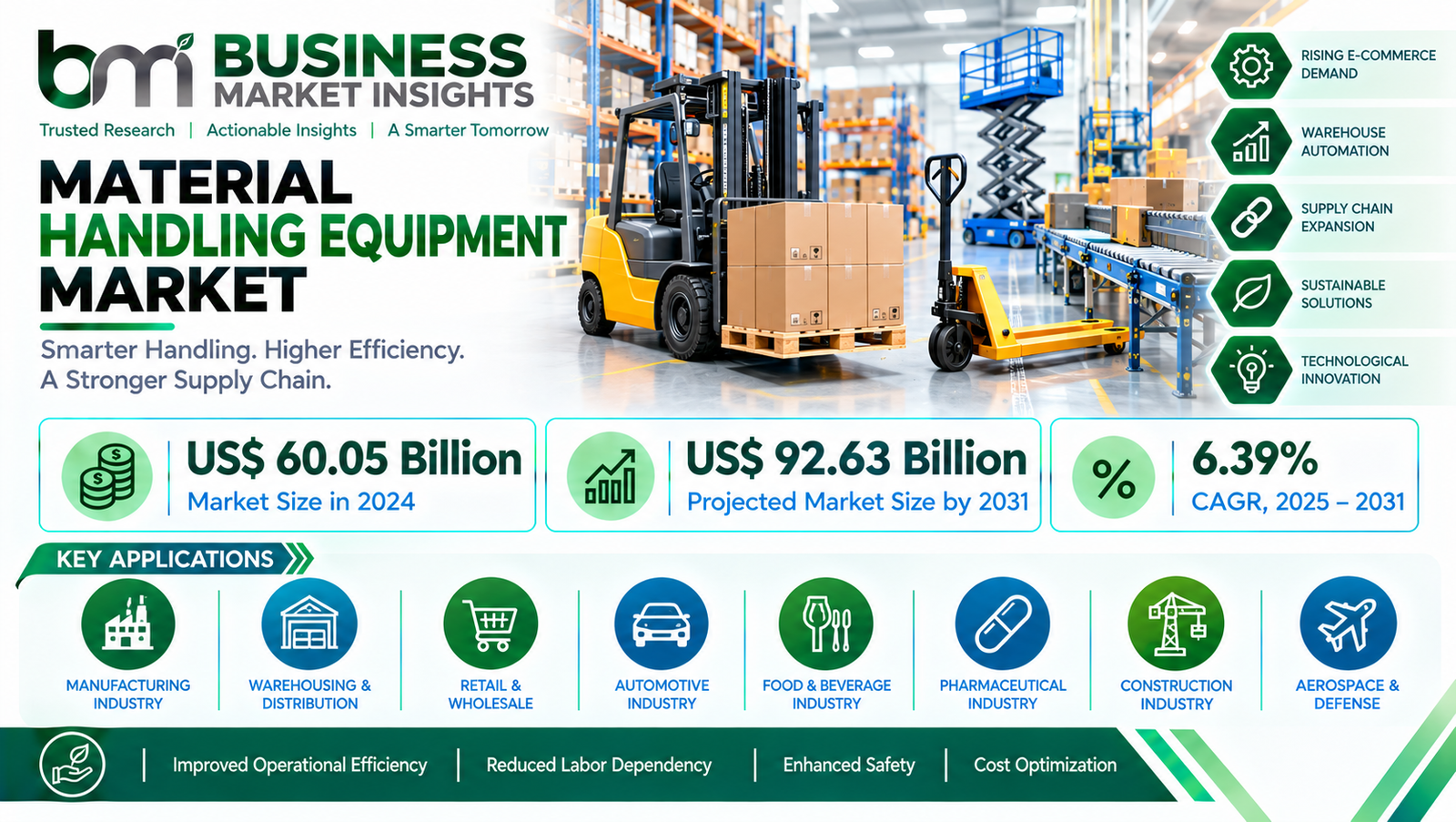
The Material Handling Equipment Market size was valued at US$ 60.05 billion in 2024 and is projected to reach US$ 92.63 billion by 2031, growing at a CAGR of 6.39% during 2025–2031. Increasing demand for warehouse automation, expansion of e-commerce and logistics operations, rising investments in manufacturing infrastructure, and growing adoption of robotics and smart material handling technologies are supporting market growth. Expanding applications across logistics, automotive, construction, food and beverages, pharmaceuticals and healthcare, and semiconductor and electronics industries are creating opportunities for material handling equipment manufacturers and industrial technology providers.
Market Overview
The Material Handling Equipment Market is evolving as manufacturers, warehouses, and distribution centers increasingly adopt advanced equipment to move, store, control, and protect materials throughout industrial and logistics operations. Material handling systems help improve workflow efficiency, optimize storage capacity, reduce manual handling, and support the movement of goods across production facilities and supply chains. The market is segmented by Equipment Type into Cranes and Lifting Equipment, Industrial Trucks, Automated Storage and Retrieval Systems (AS/RS), Conveying Systems, Racking and Storage Equipment, Automated Guided Vehicles (AGVs), Bulk Material Handling Equipment, and Others; by End-Use Industry into Logistics, Automotive, Construction, Food and Beverages, Pharmaceuticals and Healthcare, and Semiconductor and Electronics; and by Application into Assembly, Transportation, Distribution, and Others.
Asia Pacific is the leading regional market, supported by its extensive manufacturing base, industrial development, infrastructure investments, and growing adoption of warehouse automation. China, India, and Japan are important markets as manufacturers and logistics operators invest in modern material handling technologies. North America and Europe also represent significant markets, driven by advanced logistics infrastructure, automation investments, and demand for operational efficiency.
Check valuable insights in the Material Handling Equipment Market report. You can easily get a sample PDF of the report – https://www.businessmarketinsights.com/sample/BMIPUB00031690
Key Market Trends
Growing Adoption of Warehouse Automation
Warehouses and distribution centers are increasingly adopting automated storage and retrieval systems, automated guided vehicles, conveyors, and robotics to improve throughput and inventory management. Automation can help businesses manage higher order volumes, optimize available space, and reduce dependence on repetitive manual material handling tasks.
Expansion of E-Commerce and Logistics Operations
The growth of online retail and demand for faster order fulfillment are creating demand for efficient material handling solutions. Distribution centers require equipment that can move, sort, store, and retrieve goods efficiently to support high-volume operations and changing delivery expectations.
Increasing Integration of Robotics, AI, and IoT
Manufacturers are integrating robotics, artificial intelligence, Internet of Things connectivity, and sensors into material handling systems. These technologies can support real-time equipment monitoring, inventory visibility, predictive maintenance, and improved coordination across warehouses and manufacturing facilities.
Growing Demand for Electrified and Energy-Efficient Equipment
Businesses are increasingly evaluating electric industrial trucks and other energy-efficient equipment to reduce operating costs and support sustainability objectives. Improvements in battery technology, charging infrastructure, and equipment design are creating opportunities for manufacturers to develop more efficient material handling solutions.
Global Market Insights
The market is being shaped by rapid industrialization, expanding logistics networks, e-commerce growth, and the increasing need to improve productivity across manufacturing and distribution operations. Material handling equipment supports the movement of raw materials, components, work-in-progress products, and finished goods throughout industrial facilities and supply chains.
The industry ecosystem includes equipment manufacturers, automation technology providers, warehouse operators, logistics companies, industrial manufacturers, system integrators, and maintenance service providers. Companies are prioritizing equipment reliability, workplace safety, operational efficiency, and integration with warehouse management and manufacturing systems.
Industrial trucks, cranes and lifting equipment, and conveying systems remain important for moving materials across industrial environments. Automated storage and retrieval systems and automated guided vehicles offer opportunities to improve warehouse operations and reduce repetitive manual tasks. Logistics, automotive, construction, food and beverages, pharmaceuticals and healthcare, and semiconductor and electronics industries provide a broad range of applications for material handling equipment.
Explore the Material Handling Equipment industry overview for additional market insights: https://www.businessmarketinsights.com/industry-overview/material-handling-equipment-market
Regional Analysis
North America
North America represents an important market for material handling equipment, supported by established logistics infrastructure, advanced manufacturing operations, and investments in warehouse automation. Businesses are adopting modern equipment to improve inventory management, increase throughput, and address operational challenges associated with labor availability and rising fulfillment requirements.
The United States is a key market because of its extensive distribution networks, large e-commerce sector, and demand for automation across manufacturing and logistics facilities. Investments in automated storage systems, industrial trucks, conveyors, and robotic material handling solutions are creating opportunities for equipment suppliers.
Europe
Europe is an established market supported by advanced industrial capabilities, automotive manufacturing, developed logistics networks, and growing emphasis on operational efficiency. Manufacturers and warehouse operators are investing in modern material handling systems to improve productivity, optimize storage, and support increasingly complex supply chains.
Germany, the United Kingdom, France, Italy, and other European countries offer opportunities for manufacturers through their industrial bases and demand for automation. Electrification, workplace safety, energy efficiency, and integration with digital manufacturing systems are important considerations influencing equipment adoption.
Asia Pacific
Asia Pacific leads the Material Handling Equipment Market, supported by a large manufacturing base, infrastructure development, expanding e-commerce operations, and investments in industrial automation. Countries across the region are upgrading manufacturing facilities, warehouses, and distribution centers to improve productivity and supply chain performance.
China, India, Japan, South Korea, and other regional markets offer opportunities through growing industrial output and modernization of logistics infrastructure. China and Japan are important markets for robotics and automated systems, while India’s manufacturing expansion and infrastructure investment are supporting demand for industrial trucks, cranes, conveyors, and warehouse equipment.
Rest of the World
South and Central America, the Middle East, and Africa offer opportunities as industrial facilities, logistics networks, and infrastructure projects expand. Investments in construction, manufacturing, ports, warehouses, and distribution facilities can support demand for material handling equipment.
Market development across these regions will depend on capital availability, equipment affordability, infrastructure readiness, skilled labor, and access to maintenance and technical support. Businesses are likely to evaluate equipment based on reliability, operating costs, productivity benefits, and suitability for local industrial requirements.
Market Forecast by 2031
The Material Handling Equipment Market is projected to increase from US$ 60.05 billion in 2024 to US$ 92.63 billion by 2031, reflecting a CAGR of 6.39% during 2025–2031.
Cranes and lifting equipment, industrial trucks, automated storage and retrieval systems, conveying systems, and automated guided vehicles are expected to remain important equipment categories. Demand from logistics, automotive, construction, food and beverages, pharmaceuticals and healthcare, and semiconductor and electronics industries is creating opportunities for manufacturers. Continued investments in warehouse automation, industrial modernization, and supply chain efficiency may further support market development.
Strategic Analysis
Companies operating in the market are focusing on equipment innovation, automation capabilities, energy efficiency, and integration with digital systems. Investments in robotics, connected equipment, and intelligent warehouse technologies can help manufacturers respond to changing industrial and logistics requirements.
Strategic priorities include expanding product portfolios, strengthening distribution networks, improving after-sales services, and developing solutions for specific industry applications. Manufacturers that combine reliable equipment, efficient operation, safety features, and automation compatibility can strengthen their competitive positions across global markets.
Market Drivers
Expansion of E-Commerce and Warehousing
The growth of e-commerce is increasing demand for warehouse and distribution infrastructure capable of handling large order volumes and fast fulfillment cycles. Material handling equipment such as industrial trucks, conveyors, automated storage systems, and guided vehicles helps businesses move goods efficiently and manage inventory across distribution networks.
Increasing Adoption of Industrial Automation
Manufacturers and logistics operators are investing in automated equipment to improve productivity, reduce repetitive manual work, and optimize material flows. Robotics, automated guided vehicles, and intelligent storage systems are helping businesses modernize operations and improve coordination across production and warehouse facilities.
Growth in Manufacturing and Infrastructure Development
Industrial expansion and infrastructure investments are supporting demand for cranes, lifting equipment, industrial trucks, and bulk material handling systems. Construction, automotive, electronics, and other manufacturing industries require reliable equipment to transport components, raw materials, and finished products safely and efficiently.
Market Opportunities
Expansion of Smart Warehouses and Automated Logistics
The development of smart warehouses creates opportunities for suppliers of automated storage and retrieval systems, conveyors, robotics, and warehouse management technologies. Manufacturers that offer scalable systems and effective integration with existing infrastructure may benefit from increasing investment in warehouse modernization.
Development of Electric and Sustainable Equipment
Growing interest in energy efficiency and reduced operational emissions is creating opportunities for electric industrial trucks and other lower-emission material handling technologies. Improvements in battery performance, charging systems, and equipment design can help manufacturers address sustainability and operating-cost priorities.
Integration of AI, Robotics, and Predictive Maintenance
The integration of artificial intelligence, sensors, and connected monitoring systems offers opportunities to improve equipment utilization and maintenance planning. Solutions that provide real-time performance data, predictive maintenance insights, and coordinated material movement can help businesses reduce downtime and improve operational efficiency.
Market Restraints
High Initial Equipment and Automation Costs
Material handling equipment, particularly advanced automated systems, can require significant upfront investment. Costs associated with installation, software integration, infrastructure modifications, and maintenance may limit adoption among small and medium-sized businesses or companies with constrained capital budgets.
Integration Complexity and Skilled Workforce Requirements
Integrating automated equipment with existing warehouse management, enterprise resource planning, and manufacturing systems can be complex. Businesses may also require trained personnel to operate, maintain, and troubleshoot advanced equipment, creating additional implementation and operating challenges.
Competitive Landscape
The competitive environment includes global industrial equipment manufacturers and suppliers of lifting, transportation, storage, and automation technologies. Competition increasingly depends on equipment reliability, product range, energy efficiency, automation capabilities, service networks, and the ability to support different industrial applications.
Key players identified in the report include:
· Caterpillar Inc.
· Komatsu Ltd.
· John Deere
· XCMG Group
· Liebherr Group
· SANY Group
· Volvo Construction Equipment
· Hitachi Construction Machinery
· JCB
· Doosan Bobcat
Get Premium Research Report of Material Handling Equipment Market Size and Growth Report by 2031 at: https://www.businessmarketinsights.com/buy/BMIPUB00031690
Conclusion
The Material Handling Equipment Market is positioned for continued growth through 2031 as manufacturers, warehouses, and logistics operators invest in automation, modern equipment, and more efficient material movement. Expansion of e-commerce, industrial modernization, infrastructure development, and adoption of connected technologies are creating opportunities for industry participants.
Asia Pacific remains a leading regional market, while North America and Europe continue to offer opportunities through advanced manufacturing and logistics operations. Companies that prioritize reliable equipment, energy efficiency, automation compatibility, and strong after-sales support are well positioned to address evolving material handling requirements.
Related Reading / Reports
1. Automated Material Handling Equipment Market: Analysis of automated equipment, robotics, storage systems, conveyors, end-user industries, and global market opportunities.
2. Industrial Automation Market: Analysis of industrial automation technologies, manufacturing applications, digital systems, and global industry developments.
3. Heavy Construction Equipment Market: Analysis of construction equipment categories, material handling applications, end-use industries, and global market growth.
4. Industrial Robotics Market: Analysis of industrial robotics technologies, manufacturing applications, automation trends, and competitive developments.
About Us
Business Market Insights is a market research platform that provides subscription service for industry and company reports. Our research team has extensive professional expertise in domains such as Electronics & Semiconductor; Aerospace & Defense; Automotive & Transportation; Energy & Power; Healthcare; Manufacturing & Construction; Food & Beverages; Chemicals & Materials; and Technology, Media, & Telecommunications.
Contact us:
· If you have any questions about this report or would like further information, please contact us:
· Contact person: Ankit Mathur
· Email: sales@businessmarketinsights.com
· Phone: +16467917070