Atopic Dermatitis Treatment Market Growth Driven by Advanced Biologic Therapies
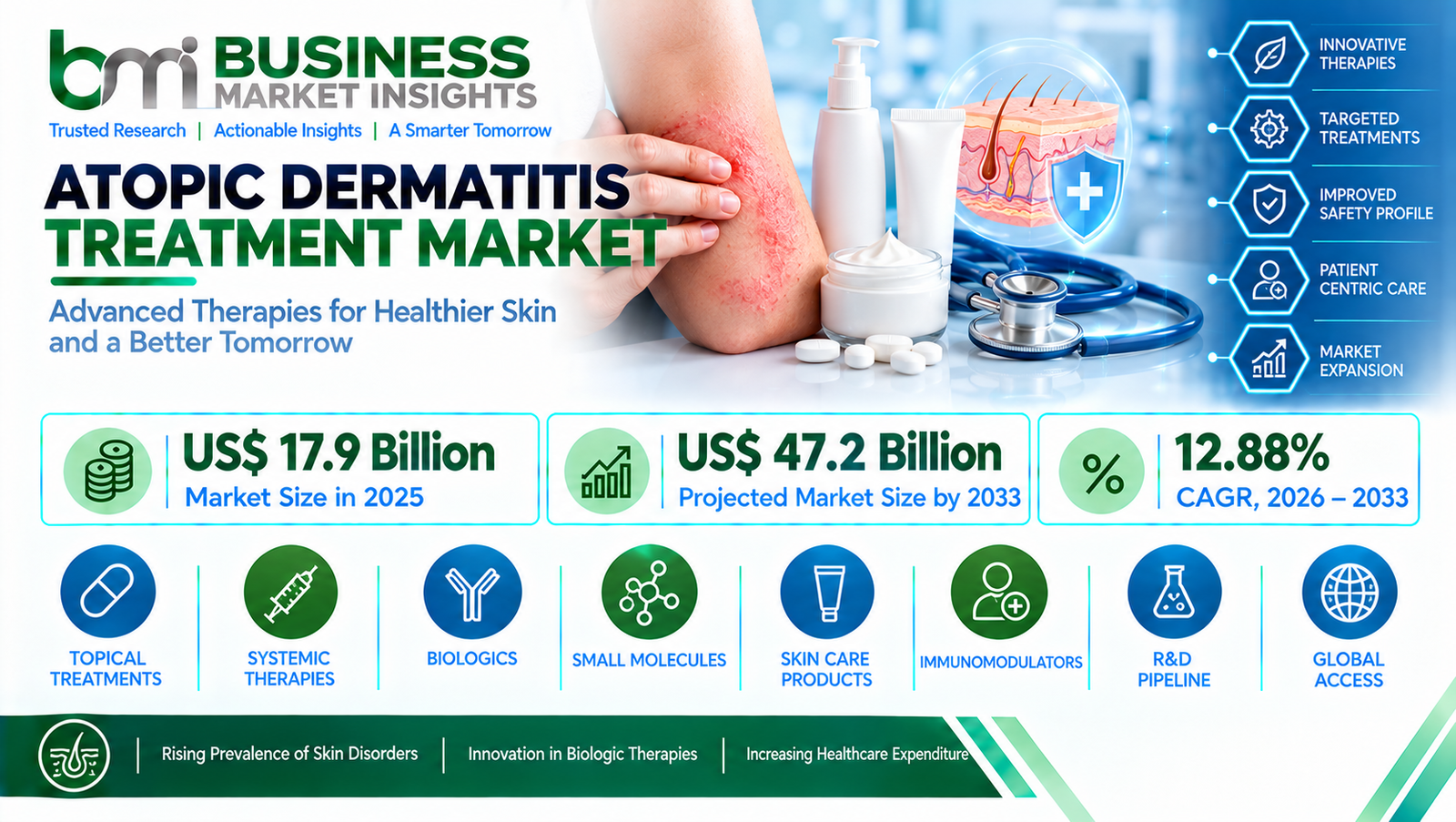
The Atopic Dermatitis Treatment Market size was valued at US$ 17.9 Billion in 2025 and is projected to reach US$ 47.2 Billion by 2033, growing at a CAGR of 12.88% from 2026 to 2033. Rising disease prevalence, increasing adoption of biologic therapies, advances in targeted immunology, improved diagnosis rates, and expanding reimbursement support are accelerating market growth across global healthcare markets.
Corticosteroids represented the leading drug class in 2025, while Interleukin Inhibitors are projected to experience the fastest growth. Topical treatments remain the leading route of administration, supported by widespread use and patient familiarity. North America holds the largest regional share, while Asia Pacific is expected to register the fastest growth, driven by increasing healthcare expenditure, improved disease awareness, expanding dermatology infrastructure, and greater access to advanced therapies.
Market Overview
The Atopic Dermatitis Treatment Market covers Corticosteroids, Antihistamines, Calcineurin Inhibitors, Interleukin Inhibitors, Topical Phosphodiesterase-4, and Antibiotics under drug class. The market is segmented by route of administration into Oral, Topical, and Injectable, and by distribution channel into Hospital Pharmacies, Retail Pharmacies, and Online Pharmacies.
Corticosteroids accounted for approximately 33%–36% of the market in 2025 and are projected to grow at a 9.5%–10.5% CAGR, supported by established prescribing practices, affordability, and widespread availability. Interleukin Inhibitors represented approximately 18%–21% of the market and are forecast to grow at a 16.5%–18.5% CAGR, driven by biologic adoption and demand for targeted treatment options. Topical treatments held approximately 46%–49% of the market, while hospital pharmacies accounted for approximately 40%–43% of distribution-channel revenue.
Check valuable insights in the Atopic Dermatitis Treatment Market report. You can easily get a sample PDF of the report – https://www.businessmarketinsights.com/sample/BMIPUB00038614
What is driving the Atopic Dermatitis Treatment Market?
Rising Global Prevalence of Atopic Dermatitis
Increasing demand for effective management of atopic dermatitis among children and adults is supporting the development of new treatment options. Greater awareness of chronic inflammatory skin conditions, improved diagnostic practices, and increased access to dermatology services are helping more patients receive appropriate treatment.
The recurring nature of the condition also creates demand for long-term disease management, symptom control, and therapies that can improve patients’ quality of life.
Expansion of Biologics and Targeted Immunology Therapies
Biologics and targeted immunomodulators are transforming treatment options for patients with moderate-to-severe atopic dermatitis. Interleukin inhibitors target specific inflammatory pathways and provide alternatives for patients who do not achieve adequate control with conventional treatments.
Pharmaceutical companies are investing in innovative therapies, clinical research, and treatment approaches designed to improve efficacy, tolerability, and disease management. These developments are supporting the growing adoption of advanced prescription medicines.
Growing Dermatology Awareness and Earlier Diagnosis
Improved awareness of dermatological conditions and greater access to specialist consultations are encouraging earlier diagnosis and treatment. Teledermatology and digital healthcare services can also help patients access medical advice, monitor symptoms, and maintain treatment continuity.
Earlier diagnosis and improved patient education support treatment adherence and increase demand for appropriate therapies across established and emerging healthcare markets.
Key Market Trends
· Increasing adoption of biologic therapies
· Growing use of interleukin inhibitors
· Rising demand for targeted immunomodulators
· Expansion of topical steroid-sparing treatments
· Increasing investment in dermatology drug development
· Growing adoption of personalized treatment strategies
· Rising use of teledermatology services
· Expansion of digital patient-support platforms
· Increasing focus on long-term disease management
· Growing access to advanced therapies in emerging markets
How are Advanced Therapies Shaping the Market?
Advances in immunology are expanding the range of treatment options available for atopic dermatitis. Biologic therapies and targeted medicines are designed to address specific mechanisms involved in inflammation, creating opportunities for patients who require alternatives to conventional treatment approaches.
Precision medicine and biomarker research may further support individualized treatment decisions by helping healthcare professionals understand differences in patient response. Meanwhile, digital health platforms, remote consultations, and patient-support programs are improving access to information and helping patients manage treatment schedules and symptoms.
Global Market Insights
· North America: Accounts for approximately 38%–41% of the market in 2025 and is projected to grow at an 11.5%–12.5% CAGR from 2026 to 2033. Biologic adoption, reimbursement support, specialist access, and strong clinical research activity underpin regional demand.
· Europe: Benefits from established healthcare systems, dermatology services, pharmaceutical innovation, and access to advanced prescription treatments.
· Asia Pacific: Holds approximately 24%–27% of the market and is projected to register the fastest growth, at a 14.0%–15.5% CAGR, supported by rising healthcare expenditure, improving diagnosis rates, expanding dermatology infrastructure, and greater access to biologics.
· South and Central America, Middle East, and Africa: Offer opportunities through improving healthcare access, growing disease awareness, pharmaceutical market expansion, and broader availability of dermatological treatments.
Industry Overview
Explore Atopic Dermatitis Treatment Market Growth in Industry Snippets at: https://www.businessmarketinsights.com/industry-overview/atopic-dermatitis-treatment-market
Regional Analysis
North America remains the largest regional market, supported by established healthcare infrastructure, access to dermatology specialists, biologic adoption, and reimbursement mechanisms. The United States accounts for approximately 82%–85% of North American revenue and is projected to grow at an 11.8%–12.4% CAGR through 2033.
Europe benefits from established pharmaceutical research, access to prescription medicines, and healthcare systems that support the management of chronic inflammatory conditions. Demand for advanced treatments is influenced by clinical evidence, treatment accessibility, reimbursement policies, and the availability of specialist dermatology services.
Asia Pacific is expected to be the fastest-growing region. China leads regional revenue, while India is projected to experience particularly strong growth. Increasing healthcare investment, rising awareness of skin disorders, expanding diagnostic capabilities, and improving access to advanced medicines are creating opportunities for pharmaceutical manufacturers.
Corticosteroids Lead the Drug Class Segment
Corticosteroids accounted for approximately 33%–36% of the market in 2025 and are projected to grow at a 9.5%–10.5% CAGR. Their established role in managing inflammatory symptoms, broad availability, affordability, and familiarity among healthcare professionals support their leading position.
Antihistamines are used to help manage itching and related symptoms, while calcineurin inhibitors provide steroid-sparing treatment options in selected cases. Topical phosphodiesterase-4 therapies offer additional nonsteroidal approaches, and antibiotics may be prescribed when secondary bacterial infections complicate the condition.
Interleukin inhibitors are emerging as a major growth segment, supported by targeted mechanisms, increasing adoption of biologics, and demand for effective management of moderate-to-severe disease.
Interleukin Inhibitors Create Growth Opportunities
Interleukin Inhibitors held approximately 18%–21% of the market in 2025 and are projected to grow at a 16.5%–18.5% CAGR. Their targeted approach to inflammatory pathways and expanding use in moderate-to-severe atopic dermatitis support the segment’s growth potential.
Additional opportunities include next-generation biologics, precision immunology, biomarker-guided treatment selection, and digital patient-support services. Pharmaceutical companies can also pursue expansion in emerging healthcare markets as diagnosis rates improve and access to specialist treatment increases.
Market Forecast by 2033
The Atopic Dermatitis Treatment Market is projected to reach US$ 47.2 Billion by 2033, expanding at a CAGR of 12.88% from 2026 to 2033. Increasing disease awareness, targeted immunology innovation, biologic adoption, and broader access to advanced therapies are expected to support continued market expansion.
What is changing in 2026?
In 2026, the market is increasingly focused on targeted biologics, next-generation immunomodulators, personalized treatment pathways, and improved patient-support systems. Pharmaceutical developers are pursuing therapies that address unmet treatment needs, while healthcare providers are emphasizing effective disease control, patient education, and treatment adherence.
Digital consultations and remote patient-support tools are also creating opportunities to improve access to dermatology services and support ongoing disease management.
What are the major investment opportunities?
Major investment opportunities include:
· Next-generation biologic therapies
· Interleukin inhibitor development
· Targeted immunomodulators
· Precision immunology and biomarker research
· Steroid-sparing topical treatments
· Oral and injectable targeted therapies
· Teledermatology platforms
· Digital patient-support programs
· Emerging-market pharmaceutical distribution
· Clinical research and treatment innovation
Strategic Analysis
The competitive landscape is shaped by pharmaceutical innovation, biologic development, clinical research, and competition across conventional and advanced treatment options. Companies are strengthening dermatology portfolios, investing in targeted immunology, expanding clinical development programs, and improving access to specialty medicines.
Market participants must also address treatment affordability, reimbursement requirements, regulatory compliance, and long-term safety monitoring. Companies that combine differentiated therapies with strong clinical evidence and effective commercialization strategies are positioned to pursue opportunities in this expanding market.
Get Premium Research Report of Atopic Dermatitis Treatment Market Size and Growth Report by 2033 at: https://www.businessmarketinsights.com/buy/BMIPUB00038614
Industry News & Developments
· Pharmaceutical companies continue to invest in biologics and targeted immunology therapies for inflammatory skin conditions.
· Interleukin inhibitors are gaining importance in advanced treatment strategies for moderate-to-severe atopic dermatitis.
· Precision medicine research is creating opportunities for more individualized treatment pathways.
· Digital dermatology services are expanding options for consultations and patient support.
· Pharmaceutical developers are investigating therapies designed to improve disease control and treatment tolerability.
· Emerging healthcare markets are attracting attention as access to dermatology services improves.
· Regulatory requirements and safety monitoring remain important considerations for advanced treatment development.
Key Players
· Sanofi
· Regeneron Pharmaceuticals, Inc.
· Eli Lilly and Company
· Pfizer Inc.
· AbbVie Inc.
· LEO Pharma A/S
· Novartis AG
· Galderma S.A.
· Bristol Myers Squibb
· Incyte Corporation
Conclusion
The Atopic Dermatitis Treatment Market is entering a strong growth phase as rising disease prevalence, biologic adoption, and advances in targeted immunology reshape treatment options. The market is projected to reach US$ 47.2 Billion by 2033, with interleukin inhibitors, next-generation biologics, personalized medicine, and digital patient-support solutions creating significant opportunities across global healthcare markets.
Trending Related Reports
1. Dermatology Drugs Market – Advances in biologics, targeted therapies, and chronic skin disease management are expanding opportunities across dermatology treatments.
2. Dermatitis Drugs Market – Growing demand for advanced treatments and targeted anti-inflammatory therapies is supporting pharmaceutical innovation in dermatitis care.
3. Allergy Treatment Market – Increasing prevalence of allergic conditions and advances in drug treatments are supporting demand across allergy management.
4. Immunomodulators Market – Innovation in therapies that modify immune responses is creating opportunities across inflammatory and immune-mediated conditions.
About Us
Business Market Insights is a market research platform that provides subscription services for industry and company reports. Our research team has extensive professional expertise in domains such as Electronics & Semiconductor; Aerospace & Defense; Automotive & Transportation; Energy & Power; Healthcare; Manufacturing & Construction; Food & Beverages; Chemicals & Materials; and Technology, Media, & Telecommunications.
Contact Us
Contact person: Ankit Mathur
Email: sales@businessmarketinsights.com
Phone: +16467917070