Buccal Drug Delivery System Market to Reach US$ 6.53 Billion by 2034 as Non-Invasive Drug Delivery Gains Momentum
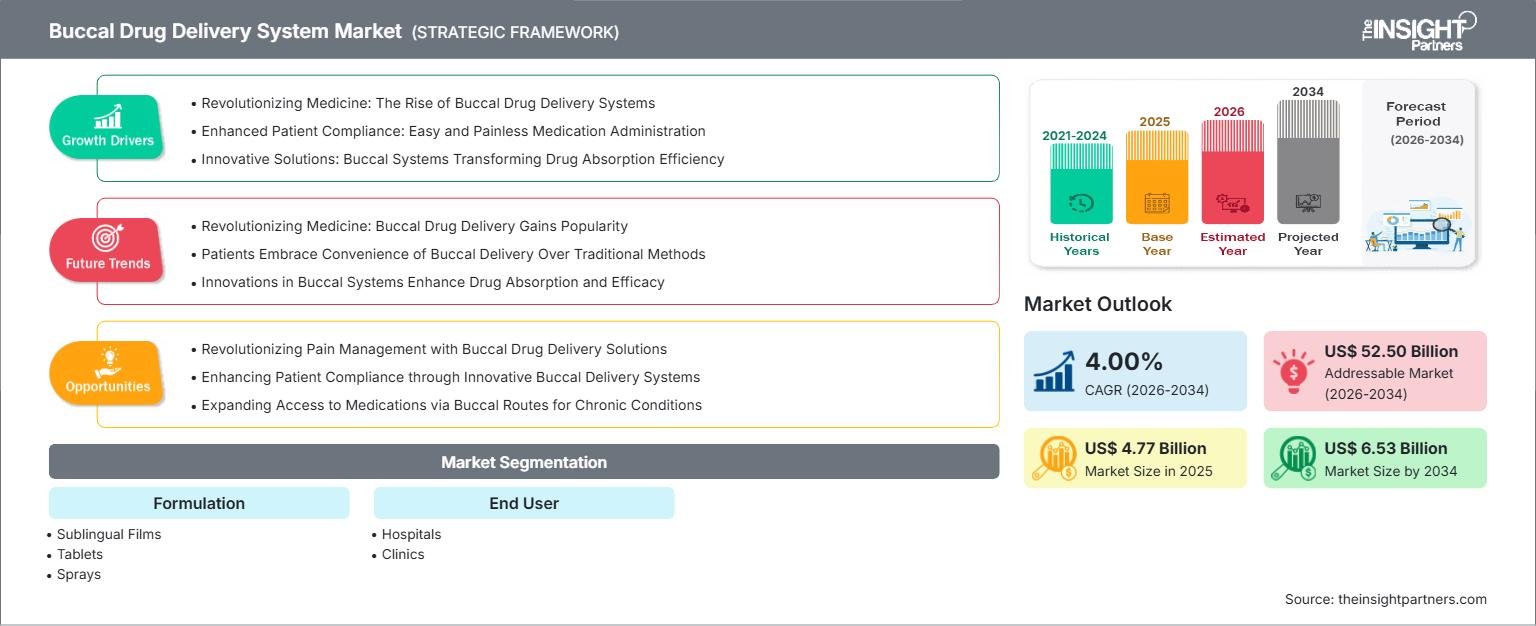
The global buccal drug delivery system market was valued at US$ 4.77 billion in 2025 and is projected to reach US$ 6.53 billion by 2034, registering a CAGR of 4.00% from 2026 to 2034, according to The Insight Partners.
The buccal drug delivery system market is expanding as pharmaceutical companies increasingly develop non-invasive dosage forms that can improve administration convenience, support patient adherence, and enable rapid absorption through the oral mucosa. Buccal and sublingual formulations can provide alternatives to conventional swallowing, injections, and rectal administration, particularly in therapies requiring fast onset or convenient administration.
The market was valued at US$ 4.77 billion in 2025 and is forecast to reach US$ 6.53 billion by 2034. The market is expected to grow at a 4.00% CAGR between 2026 and 2034, while the addressable market is estimated at US$ 52.50 billion during 2026-2034.
Download Sample PDF @ https://www.theinsightpartners.com/sample/TIPRE00011936
Growing Demand for Non-Invasive Drug Delivery Supports Market Growth
The increasing need for non-invasive rescue and maintenance therapies is a key factor supporting market expansion. Buccal formulations can provide convenient administration when swallowing is difficult or when rapid dosing is important. This is particularly relevant to seizure rescue, pain management, opioid-use-disorder treatment, and emergency-care applications.
The convenience of buccal delivery is also relevant to pediatric and geriatric populations, where conventional oral or injectable routes can present administration challenges. Products that can be administered by patients or caregivers outside traditional clinical environments can support broader access to treatment.
Sublingual Films Lead Formulation Segment
Sublingual films held an estimated 42-46% market share in 2025 and are projected to grow at a CAGR of 4.1-4.7% through 2034. Their portability, rapid dissolution, and suitability for rescue and maintenance therapies are supporting their position within the formulation landscape.
Films can also provide opportunities for pharmaceutical companies to differentiate established active ingredients through new dosage forms. Tablets remain relevant in cost-sensitive markets, while sprays can address rapid administration requirements, although dose precision and mucosal retention remain important considerations.
Reformulation Strategies Create Pharmaceutical Opportunities
The reformulation of established active pharmaceutical ingredients into buccal films, tablets, and sprays represents an important opportunity. Developers can potentially use established safety information while focusing development efforts on bioavailability, usability, formulation performance, and manufacturing consistency.
The report highlights 505(b)(2)-style development strategies in the US as an important pathway for companies seeking lifecycle extensions and differentiated formulations. This approach is encouraging partnerships between specialty pharmaceutical companies, formulation developers, and contract development and manufacturing organizations.
Advances in Film Technology Strengthen Market Trends
Buccal drug delivery technology is moving beyond conventional tablet formulations toward thin-film laminates, mucoadhesive polymers, permeation enhancers, and solvent-casting processes. These technologies are being developed to improve dose uniformity, dissolution, adhesion, taste masking, packaging, and stability.
Manufacturers are increasingly combining formulation technologies with drug-device studies and pediatric-friendly administration approaches. Controlled-release systems and improved packaging technologies are also contributing to product differentiation.
Clinics Gain Strategic Importance in Outpatient Treatment
Clinics represented an estimated 36-40% market share in 2025 and are projected to grow at a CAGR of 4.4-5.0% from 2026 to 2034. Increasing outpatient prescribing is supporting the role of clinics in opioid-use-disorder treatment, neurological care, pain management, and follow-up treatment.
Hospitals remain important for emergency care, formulary evaluation, therapy initiation, and monitored treatment. However, the expansion of outpatient care is creating additional demand for portable and easy-to-administer dosage forms.
AI and Printable Oral Films Represent Emerging Trends
Artificial intelligence and predictive modeling are emerging as potential tools for formulation development. These technologies can assist developers in evaluating polymer selection, dissolution behavior, taste masking, and dose uniformity during early formulation stages.
Printable oral films may also support customized dose strengths, particularly for pediatric and geriatric populations. Wider commercialization will depend on regulatory acceptance, manufacturing reproducibility, process validation, and consistent analytical performance.
North America Maintains a Leading Market Position
North America accounted for approximately 38-42% of the buccal drug delivery system market in 2025 and is projected to grow at a CAGR of 3.7-4.3% during 2026-2034. The region benefits from established specialty drug-delivery infrastructure, FDA familiarity with transmucosal medicines, specialty distribution networks, and reimbursement pathways.
The US represented approximately 84-88% of the North American market in 2025 and is expected to grow at a CAGR of 3.8-4.4% through 2034. Seizure rescue therapy, opioid-use-disorder treatment, chronic pain management, and emergency preparedness are among the important application areas.
Asia Pacific Shows Strong Growth Potential
Asia Pacific accounted for approximately 18-22% of the market in 2025 and is projected to register the highest regional CAGR, at 4.6-5.2% from 2026 to 2034. Pharmaceutical manufacturing capabilities, specialty medicine adoption, and healthcare accessibility are supporting regional expansion.
Japan, China, India, South Korea, and Australia are identified as important markets. The region also offers manufacturing and contract development opportunities as pharmaceutical companies seek cost-efficient formulation capabilities and broader access to specialty medicines.
Europe Expands Through Specialty Care and Hospital Adoption
Europe held approximately 24-28% of the global market in 2025 and is expected to grow at a CAGR of 3.4-4.0% through 2034. The UK, Germany, France, Italy, and Spain represent key markets, supported by specialist prescribing, hospital pharmacy systems, reimbursement structures, and increasing interest in non-invasive rescue therapies.
The substitution of selected invasive administration routes with buccal and sublingual formulations is creating additional opportunities across neurological, pain-management, and palliative-care applications.
Specialty Neurology and Pain Therapies Create New Opportunities
Neurology and pain management remain important opportunity areas because treatment can benefit from rapid administration, portability, and caregiver-friendly dosage forms. The market report identifies specialty pipeline licensing as an opportunity where established active ingredients can be reformulated into buccal films for episodic symptoms or rescue treatment.
Companies can pursue licensing, co-development, regional commercialization, and technology-transfer arrangements to combine proprietary film technologies with established pharmaceutical ingredients.
Recent Industry Developments
In November 2025, Tharimmune, Inc. received positive FDA feedback concerning its TH104 nalmefene buccal film simulation modeling plan for prophylaxis against respiratory depression caused by fentanyl and ultrapotent opioids. The company indicated that the feedback supported its planned 505(b)(2) NDA strategy and chemistry, manufacturing, and controls planning.
In May 2025, Indivior PLC updated the US prescribing information for SUBOXONE sublingual film, including dosage and administration revisions. The labeling continues to include sublingual or buccal administration.
In December 2024, Aquestive Therapeutics, Inc. received US FDA orphan drug exclusivity for Libervant diazepam buccal film for pediatric patients aged two to five with seizure clusters. The exclusivity provides seven years of US market protection for the approved pediatric indication.
Get Full Copy @ https://www.theinsightpartners.com/buy/TIPRE00011936
Competitive Landscape
The buccal drug delivery system market includes specialty pharmaceutical companies, drug delivery technology developers, formulation companies, and contract development and manufacturing organizations. Key companies analyzed by The Insight Partners include Actavis Pharma, Inc.; Applied Pharma Research SA; Ardea Biosciences, Inc.; BioDelivery Sciences International, Inc.; Sumitomo Pharma America, Inc.; Endo Pharmaceuticals Inc.; Ethypharm S.A.S.; Aquestive Therapeutics, Inc.; Indivior PLC; IntelGenx Technologies Corp.; ZIM Laboratories Limited; LTS Lohmann Therapie-Systeme AG; Tharimmune, Inc.; and Collegium Pharmaceutical, Inc.
Competition is increasingly centered on proprietary film platforms, regulatory expertise, formulation performance, manufacturing scalability, therapeutic specialization, and the ability to demonstrate practical advantages over conventional administration routes.
Future Outlook
The global buccal drug delivery system market is projected to grow from US$ 4.77 billion in 2025 to US$ 6.53 billion by 2034, representing a 4.00% CAGR during 2026-2034.
Future market development is expected to focus on advanced film technologies, mucoadhesive polymers, improved taste masking, controlled release, AI-assisted formulation design, printable oral films, and dosage forms designed for pediatric and geriatric patients.
The expansion of specialty clinics and outpatient treatment is also expected to create demand for portable and caregiver-friendly formulations. Meanwhile, Asia Pacific is likely to provide opportunities for local manufacturing partnerships, formulation development, and wider distribution of buccal medicines.
As pharmaceutical developers seek alternatives to injections, conventional oral administration, and other less convenient routes, buccal drug delivery technologies are expected to remain an important area of formulation innovation and lifecycle management.
About Us
The Insight Partners, we provide comprehensive analysis and insights into market trends that empower businesses to make informed decisions. Our reports are designed to equip stakeholders with the necessary information to navigate the complexities of various industries, including healthcare, technology, and finance. We are dedicated to delivering high-quality research that enables our clients to achieve their strategic objectives.
Contact Us:
Contact Person: Ankit Mathur
E-mail: ankit.mathur@theinsightpartners.com
Phone: +1-646-491-9876
Also Available in : Korean German Japanese French Chinese Italian Spanish