Artificial Organs and Bionics Market to Reach US$ 50.00 Billion by 2034
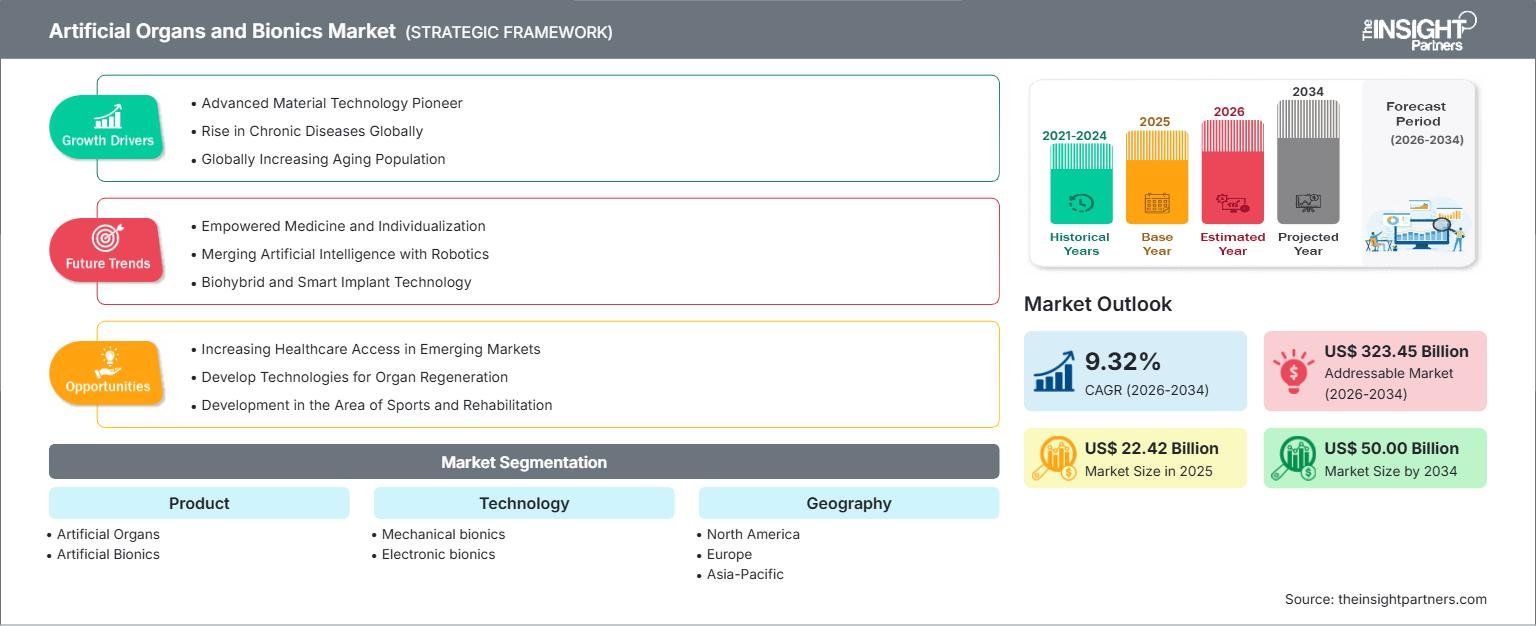
Artificial Organs and Bionics Market is projected to grow from US$ 22.42 billion in 2025 to US$ 50.00 billion by 2034, registering a CAGR of 9.32% from 2026 to 2034
The global Artificial Organs and Bionics Market is expanding as healthcare providers, medical-device manufacturers, and technology developers advance solutions designed to replace, support, or restore impaired biological functions. According to the latest analysis from The Insight Partners, the market was valued at US$ 22.42 billion in 2025 and is projected to reach US$ 50.00 billion by 2034, registering a CAGR of 9.32% from 2026 to 2034.
The market spans technologies used across organ replacement, circulatory support, orthopedic reconstruction, prosthetics, sensory restoration, rehabilitation, and other applications. Increasing organ failure, population aging, disability, and technological progress in implantable and wearable medical devices are contributing to market development.
Download Sample PDF @ https://www.theinsightpartners.com/sample/TIPRE00018936
Rising Burden of Organ Failure Drives Demand
The increasing prevalence of cardiovascular diseases, kidney failure, diabetes-related complications, musculoskeletal disorders, and other chronic conditions is creating a larger patient population requiring organ support, replacement, or functional restoration.
Artificial organs can provide alternatives or support when conventional treatment options are insufficient or when donor-organ availability does not meet clinical requirements. Similarly, bionic technologies can assist patients experiencing mobility or sensory limitations.
The aging global population is adding another dimension to demand. Age-associated conditions can increase the need for orthopedic reconstruction, mobility assistance, rehabilitation technologies, and other devices designed to maintain independence and quality of life.
Advanced Materials Transform Artificial Organ Development
Advances in materials science are supporting the development of artificial organs and bionic devices with improved durability, biocompatibility, and functional performance.
Manufacturers are increasingly working with advanced polymers, precision components, specialized coatings, electronics, and other materials to develop devices capable of operating reliably within demanding physiological environments.
Material innovation is particularly relevant for implantable systems, where long-term performance, tissue compatibility, sterilization, and mechanical reliability are important considerations. Improvements in these areas can support the development of smaller and more durable medical devices.
Miniaturization and Integrated Sensors Create New Possibilities
Device miniaturization is becoming increasingly important across the artificial organs and bionics industry. Smaller pumps, sensors, processors, batteries, and communication components can support the development of more compact implantable and wearable technologies.
The integration of sensing and electronic components also allows devices to capture physiological or movement-related information. These capabilities are particularly relevant to electronically controlled prostheses, rehabilitation systems, neurotechnology, and other bionic applications.
As devices become more connected, manufacturers are also required to address cybersecurity, interoperability, battery safety, software reliability, and lifecycle management alongside traditional requirements such as durability and clinical performance.
Artificial Bionics Expand With Electronic Technologies
The market is segmented by product into Artificial Organs and Artificial Bionics. Artificial Organs represents the larger product segment, reflecting established applications in cardiovascular, renal, orthopedic, and other organ-support technologies.
Artificial Bionics is developing rapidly as prosthetic, sensory, mobility, and neurotechnology platforms increasingly combine mechanical structures with electronic components and digital controls.
Electronic bionics can incorporate sensors, microprocessors, wireless connectivity, and adaptive-control technologies. These capabilities are creating opportunities for more personalized device performance and improved interaction between devices and users.
Electronic Bionics Represent a High-Growth Technology Segment
Based on technology, the Artificial Organs and Bionics Market is divided into Mechanical Bionics and Electronic Bionics.
Mechanical bionics remains important for structural replacement, load-bearing applications, movement assistance, and circulatory support. Reliability, fatigue resistance, biocompatibility, and predictable mechanical performance remain important development considerations.
Electronic bionics, meanwhile, benefits from advances in sensing, digital control, connectivity, and embedded computing. The report estimates that Electronic Bionics will expand at approximately 10.5% to 11.5% CAGR during 2026–2034, compared with approximately 8.0% to 9.0% for Mechanical Bionics.
Minimally Invasive and Robot-Assisted Procedures Expand Applications
The increasing adoption of minimally invasive and robot-assisted interventions is creating additional opportunities for advanced artificial organs and bionic technologies.
Transcatheter valves, catheter-delivered circulatory support systems, image-guided implants, and robotic orthopedic technologies demonstrate how procedural innovation can expand the use of sophisticated medical devices.
These technologies require close integration between implants, delivery systems, imaging platforms, software, and clinical workflows. As hospitals invest in advanced procedural infrastructure, manufacturers are increasingly competing on complete technology ecosystems rather than individual device specifications alone.
Personalized Bionics and 3D Printing Create New Opportunities
Personalization is becoming an important development area within artificial organs and bionics. Advances in 3D printing and AI-enabled design are enabling the development of prosthetic and replacement devices tailored to individual patient requirements.
Customized designs can potentially improve fit, comfort, functionality, and usability. This is particularly relevant to prosthetics and orthopedic applications, where anatomical differences can influence device requirements.
The increasing availability of digital design tools is also creating opportunities for manufacturers to combine patient-specific data with advanced manufacturing processes.
AI and Robotics Transform Bionic Systems
The integration of artificial intelligence and robotics is emerging as an important trend across the market. AI-enabled technologies can process signals generated by sensors and assist devices in adapting to changing movement or physiological conditions.
Robotic technologies can provide controlled movement and mechanical assistance across prosthetic and rehabilitation applications. Together, AI and robotics are supporting the development of bionic systems designed to provide more responsive and personalized functionality.
Future development will require extensive validation to establish safety, reliability, cybersecurity, and meaningful clinical or functional benefits.
Biohybrid and Smart Implants Gain Attention
Biohybrid systems and smart implants represent another developing area within the Artificial Organs and Bionics Market. These technologies seek to combine biological components or tissue interfaces with engineered materials and electronic systems.
Smart implants can incorporate sensors capable of monitoring physiological parameters or device performance. Real-time information may support clinical monitoring and enable more responsive device behavior.
Although these technologies remain technically and commercially challenging, advances in biomaterials, sensing, tissue engineering, and electronics are creating new opportunities for future product development.
Asia Pacific Emerges as the Fastest-Growing Region
Asia Pacific is projected to be the fastest-growing regional market, with an estimated 10.5% to 11.5% CAGR from 2026 to 2034. The region accounted for an estimated 20% to 24% share of the global market in 2025. China, Japan, South Korea, India, and Australia are among the key markets covered in the regional analysis.
Growing healthcare investment, hospital development, aging populations, and expanding specialist capacity are supporting market opportunities across Asia Pacific.
China is investing in domestic medical-device capabilities, while Japan has significant requirements associated with advanced implants and elderly care. South Korea benefits from its strong electronics ecosystem, while India is expanding tertiary-care capacity and specialized healthcare services.
North America Maintains a Strong Market Position
North America represented an estimated 42% to 46% of the global Artificial Organs and Bionics Market in 2025 and is projected to grow at approximately 8.7% to 9.5% CAGR through 2034. Advanced cardiovascular and orthopedic care, specialized hospitals, rehabilitation infrastructure, and established reimbursement pathways support regional demand.
The US represents approximately 82% to 86% of North American revenue in 2025. The country combines substantial cardiovascular and orthopedic procedure volumes with established medical-device research, manufacturing, distribution, and physician-training networks.
Europe Benefits From Established Healthcare Infrastructure
Europe accounted for an estimated 25% to 29% of the market in 2025 and is projected to register approximately 9.0% to 9.8% CAGR through 2034. Germany, the UK, France, Italy, and Spain represent major markets in the region.
The region benefits from established healthcare systems, specialist hospitals, medical-device manufacturing capabilities, rehabilitation programs, and insurance infrastructure.
Germany has a particularly developed medical-device manufacturing and tertiary-care ecosystem, while the UK, France, Italy, and Spain continue to support demand through cardiovascular, orthopedic, rehabilitation, and implant-related healthcare services.
Regenerative Medicine Opens Long-Term Opportunities
The convergence of artificial organs with regenerative medicine and tissue engineering represents a longer-term opportunity. Researchers and technology developers are exploring approaches that combine engineered structures with biological materials to improve tissue integration and functionality.
Such technologies could potentially bridge the gap between conventional synthetic implants and biological replacement. However, manufacturing complexity, immune response, durability, regulatory requirements, and long-term clinical validation remain important considerations.
The development of regenerative approaches may create opportunities for partnerships among medical-device companies, biomaterials developers, cell-therapy specialists, and academic research institutions.
Get Full Copy @ https://www.theinsightpartners.com/buy/TIPRE00018936
Key Companies in the Artificial Organs and Bionics Market
The competitive landscape includes established medical-device manufacturers and specialized bionics companies. Companies profiled by The Insight Partners include Medtronic, Zimmer Biomet Holdings, Inc., Abbott, ABIOMED, Inc., Biomet, Inc., Berlin Heart GmbH, Edwards Lifesciences Corporation, Boston Scientific Corporation, Ekso Bionics, Inc., and SynCardia Systems, LLC.
Market participants are focusing on miniaturization, implant longevity, advanced sensing, robotics, intelligent control, rehabilitation technologies, and integration between hardware and software.
Portfolio breadth, clinical evidence, manufacturing capabilities, specialist distribution, physician training, and post-market support remain important factors within the competitive environment.
Future Outlook
The global Artificial Organs and Bionics Market is projected to increase from US$22.42 billion in 2025 to US$50.00 billion by 2034, representing a 9.32% CAGR from 2026 to 2034.
The market’s future development will be influenced by the rising burden of organ failure and disability, population aging, advances in materials science, device miniaturization, and increasing integration of electronics and software.
Electronic bionics, personalized prosthetics, smart implants, AI-enabled systems, robotics, and closed-loop technologies are expected to contribute to continued innovation. At the same time, regenerative medicine could create longer-term opportunities for technologies that combine engineered structures with biological materials.
Asia Pacific is expected to experience the fastest regional growth, while North America is projected to remain an important market supported by advanced clinical infrastructure and established reimbursement systems. As technology development continues, manufacturers are likely to focus on safety, durability, personalization, interoperability, cybersecurity, and evidence-based clinical performance.
About Us
The Insight Partners, we provide comprehensive analysis and insights into market trends that empower businesses to make informed decisions. Our reports are designed to equip stakeholders with the necessary information to navigate the complexities of various industries, including healthcare, technology, and finance. We are dedicated to delivering high-quality research that enables our clients to achieve their strategic objectives.
Contact Us:
Contact Person: Ankit Mathur
E-mail: ankit.mathur@theinsightpartners.com
Phone: +1-646-491-9876
Also Available in : Korean German Japanese French Chinese Italian Spanish