Cardiac Surgery Instruments Market to Reach US$5.85 Billion by 2034 as Minimally Invasive Cardiac Procedures Expand
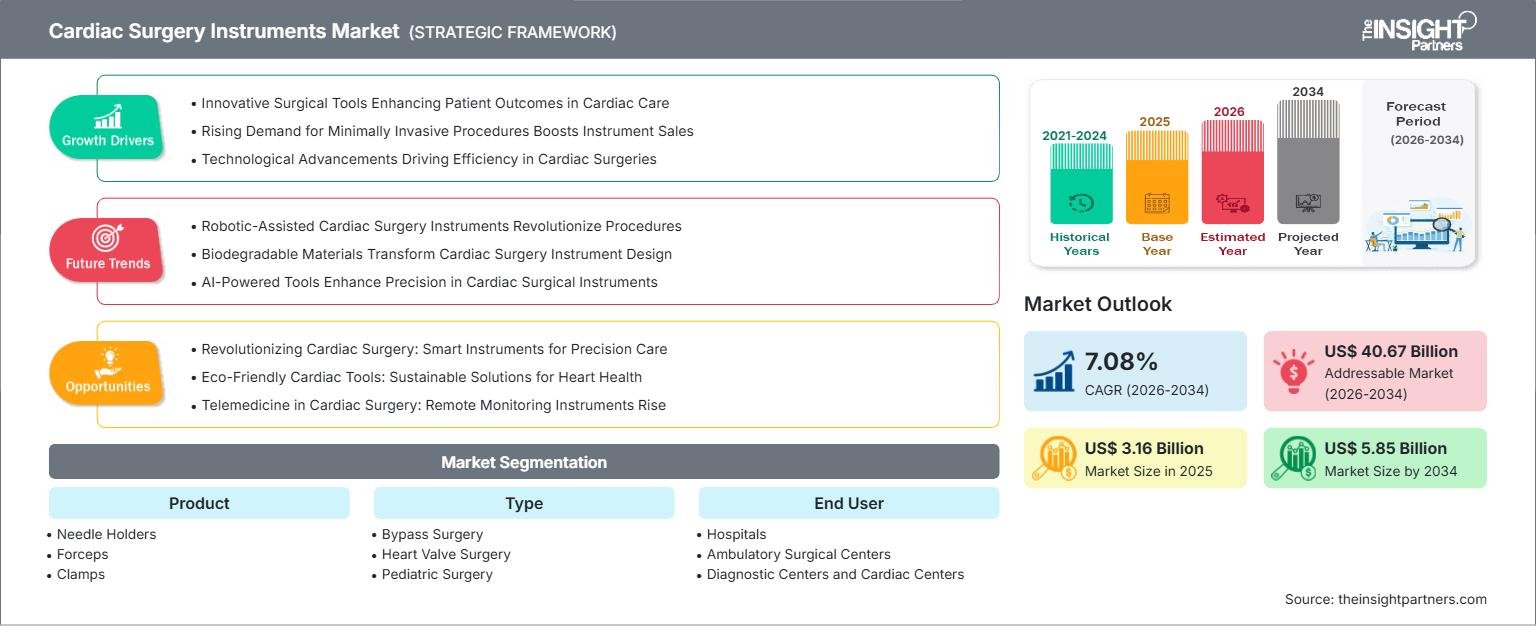
The global Cardiac Surgery Instruments Market is experiencing sustained growth as healthcare systems expand cardiac surgery capacity, replace reusable surgical instruments, and adopt minimally invasive and specialized cardiac procedures. According to the latest analysis, the global cardiac surgery instruments market was valued at US$3.16 billion in 2025 and is projected to reach US$5.85 billion by 2034, registering a CAGR of 7.08% from 2026 to 2034.
Cardiac surgery instruments are essential for procedures involving coronary arteries, heart valves, congenital cardiac conditions, and other cardiovascular disorders requiring surgical intervention. The market encompasses precision instruments such as needle holders, forceps, clamps, and scissors, with hospitals remaining a major purchasing channel.
Download Sample PDF @ https://www.theinsightpartners.com/sample/TIPRE00003097
Growing Cardiovascular Disease Burden Supports Market Expansion
The continuing burden of cardiovascular disease is creating sustained demand for cardiac surgical procedures and associated instruments. The Insight Partners cites World Health Organization data estimating that cardiovascular diseases caused approximately 19.8 million deaths in 2022, representing about 32% of deaths globally.
Although medical therapy and catheter-based interventions can address many cardiovascular conditions, surgical procedures remain important for patients requiring bypass operations, valve procedures, congenital heart interventions, and other complex treatments.
As the number of cardiac procedures increases, healthcare facilities require reliable instruments capable of supporting precise tissue handling, vessel management, dissection, cutting, and suturing.
Minimally Invasive Cardiac Surgery Creates Demand for Specialized Instruments
The transition toward minimally invasive cardiac procedures is reshaping instrument requirements. Smaller access points and restricted operating fields require instruments with longer shafts, slender tips, specialized angles, and articulating mechanisms.
These requirements are encouraging manufacturers to develop procedure-specific instruments that provide surgeons with greater control in confined anatomical spaces. The adoption of minimally invasive techniques is also increasing the importance of specialized instrument sets and surgeon training programs.
As hospitals invest in minimally invasive cardiac programs, demand can extend beyond individual instruments to complete procedure-specific trays, visualization systems, training, maintenance, and technical support.
Replacement of Reusable Instruments Supports Recurring Demand
Reusable cardiac instruments are exposed to repeated cleaning, disinfection, sterilization, mechanical stress, and handling. Over time, these processes can affect cutting edges, jaw alignment, locking mechanisms, and surface condition.
Consequently, hospitals periodically replace or repair instruments to maintain performance and support operating-room efficiency. The market analysis identifies replacement and standardization of reusable instrument inventories as important growth factors.
Hospitals are also increasingly standardizing instrument trays to simplify preparation, sterilization, inventory management, and operating-room workflows. This creates opportunities for manufacturers and service providers offering standardized sets, repairs, sharpening, inspection, and tray optimization.
Instrument Design Advances Improve Surgical Precision
Cardiac instrument design is evolving from conventional stainless-steel sets toward specialized instruments featuring atraumatic jaws, smaller working tips, lightweight materials, and ergonomic handles.
Precision machining and surface treatment are also being used to improve alignment, corrosion resistance, and consistent instrument performance. These characteristics are particularly important during complex cardiac procedures where controlled tissue handling and precise suturing are required.
Ergonomic design is gaining importance as cardiac procedures can be lengthy and technically demanding. Manufacturers are therefore exploring handle configurations, spring tension, working-tip geometry, and lightweight materials that can improve surgeon control.
Needle Holders, Forceps, Clamps, and Scissors Serve Diverse Procedures
By product, the Cardiac Surgery Instruments Market is segmented into needle holders, forceps, clamps, scissors, and others. Each category addresses specific requirements within cardiac surgical workflows.
Needle holders are used for controlled suturing during coronary anastomosis, valve repair, and congenital cardiac procedures. Forceps support tissue handling and dissection, with atraumatic tips and fine profiles becoming particularly relevant to minimally invasive and microsurgical applications.
Clamps support vessel occlusion, graft preparation, and control of the surgical field. Cardiac scissors are designed for controlled cutting and dissection, with curved patterns and fine blades supporting procedures involving sensitive cardiovascular structures.
Bypass Surgery Remains a Major Application
By type, the market covers bypass surgery, heart valve surgery, pediatric surgery, and others. Bypass procedures generate recurring demand for instruments used during vessel handling, graft preparation, anastomosis, and tissue dissection.
Reliable clamps, forceps, scissors, needle holders, and related instruments are important components of standardized bypass procedure sets. Hospitals therefore place emphasis on instrument durability, consistent performance, and compatibility with established surgical workflows.
The recurring nature of cardiac procedures also contributes to replacement demand as instruments undergo repeated sterilization and use.
Heart Valve Procedures Encourage Specialized Instrument Development
Heart valve repair and replacement procedures require precise tissue handling, exposure, cutting, and suturing. The increasing adoption of repair-oriented and minimally invasive approaches is creating demand for specialized instruments designed for restricted access and delicate anatomical structures.
Instrument manufacturers are responding with finer working tips, specialized jaw configurations, longer shafts, and ergonomic designs. These developments allow product portfolios to address increasingly differentiated procedural requirements.
The aging population and continued burden of valvular disease also contribute to demand for cardiac valve procedures, supporting the long-term need for specialized surgical instruments.
Pediatric Cardiac Surgery Requires Precision Instruments
Pediatric cardiac surgery represents another specialized application. Procedures involving children require instruments designed for smaller anatomical structures and delicate tissue.
The market analysis highlights the importance of smaller and atraumatic instruments for pediatric procedures. Demand is concentrated in specialist centers with dedicated congenital cardiac expertise and customized surgical instrument sets.
Manufacturers capable of providing specialized pediatric patterns can therefore address a distinct segment of the broader cardiac surgery instruments industry.
Hospitals Remain the Largest End User
By end user, the market is segmented into hospitals, ambulatory surgical centers, diagnostic centers, and cardiac centers. Hospitals represented the largest end-user segment, accounting for 66% to 70% of market share in 2025, according to the report.
Hospitals require extensive cardiac surgical infrastructure, including operating rooms, intensive care facilities, diagnostic services, perfusion capabilities, and multidisciplinary teams. Their purchasing requirements therefore extend beyond individual instruments to complete standardized trays and lifecycle services.
The market analysis indicates that ambulatory surgical centers represented approximately 13% to 16% of the market in 2025 and are expected to register faster growth as selected cardiovascular procedures move toward efficient outpatient environments.
Digital Traceability Is Emerging as a Key Market Trend
Digital identification and traceability are becoming increasingly relevant to cardiac surgical instrument management. Instrument-level identification can enable hospitals to track tray contents, utilization, maintenance, sterilization cycles, and replacement requirements.
Digital traceability can also help healthcare systems identify underused instruments, improve tray accuracy, and plan preventive maintenance based on actual usage rather than estimated instrument age.
The adoption of digital lifecycle management could gradually change procurement models by connecting instrument purchases with maintenance, repair, utilization reporting, and sterile-processing operations.
Asia Pacific Offers Significant Growth Opportunities
Asia Pacific represented approximately 20% to 23% of global revenue in 2025 and is projected to register an 8.2% to 8.8% CAGR from 2026 to 2034, according to the report. China, Japan, India, South Korea, and Australia are among the major markets in the region.
China benefits from hospital expansion and growing local manufacturing capabilities, while Japan maintains demand for high-precision surgical instruments. India offers significant volume opportunities as private cardiac healthcare networks expand beyond major metropolitan areas.
Hospital investment, medical tourism, insurance coverage, surgeon training, and local manufacturing are expected to contribute to regional market development.
North America Maintains a Strong Market Position
North America accounted for approximately 44% to 47% of global revenue in 2025 and is projected to expand at a 6.6% to 7.0% CAGR through 2034. Established cardiothoracic infrastructure, minimally invasive cardiac surgery, and replacement of reusable instrument inventories support regional demand.
The US represented approximately 86% to 89% of North American revenue in 2025. High-volume cardiac centers and hospitals with expertise in conventional and minimally invasive procedures contribute to demand for specialized cardiac instruments.
Procurement decisions increasingly consider durability, sterilization compatibility, traceability, ergonomic design, and standardized instrument sets.
Europe Continues to Support Market Development
Europe represented approximately 25% to 28% of global sales in 2025 and is projected to register a 6.2% to 6.7% CAGR through 2034. Germany, the UK, France, Italy, and Spain remain important procurement markets.
The region’s established healthcare infrastructure and cardiac surgery capabilities provide a stable base for instrument demand. Replacement of legacy inventories and adoption of minimally invasive approaches are also supporting market development.
European procurement increasingly emphasizes documented quality, traceability, reprocessing requirements, and lifecycle management.
Manufacturers Explore Lifecycle Service Models
The competitive environment is increasingly extending beyond the sale of individual instruments. Hospitals are seeking solutions that can combine instrument supply with inspection, sharpening, repair, tray rationalization, inventory management, and replacement services.
Lifecycle service models can help healthcare systems manage complex inventories and reduce operational inefficiencies associated with inconsistent instrument sets. The market analysis identifies these services as an opportunity for manufacturers and distributors with technical support and logistics capabilities.
Such models may become particularly relevant for multisite hospital networks seeking standardized cardiac procedure trays across multiple facilities.
Get Full Copy @ https://www.theinsightpartners.com/buy/TIPRE00003097
Competitive Landscape
The Cardiac Surgery Instruments Market includes established medical device manufacturers and specialized surgical instrument companies. Key companies profiled in the report include Becton, Dickinson and Company, Millennium Surgical Corp., Sklar Instruments, Inc., B. Braun SE, Teleflex Incorporated, Symmetry Surgical Inc., Scanlan International, Inc., Wexler Surgical, Inc., STILLE AB, and Surtex Instruments Limited.
Competition is influenced by instrument quality, precision engineering, durability, procedure-specific product portfolios, customization capabilities, distribution networks, repair services, and surgeon relationships.
Specialized manufacturers continue to compete through customized patterns and microsurgical instruments, while larger companies benefit from broader distribution capabilities and hospital contracts.
Recent Industry Developments
The report identifies several developments illustrating the broader evolution of cardiac and surgical technology. In September 2025, B. Braun SE acquired True Digital Surgery, bringing its technology team into the Aesculap surgical division and supporting the development of digital visualization capabilities.
In April 2025, Becton, Dickinson and Company launched the HemoSphere Alta advanced hemodynamic monitoring platform with AI-led predictive algorithms. In February 2025, Teleflex announced an agreement to acquire substantially all of BIOTRONIK’s vascular intervention business.
These developments illustrate the increasing convergence of surgical instruments, cardiovascular technologies, digital visualization, monitoring, and minimally invasive care.
Future Outlook
The global Cardiac Surgery Instruments Market is projected to increase from US$3.16 billion in 2025 to US$5.85 billion by 2034, registering a 7.08% CAGR from 2026 to 2034.
Market development will be influenced by the continuing burden of cardiovascular disease, expansion of cardiac surgery capacity, adoption of minimally invasive procedures, replacement of reusable instruments, and demand for specialized surgical tools.
Future opportunities are expected to emerge from digitally traceable instrument lifecycles, procedure-specific ergonomics, micro-instrumentation, robotic and minimally invasive cardiac programs, regional manufacturing, and lifecycle service models.
The Insight Partners’ Cardiac Surgery Instruments Market report provides detailed analysis of market size, growth, product segmentation, surgical procedure types, end users, regional markets, market drivers, trends, opportunities, and competitive dynamics. The study uses 2025 as the base year, includes historical data from 2021 to 2024, and provides forecasts through 2034.
For detailed market insights, regional analysis, competitive intelligence, and forecast data, access the full Cardiac Surgery Instruments Market report from The Insight Partners.
About Us
The Insight Partners, we provide comprehensive analysis and insights into market trends that empower businesses to make informed decisions. Our reports are designed to equip stakeholders with the necessary information to navigate the complexities of various industries, including healthcare, technology, and finance. We are dedicated to delivering high-quality research that enables our clients to achieve their strategic objectives.
Contact Us:
Contact Person: Ankit Mathur
E-mail: ankit.mathur@theinsightpartners.com
Phone: +1-646-491-9876
Also Available in : Korean German Japanese French Chinese Italian Spanish