Artificial Ventilation and Anesthesia Masks Market to Reach US$4.71 Billion by 2034 as Respiratory Care Demand Expands
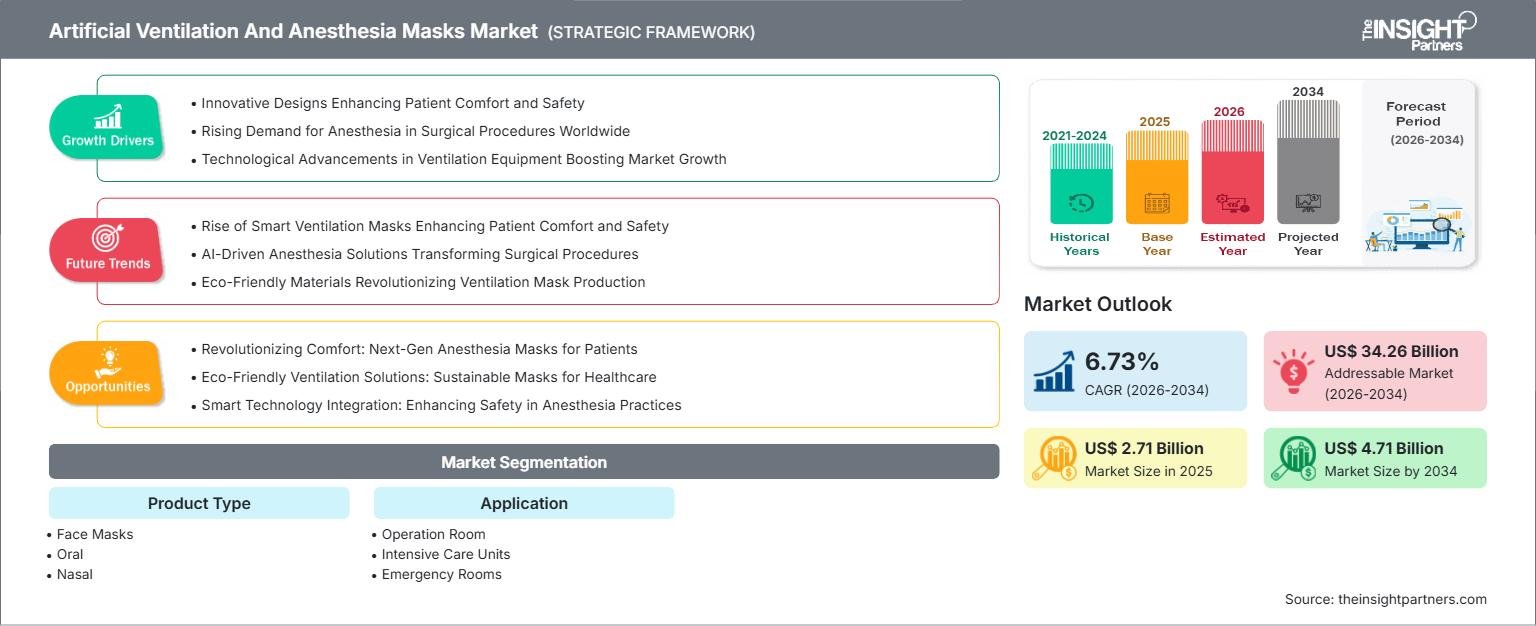
The global Artificial Ventilation and Anesthesia Masks Market is experiencing steady expansion as healthcare systems increase their capacity for respiratory care, critical care ventilation, anesthesia procedures, emergency respiratory support, and home-based respiratory treatment. According to the latest market analysis, the global market was valued at US$2.71 billion in 2025 and is projected to reach US$4.71 billion by 2034, registering a CAGR of 6.73% from 2026 to 2034.
Artificial ventilation and anesthesia masks serve as essential interfaces between patients and respiratory or anesthesia systems. These products are used across operating rooms, intensive care units, emergency departments, and home-care environments. Increasing procedure volumes, the prevalence of respiratory diseases, replacement of aging respiratory equipment, and continued innovation in mask design are contributing to market expansion.
Download Sample PDF @ https://www.theinsightpartners.com/sample/TIPRE00021556
Growing Respiratory Disease Burden Supports Market Expansion
The increasing burden of respiratory diseases is one of the fundamental factors supporting demand for artificial ventilation and respiratory interfaces. Chronic respiratory conditions can require long-term monitoring and assisted ventilation, while acute respiratory complications can create demand for immediate respiratory support in hospital and emergency settings.
The growing need for respiratory care is consequently expanding the utilization of ventilation interfaces across healthcare environments. According to the market analysis, the combined burden of asthma and chronic obstructive pulmonary disease represents a substantial global patient population, creating continued requirements for respiratory management and associated equipment.
This demand extends across both acute and chronic care. Hospitals require masks for critical-care and emergency applications, while home-care providers increasingly use respiratory interfaces for patients receiving longer-term ventilation outside traditional healthcare facilities.
Expansion of Intensive Care and Anesthesia Services Drives Demand
Intensive care units and operating rooms represent major application environments for artificial ventilation and anesthesia masks. Increasing hospital capacity and the continued need for surgical and critical-care services support recurring demand for respiratory interfaces.
In operating rooms, anesthesia masks must provide reliable connections to breathing circuits while maintaining an effective seal and patient comfort. In intensive care settings, masks may be used for noninvasive ventilation and other forms of respiratory support where leakage control and fit are particularly important.
The continued development of healthcare infrastructure and expansion of critical-care capacity are therefore expected to remain important contributors to market growth through 2034.
Shift Toward Noninvasive Ventilation Creates New Opportunities
The increasing use of noninvasive ventilation is creating opportunities for manufacturers of specialized respiratory interfaces. Noninvasive approaches can provide respiratory support without requiring invasive airway procedures in appropriate clinical situations.
Mask design is particularly important in noninvasive ventilation because an effective seal is necessary to deliver therapy while limiting air leakage. At the same time, excessive pressure or poor fit can affect patient comfort and adherence.
Manufacturers are consequently focusing on anatomical fit, cushion design, leakage reduction, dead-space management, and compatibility with different ventilation systems. These developments are influencing product innovation across both hospital and home-care applications.
Home Respiratory Care Emerges as a High-Growth Application
The movement of selected respiratory therapies from hospitals to homes is creating an expanding opportunity for artificial ventilation and anesthesia mask manufacturers. The latest market analysis identifies Home Care as a high-growth segment, supported by the increasing decentralization of respiratory management.
Home-care interfaces must satisfy requirements that can differ from those of acute-care products. Patients may need to use masks for extended periods, making comfort, fit, ease of cleaning, portability, and durability important considerations.
The expansion of home respiratory treatment is also creating opportunities for recurring replacement demand. As patients use respiratory interfaces over extended periods, replacement components and consumables can contribute to ongoing market demand.
Anatomical Design and Patient Comfort Shape Product Development
Technological development in the market is moving beyond simple molded mask designs toward more anatomically oriented interfaces. Manufacturers are increasingly considering facial anatomy, sealing characteristics, patient comfort, dead-space control, and compatibility with ventilation equipment during product development.
Silicone, PVC, and other medical-grade plastics continue to serve different application requirements. Cushion and headgear designs are also evolving to improve fit and reduce pressure points during prolonged use.
These developments are particularly relevant to home ventilation, where patient comfort can influence continued use. In hospitals, ease of application, infection-control requirements, and compatibility with existing respiratory equipment are also important procurement considerations.
Infection Control Influences Purchasing Decisions
Infection prevention remains an important consideration in the selection and use of respiratory interfaces. Hospitals and other healthcare providers increasingly evaluate products based on disposability, cleaning requirements, replaceable components, and compatibility with established infection-control procedures.
Single-use products can offer operational advantages in settings where rapid turnover and infection-control protocols are important. At the same time, reusable systems can provide different economic and operational benefits depending on the clinical environment.
Manufacturers are therefore developing products around varying requirements for disposability, cleaning, sterilization, and component replacement. Infection-control considerations are expected to remain an important factor shaping purchasing decisions across the market.
Face Masks Maintain a Dominant Market Position
By product type, the Artificial Ventilation and Anesthesia Masks Market is segmented into face masks, oral interfaces, and nasal interfaces. Face masks represented the largest product segment in 2025, accounting for approximately 58% to 63% of the market, and are projected to expand at a 6.4% to 7.0% CAGR through 2034.
Face masks have broad applicability across anesthesia and ventilation procedures, making them an important product category for hospitals and other healthcare facilities. Their ability to cover the mouth and nose allows them to serve multiple respiratory and anesthesia applications.
Oral and nasal interfaces provide alternatives for specific patient requirements. Nasal interfaces are particularly relevant to home respiratory care, where reduced facial coverage and long-duration comfort can influence product selection.
Operating Rooms and Intensive Care Units Remain Key Applications
The market is segmented by application into Operation Room, Intensive Care Units, Emergency Rooms, and Home Care. Operating rooms and intensive care units represent significant areas of demand because of their requirements for anesthesia delivery and respiratory support.
Operating-room applications require masks that can be rapidly fitted and connected to anesthesia breathing circuits. Reliability, patient comfort, sealing performance, and compatibility with anesthesia systems are important considerations.
In intensive care units, masks may be required for sustained noninvasive ventilation. Product selection can therefore depend on leakage control, sizing, patient anatomy, durability, and compatibility with ventilators.
Emergency rooms create demand for interfaces that can be deployed quickly during acute respiratory situations. Home care, meanwhile, is becoming increasingly important as respiratory treatment becomes more decentralized.
Asia Pacific Offers Significant Growth Potential
Asia Pacific is emerging as an important growth region for the Artificial Ventilation and Anesthesia Masks Market. The region accounted for approximately 21% to 25% of the global market in 2025 and is projected to register a 7.4% to 8.2% CAGR from 2026 to 2034. China, Japan, South Korea, India, and Australia are among the key markets contributing to regional demand.
Investment in hospitals and respiratory-care infrastructure is increasing across several Asia Pacific markets. Growing healthcare capacity and improving access to respiratory treatment are supporting demand for ventilation and anesthesia interfaces.
India and China offer opportunities associated with healthcare infrastructure expansion and high patient volumes, while Japan and Australia have established healthcare systems with emphasis on product quality and integration into clinical practice.
North America Maintains a Strong Market Position
North America accounted for approximately 38% to 42% of the market in 2025 and is projected to expand at a 6.2% to 6.8% CAGR between 2026 and 2034. Established critical-care infrastructure, respiratory therapy utilization, home-care adoption, and replacement of aging respiratory interfaces contribute to the region’s market position.
The US represents a major portion of the North American market. Demand is supported by hospital networks, critical-care facilities, ambulatory procedures, and established home respiratory service providers.
Healthcare providers in the region increasingly consider infection control, fit, disposability, device compatibility, and total lifecycle economics when selecting respiratory interfaces.
Europe Continues to Support Market Development
Europe represented approximately 27% to 31% of the market in 2025 and is expected to register a 6.0% to 6.6% CAGR through 2034. Germany, the UK, France, Italy, and Spain represent important markets within the region.
The region’s established hospital infrastructure and anesthesia services support consistent demand for respiratory and anesthesia masks. Manufacturers are also responding to requirements related to infection control, product quality, patient comfort, and compatibility with respiratory systems.
Get Full Copy @ https://www.theinsightpartners.com/buy/TIPRE00021556
Competitive Landscape
The competitive landscape includes diversified medical technology companies as well as specialists focused on respiratory care, anesthesia, and airway management. Companies profiled in the market analysis include Becton, Dickinson and Company, Air Liquide Healthcare, Koninklijke Philips N.V., Fisher & Paykel Healthcare Corporation Limited, ResMed Inc., Ambu A/S, Acutronic Medical Systems AG, GaleMed Corporation, HOFFRICHTER GmbH, Drägerwerk AG & Co. KGaA, Armstrong Medical Limited, Flexicare Medical Limited, Hsneir, HYZ Medical Equipment Limited, VBM Medizintechnik GmbH, BioMatrix Healthcare Private Limited, and Comepa Industries.
Competition is influenced by product portfolios, clinical application coverage, manufacturing flexibility, geographic distribution, and the ability to provide different mask configurations. Companies are also focusing on compatibility between masks and ventilation systems and expanding single-use product portfolios.
Focus on Regulatory Compliance and Manufacturing Quality
Regulatory compliance is an important consideration for manufacturers operating in the artificial ventilation and anesthesia masks industry. Products must address requirements associated with biocompatibility, infection control, traceability, manufacturing processes, and clinical safety.
Manufacturers that can maintain consistent material quality and reliable production processes while offering a broad range of configurations may be better positioned to address diverse procurement requirements.
The supply chain spans medical-grade polymer and silicone suppliers, molding and assembly operations, sterilization, packaging, distribution, and healthcare procurement. This creates opportunities for companies with efficient and flexible manufacturing capabilities.
Future Outlook
The global Artificial Ventilation and Anesthesia Masks Market is projected to increase from US$2.71 billion in 2025 to US$4.71 billion by 2034, registering a 6.73% CAGR from 2026 to 2034. Market development will be influenced by the rising burden of respiratory conditions, expansion of critical-care infrastructure, increasing use of noninvasive ventilation, growth in home respiratory treatment, equipment replacement, and continued product innovation.
Future product development is expected to focus increasingly on patient comfort, anatomical fit, leakage reduction, infection control, interoperability, and ease of use. The expansion of home respiratory care and healthcare infrastructure in Asia Pacific and selected Middle Eastern markets could further broaden the addressable market.
The Insight Partners’ Artificial Ventilation and Anesthesia Masks Market report provides detailed analysis of market size, growth, product types, applications, regional markets, market drivers, trends, opportunities, and competitive dynamics. The latest study uses 2025 as the base year, includes historical data from 2021 to 2024, and provides forecasts through 2034.
About Us
The Insight Partners, we provide comprehensive analysis and insights into market trends that empower businesses to make informed decisions. Our reports are designed to equip stakeholders with the necessary information to navigate the complexities of various industries, including healthcare, technology, and finance. We are dedicated to delivering high-quality research that enables our clients to achieve their strategic objectives.
Contact Us:
Contact Person: Ankit Mathur
E-mail: ankit.mathur@theinsightpartners.com
Phone: +1-646-491-9876
Also Available in :Korean German Japanese French Chinese Italian Spanish