Veterinary Regenerative Wound Care Market Size & Share Report, 2033
Veterinary Regenerative Wound Care Market Summary
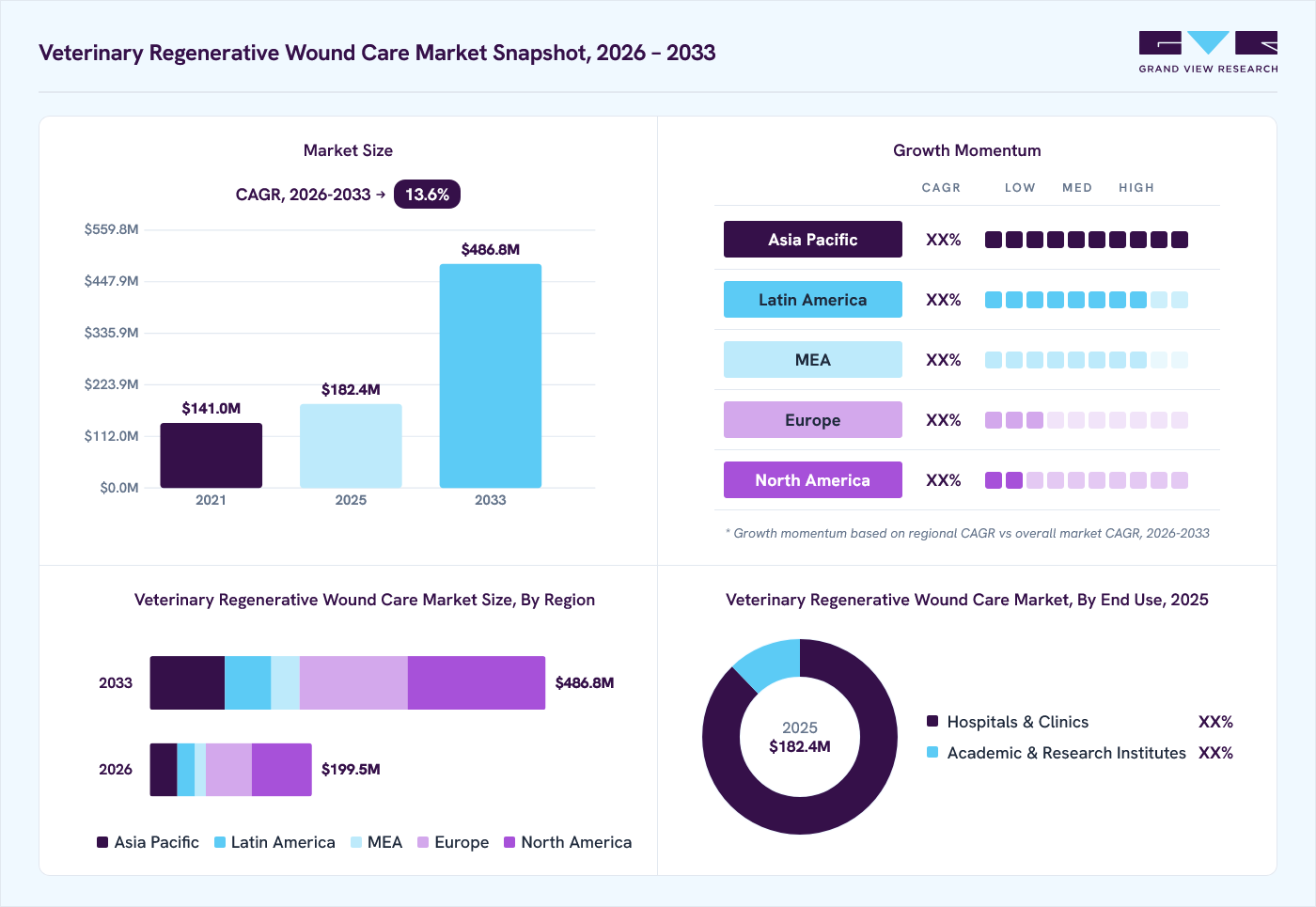
The global veterinary regenerative wound care market size was valued at USD 182.4 million in 2025 and is projected to grow from USD 199.5 million in 2026 to USD 486.8 million by 2033, at a CAGR of 13.6% from 2026 to 2033. The market in North America dominated with a revenue share of 37.3% in 2025. The market growth is driven by increasing R&D activities in veterinary regenerative medicine, rising prevalence of chronic and complex animal wounds, growing adoption of advanced biological wound-care products, expansion of specialty veterinary hospitals, and the adoption of regenerative therapies.
Market Dynamics
The veterinary regenerative wound care market growth is driven by increasing incidence of traumatic, surgical, chronic, and non-healing wounds in companion and equine animals, alongside rising veterinary expenditure and growing demand for advanced tissue-repair solutions. Besides this, the expansion of platelet-rich plasma (PRP), stem cell therapies, amniotic tissue products, and regenerative wound matrices is increasing treatment options for complex wounds. However, high therapy costs, limited reimbursement, inconsistent clinical protocols, specialized equipment requirements, and variability in treatment outcomes constrain adoption, particularly among smaller veterinary practices.
In addition, technological development is progressing through cell isolation systems, extracellular matrix scaffolds, acellular amniotic allografts, fish-skin matrices, collagen-based products, and secretome-derived formulations. Some of the innovations are focused on improving tissue regeneration, wound closure, product handling, storage stability, and application efficiency. Furthermore, combination therapies integrating biological matrices with cells, growth factors, or platelet concentrates are gaining research attention. In addition, greater clinical validation and standardized treatment protocols are expected to support broader utilization across veterinary hospitals and specialty clinics.
Request Free Sample Report: Veterinary Regenerative Wound Care Market
Product Insights
The blood-derived regenerative products segment dominated the veterinary regenerative wound care industry, accounting for the largest revenue share of 36.3% in 2025. This segment comprises platelet-rich plasma, autologous conditioned serum, interleukin-1 receptor antagonist protein, and autologous protein solution, with platelet-rich plasma (PRP) as a major component because it provides concentrated growth factors that support angiogenesis, collagen formation, cell proliferation, and tissue remodeling. This segment’s growth is due to its established clinical use, relatively accessible preparation procedures, and broad applicability across wound types. Besides this, veterinary applications include chronic wounds, cutaneous ulcers, burns, corneal injuries, and traumatic wounds, particularly in dogs and horses. In addition, autologous preparation reduces dependence on external biological materials and supports point-of-care use. In addition, growing familiarity among veterinarians with blood-derived therapies and the availability of commercial preparation systems are supporting utilization across hospitals and specialty practices.
Application Insights
The chronic and non-healing wounds segment dominated the veterinary regenerative wound care market, accounting for the largest revenue share of 32.4% in 2025, and is expected to grow at the fastest CAGR over the forecast period, because these wounds frequently require prolonged treatment and may respond inadequately to conventional wound management. Additionally, persistent inflammation, infection, tissue damage, dehiscence, and underlying disorders can delay healing and increase the frequency of treatment. In addition, regenerative approaches such as PRP, stem cell therapies, extracellular vesicle products, amniotic tissues, and advanced wound matrices are being investigated to stimulate tissue repair and restore normal healing. Similarly, high clinical need and ongoing product development are supporting rapid segment expansion.
Regional Insights
The North America veterinary regenerative wound care market held the largest global revenue share of 37.3% in 2025, supported by advanced veterinary infrastructure, high companion animal healthcare expenditure, and established adoption of regenerative medicine. The U.S. was the leading contributor, with PRP, stem-cell therapies, amniotic products, and biological wound matrices gaining use in specialty veterinary settings. FDA has established a regulatory framework for animal cells, tissues, and cell- and tissue-based products, including stem cells, PRP, and amnion, supporting development and commercialization pathways.
Key Veterinary Regenerative Wound Care Company Insights
The veterinary regenerative wound care market remains fragmented, with established animal-health companies competing alongside specialized regenerative medicine and biotechnology firms. Zoetis, Dechra, Integra LifeSciences, Kerecis, Arthrex, VetStem, AniCell, Vetrix, Vetherapy, and Animalia Biogenesis maintain differentiated portfolios spanning PRP, stem-cell therapies, amniotic products, biological matrices, and advanced wound-healing technologies. Established companies benefit from broader distribution and veterinary relationships, while specialized players compete through proprietary regenerative platforms.
Key Veterinary Regenerative Wound Care Companies
The following key companies have been profiled for this study of the veterinary regenerative wound care market.
· Zoetis Services LLC
· Animalia Biogenesis
· FatStem Laboratories
· Vetherapy
· AniCell
· Integra LifeSciences Corporation
· Vetrix
· VetStem, Inc.
· Cell Therapy Sciences
· Amniovet
· Kerecis
· Dechra
· CelluHeal
· Enovis (Companion Animal Health)
· Arthrex, Inc.
· Rebound PRP (Vetrius Animal Health)
· Medrego
Global Veterinary Regenerative Wound Care Market Report Segmentation
This report forecasts revenue growth at the global, regional, and country levels and provides an analysis of the latest industry trends in each of the sub-segments from 2021 to 2033. For this study, Grand View Research has segmented the global veterinary regenerative wound care market report based on product, animal, application, delivery mode, distribution channel, end use, and region:
· Product Outlook (Revenue, USD Million, 2021 – 2033)
· Blood-Derived Regenerative Products
o Platelet-Rich Plasma
o Autologous Conditioned Serum
o Interleukin-1 Receptor Antagonist Protein
o Autologous Protein Solution
· Cell-Based Regenerative Products
o Autologous Stem Cell Therapy
o Stem Cell Processing & Isolation Systems
· Regenerative Tissue Products
· Regenerative Wound Matrices & Skin Substitutes
· Animal Outlook (Revenue, USD Million, 2021 – 2033)
· Canine
· Feline
· Equine
· Others
· Application Outlook (Revenue, USD Million, 2021 – 2033)
· Traumatic Wounds
· Surgical Wounds
· Chronic & Non-Healing Wounds
· Burns & Thermal Injuries
· Corneal & Ocular Surface Wounds
· Soft Tissue Defects & Reconstructive Applications
· Delivery Mode Outlook (Revenue, USD Million, 2021 – 2033)
· Injectable
· Topical
· Distribution Channel Outlook (Revenue, USD Million, 2021 – 2033)
· Direct Sales
· Veterinary Distributors
· Online / E-commerce
· End Use Outlook (Revenue, USD Million, 2021 – 2033)
· Hospitals & Clinics
· Academic & Research Institutes
· Regional Outlook (Revenue, USD Million, 2021 – 2033)
· North America
o U.S.
o Canada
o Mexico
· Europe
o UK
o Germany
o France
o Italy
o Spain
o Denmark
o Sweden
o Norway
· Asia Pacific
o Japan
o China
o India
o Australia
o Thailand
o South Korea
· Latin America
o Brazil
o Argentina
· Middle East & Africa
o South Africa
o UAE
o Saudi Arabia
o Kuwait
o Qatar
o Oman