Circular Economy Chemicals Market (2026 – 2033)
Circular Economy Chemicals Market Summary
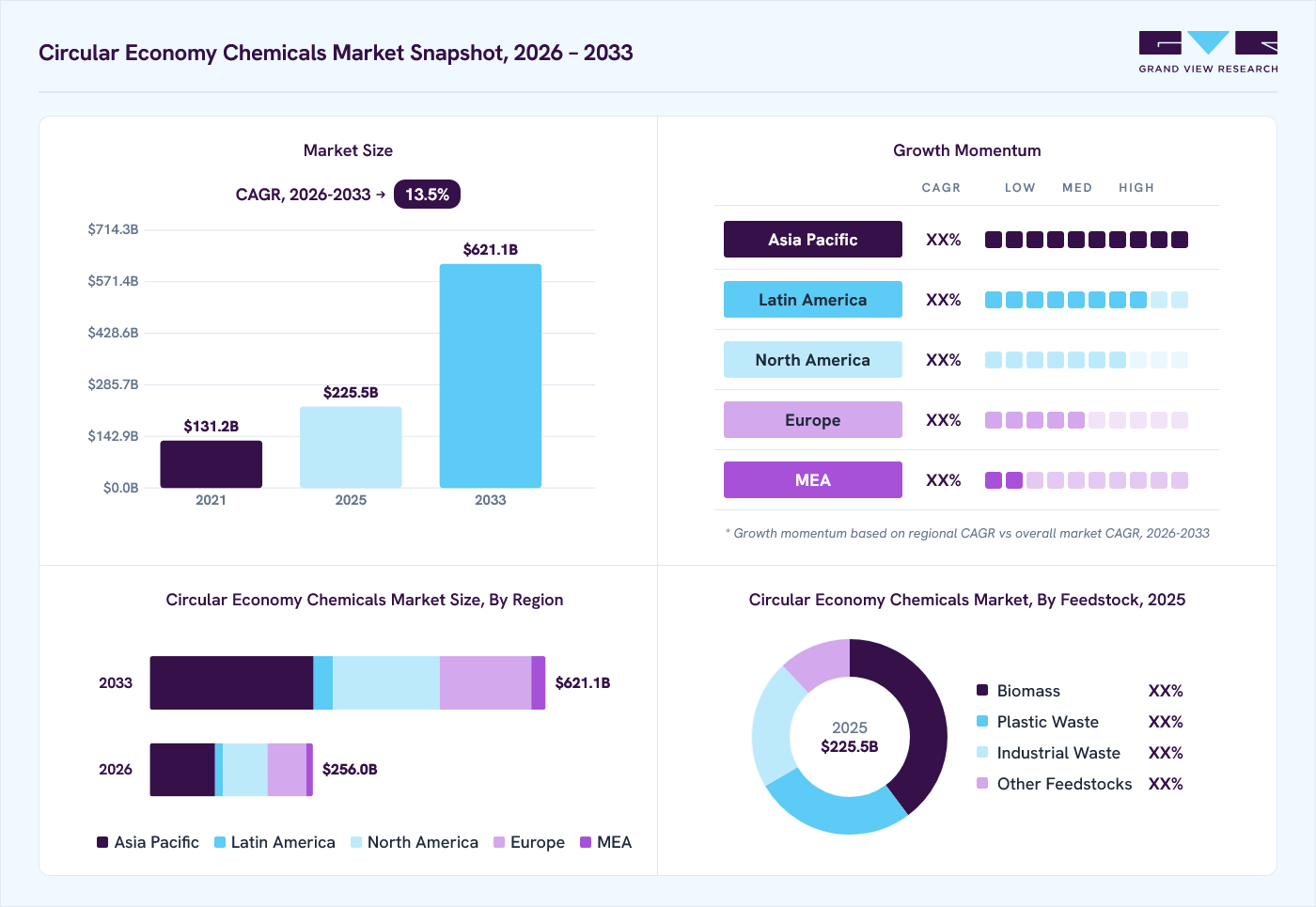
The global circular economy chemicals market size was valued at USD 225.5 billion in 2025 and is projected to grow from USD 256.0 billion in 2026 to reach USD 621.1 billion by 2033, at a CAGR of 13.5% from 2026 to 2033. Asia Pacific dominated the market, accounting for the largest revenue share of 39.8% in 2025. The market growth is driven by increasing adoption of bio based and recycled chemicals, growing utilization of waste derived feedstocks, and expanding demand for circular chemical solutions across packaging, automotive, building and construction, and chemical and petrochemical industries.
Key Market Trends & Insights
- By chemical: The bio based chemicals segment held the largest revenue share of 35.0% in 2025.
- By feedstock: The biomass segment held the largest revenue share of 39.8% in 2025.
- By end use: The packaging segment led the market, accounted for the largest revenue share of 22.7% in 2025.
Regional Highlights
- Largest Region: Asia Pacific (39.8% revenue share, 2025)
- By country: China dominated the APAC market in 2025
Market Size & Forecast
- Market size in 2025: USD 225.5 billion
- Estimated market size in 2026: USD 256.0 billion
- Projected market size by 2033: USD 621.1 billion
- CAGR (2026-2033): 13.5%
Growing environmental concerns and increasing emphasis on resource efficiency are driving the adoption of circular economy chemicals across multiple industries. Applications across packaging, automotive, building and construction, chemical and petrochemicals, consumer goods, electronics, healthcare and pharmaceuticals, and paper and textile are gaining traction as manufacturers seek to reduce waste, improve resource utilization, and integrate recycled, bio based, and carbon derived chemical solutions into their operations.
Market Dynamics
The global circular economy chemicals market is supported by increasing demand for sustainable chemical solutions across packaging, automotive, building and construction, chemical and petrochemicals, consumer goods, electronics, healthcare and pharmaceuticals, and paper and textile applications. Rising adoption of recycled and bio based chemicals, growing utilization of waste derived feedstocks, and increasing emphasis on resource efficiency are encouraging end users to integrate circular chemical solutions into their operations. Advancements in chemical recovery, recycling, biomass utilization, and carbon utilization are improving the efficiency and scalability of circular chemical production, enabling the development of solutions tailored to diverse industrial requirements. In addition, growing regulatory focus on waste reduction, resource conservation, and environmental sustainability is creating opportunities for manufacturers to expand their circular chemical portfolios.
The increasing focus on resource efficiency, waste reduction, and sustainable production practices is a primary factor driving the global circular economy chemicals market. Industries are increasingly adopting bio based, recycled, and carbon utilization chemicals to reduce dependence on conventional raw materials and improve resource utilization across packaging, automotive, building and construction, and chemical and petrochemical applications. Growing availability of biomass, plastic waste, and industrial waste as alternative feedstocks is further accelerating the transition toward circular chemical production. In addition, rising adoption across consumer goods, electronics, healthcare and pharmaceuticals, and paper and textile industries is expanding the application potential of circular economy chemicals.
In response to expanding sustainability requirements, manufacturers are increasing investments in product innovation, production capacity, and circular chemical technologies. Companies are developing chemical solutions based on recycled materials, renewable biomass, waste derived feedstocks, and carbon utilization pathways, enabling end users to improve material efficiency while supporting waste reduction objectives. Continuous advancements in circular production processes, coupled with growing demand for sustainable chemical solutions, are expected to support long term market growth and strengthen the adoption of circular economy chemicals across global industries.
Market Concentration & Characteristics
The global circular economy chemicals market is moderately consolidated, with competition centered on product portfolio, circular production capabilities, feedstock access, technology development, distribution networks, and long term partnerships with end use industries. Leading companies are expanding their bio based, recycled, and carbon utilization chemical portfolios to address growing demand across packaging, automotive, building and construction, consumer goods, electronics, and other applications. Investments in production capacity expansion, circular technology development, product innovation, feedstock diversification, and sustainability capabilities have become key competitive differentiators.