Gardening Equipment Market (2026 – 2033)
Gardening Equipment Market Summary
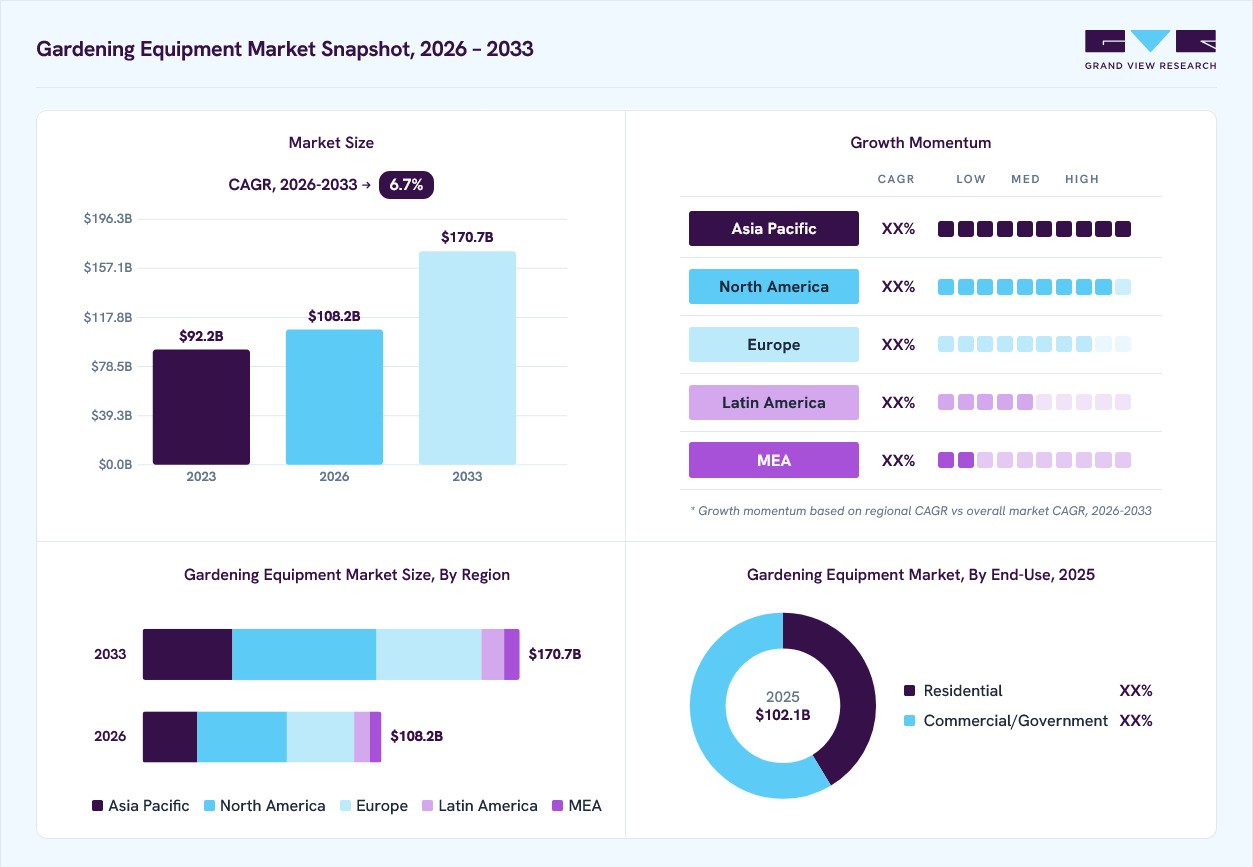
The global gardening equipment market size was valued at USD 102.1 billion in 2025 and is projected to grow from USD 108.2 billion in 2026 to USD 170.7 billion by 2033, growing at a CAGR of 6.7% from 2026 to 2033. North America dominated the global market with the largest revenue share of 37.4% in 2025. In addition, higher disposable income and a decline in home prices have led to an increase in real estate developments in all economies.
Request a free sample copy or view report summary: https://www.grandviewresearch.com/industry-analysis/gardening-equipment-market/request/rs1
Key Market Trends & Insights
- By product: Lawn mowers segment dominated the market, with a revenue share of 37.5% in 2025
- By sales channel: Home centers segment held the largest market share of 37.1% in 2025
- By end use: Commercial/government segment held the largest market share of 58.7% in 2025.
Regional Highlights
- Largest regional market: North America (37.4% revenue share, 2025)
- Fastest-growing regional market: Asia Pacific (highest CAGR, 2026-2033)
- By country: The U.S. held the largest market share in 2025.
Market Size & Forecast
- Market size in 2025: USD 102.1 Billion
- Estimated market size in 2026: USD 108.2 Billion
- Projected market size by 2033: USD 170.7 Billion
- CAGR (2026-2033): 6.7%
Over the projected period, this trend is anticipated to fuel demand for gardening equipment. Another trend among millennials to turn outside spaces into relaxing spaces with lounges, entertainment areas, outdoor kitchens, and party spots is also expected to augment the gardening equipment industry growth.
Due to the COVID-19 epidemic, the gardening equipment industry saw a modest decline in early 2020. Lower customer demand for garden and tool equipment and the temporary suspension of store outlets are both blamed for the gardening equipment industry’s sluggish growth. The impact of the epidemic has been mitigated, though, by a favorable climate, a longer growing season, and gardeners’ preference for online shopping. The rules encouraging people to stay at home to prevent the spread of COVID-19 have also urged people to spend a lot of time at home, propelling the demand for gardening equipment.
In the first half of 2021, the sudden surge in demand for battery-based tools, including augers, chainsaws, edgers, and trimmers, did not keep up with the production rate. In addition, OEMs worldwide were experiencing a lack of lithium-ion batteries and semiconductors, which further hindered production. Furthermore, it is anticipated that the Russian-Ukrainian conflict will reduce demand for gardening equipment powered by gas due to disrupted supply chain operations, raising raw material prices and driving up oil prices. Consequently, OEMs may raise the price of their products. These macroeconomic determinants are anticipated to decrease, but they are likely only temporary.
Over the forecast period, it is anticipated that increasing adoption of DIY landscape projects will propel market expansion. DIY projects are activities made for people from all walks of life, including enthusiasts, hobbyists, and homeowners undertaking projects like repairs and remodeling that are typically classified as home improvement. The gardening equipment industry is expected to do well as a result of the rising single-family construction investment and a growing interest in Do-It-Yourself (DIY) projects. Given the increasing popularity of DIY projects, garden equipment OEMs are introducing a product lineup that is inexpensive and user-friendly for household use. Garden trowels, spades, shovels, pruners, and other gardening hand tools are required for home renovation projects, and these tools come in a wide variety and have a wide range of applications.
Throughout the forecast period, the gardening equipment industry development is anticipated to be aided by the growing popularity of battery-powered ergonomically design tools. Gardening is a laborious task involving digging up the earth, pulling weeds, and trimming shrubs, repetitive stress through these activities can result in chronic back pain. Using garden equipment without proper knowledge, particularly by senior citizens, can cause undue strain, leading to inflammation or pain in many body areas, including the knees, wrists, and back. The demand for ergonomic designing tools among professional architects & landscapers, hobbyists, and enthusiasts is anticipated to help the market grow over the coming years.