Waste To Energy Market (2026 – 2033)
Waste To Energy Market Summary
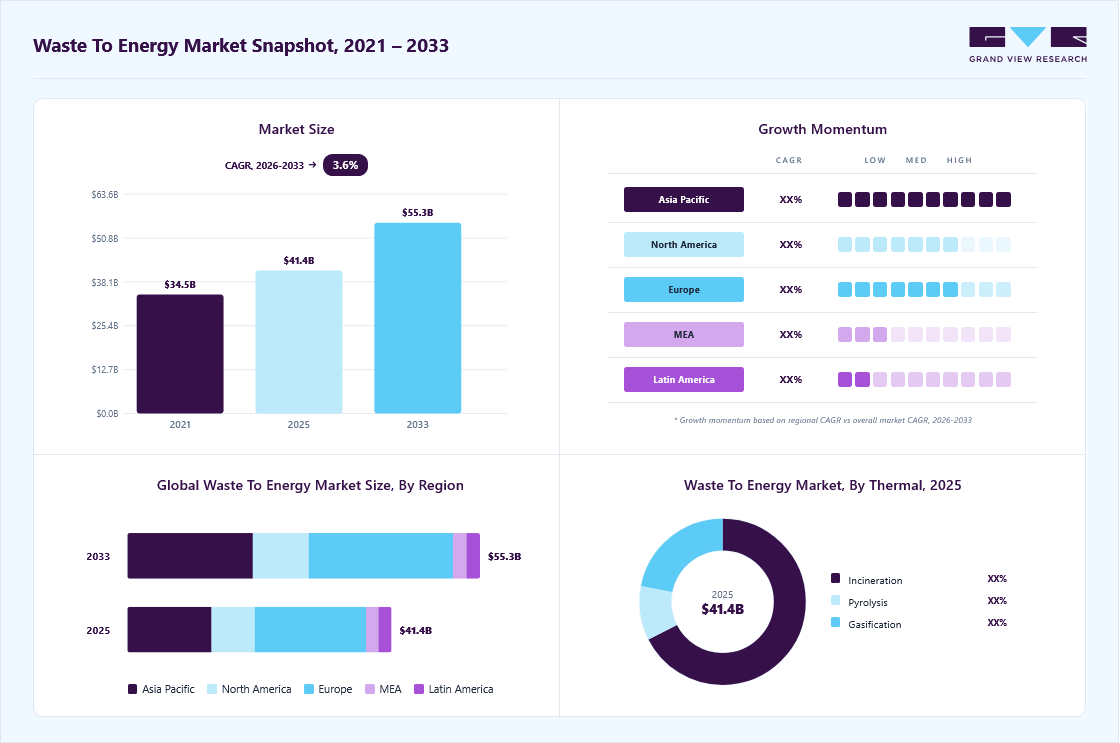
The global waste to energy market size was valued at USD 41.4 billion in 2025 and is projected to grow from USD 43.1 billion in 2026 to USD 55.3 billion by 2033, at a CAGR of 3.6% from 2026 to 2033. The Europe held the largest share of 42.1% of the global market in 2025. The market is witnessing a strong growth due to the rising volume of municipal solid waste (MSW) because of rapid urbanization and population growth, creating an urgent need for efficient waste management solutions.
Request a free sample copy or view report summary: https://www.grandviewresearch.com/industry-analysis/waste-to-energy-technology-industry/request/rs1
Key Market Trends & Insights
- By technology: Thermal segment held the largest market share of 80.4% in 2025.
- By technology: Biological segment is expected to witness the fastest growth, registering a CAGR of 5.8%.
Regional Highlights
- Largest regional market: Europe (42.1% revenue share, 2025)
- Fastest-growing regional market: Asia Pacific (highest CAGR, 2026-2033)
- By country: Germany is a major contributor to the market.
Market Size & Forecast
- Market size in 2025: USD 41.4 Billion
- Estimated market size in 2026: USD 43.1 Billion
- Projected market size by 2033: USD 55.3 Billion
- CAGR (2026-2033): 3.6%
Increasing demand for cleaner and more sustainable energy sources, along with efforts to reduce landfill usage and greenhouse gas emissions, is further supporting market expansion. The global waste-to-energy industry is experiencing robust growth, driven by the increasing need for efficient waste management solutions alongside the rising demand for cleaner and more sustainable energy sources.
Rapid urbanization and population growth are significantly increasing municipal solid waste generation, prompting governments and industries to adopt waste-to-energy (WTE) technologies to reduce landfill dependency and recover value from waste. Expanding investments in large-scale waste processing facilities and integrated energy recovery systems are enabling market participants to improve operational efficiency while supporting the transition toward a circular economy.
Waste-to-energy plays a crucial role in enhancing energy security and resource efficiency by converting non-recyclable waste into reliable energy. Technological advancements in incineration, gasification, anaerobic digestion, and emission control systems are improving efficiency, environmental performance, and scalability, thereby strengthening the adoption of waste-to-energy solutions globally.
Drivers, Opportunities & Restraints
The waste-to-energy industry is primarily driven by the rising volume of municipal solid waste generated due to rapid urbanization and population growth, creating significant pressure on existing waste management systems. Increasing restrictions on landfilling, particularly across regions such as Europe and Asia, are accelerating the shift toward converting non-recyclable waste into electricity and heat, thereby supporting landfill diversion and resource recovery. Supportive government policies and climate commitments are playing a crucial role in market growth. Governments worldwide, including India and the European Union, are implementing incentives, subsidies, and renewable energy targets to reduce dependence on fossil fuels and promote sustainable waste management practices.
The waste-to-energy (WTE) industry presents significant growth opportunities through advancements in waste processing and resource recovery. One major opportunity lies in the production of refuse-derived fuel (RDF) pellets, which convert non-recyclable waste into a high-calorific fuel widely used in industrial boilers and biomass power plants, enabling efficient large-scale waste utilization. The rapid expansion of biogas and bio-CNG production is also creating strong momentum in the market, as organic waste streams such as food waste, agricultural residues, and poultry litter are increasingly being utilized through biomethanation processes.
However, the market faces challenges due to poor waste segregation practices, particularly in developing regions. Inadequate source-level separation often results in mixed waste streams with high moisture content, such as food waste combined with dry materials, which lowers the overall calorific value and reduces combustion efficiency. This makes the waste less suitable for direct incineration and increases the need for additional pre-treatment processes, thereby raising operational costs and complexity. The inefficient segregation not only impacts energy recovery potential but also hinders the scalability and economic viability of waste-to-energy projects.
The market is restrained by stringent regulatory and environmental requirements, which increase project complexity and costs. Strict emission norms related to air pollutants, ash disposal, and plant operations require advanced pollution control systems and continuous monitoring, making projects capital-intensive. In many developing regions, inadequate policy frameworks for proper waste segregation and collection create inconsistencies in feedstock quality, limiting operational efficiency.