Industrial Protective Clothing Market (2026 – 2033)
Industrial Protective Clothing Market Summary
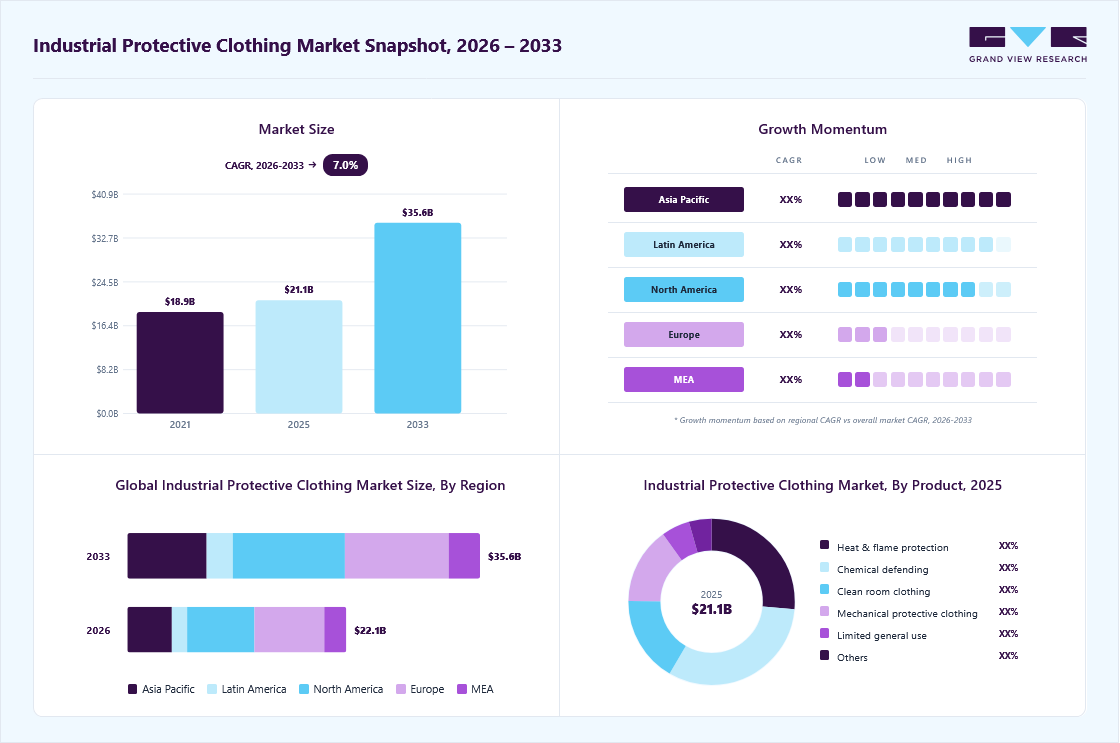
The global industrial protective clothing market size was valued at USD 21.1 billion in 2025 and is projected to grow from USD 22.1 billion in 2026 to USD 35.6 billion by 2033, at a CAGR of 7.0% from 2026 to 2033. Europe dominated the global market, accounting for the largest revenue share of 32.3% in 2025. The industrial protective clothing market is primarily driven by increasingly stringent workplace safety regulations across industries such as construction, oil & gas, manufacturing, and chemicals.
Request a free sample copy or view report summary: https://www.grandviewresearch.com/industry-analysis/industrial-protective-clothing-market/request/rs1
Key Market Trends & Insights
- By product: Chemical defending protective clothing accounted for the largest share of the market and accounted for 31.9% share in 2025.
- By end use: Healthcare held a dominant position in 2025, capturing 19.4% of the market.
Regional Highlights
- Largest regional market: Europe (32.3% revenue share, 2025)
- Fastest-growing regional market: Asia Pacific (highest CAGR, 2026-2033)
- By country: The Germany industrial protective clothing industry is a major contributor to the global market.
Market Size & Forecast
- Market size in 2025: USD 21.1 Billion
- Estimated market size in 2026: USD 22.1 Billion
- Projected market size by 2033: USD 35.6 Billion
- CAGR (2026-2033): 7.0%
Governments and regulatory bodies are enforcing strict compliance standards to reduce workplace injuries and fatalities, which is compelling organizations to invest in high-quality protective apparel.
Another key driver is the rapid expansion of industrialization and infrastructure development, particularly in emerging economies. Rising activities in sectors like construction, mining, and energy are increasing the demand for durable and specialized protective clothing. In addition, the healthcare and pharmaceutical industries are contributing significantly to market growth due to heightened focus on infection control, hygiene standards, and cleanroom environments. Continuous innovation in materials, including lightweight, breathable, and high-performance fabrics, is further supporting market expansion by improving comfort and usability for workers.
Market Concentration & Characteristics
The industrial protective clothing market is fragmented, with a mix of large multinational corporations and numerous regional and niche manufacturers competing across different product categories and end-use industries. While established players such as 3M, DuPont, and PIP hold strong brand recognition and technological advantages, smaller companies that cater to specific applications, cost-sensitive segments, or local demand serve a significant portion of the market. This competitive landscape is shaped by factors such as product innovation, compliance with safety standards, pricing, and distribution networks, resulting in a dynamic market with no single player dominating globally.
The industrial protective clothing market shows a steady level of innovation, largely driven by the need for better safety, comfort, and durability. Companies are investing in advanced materials such as lightweight, breathable fabrics that still provide high resistance to heat, chemicals, and mechanical risks. There is also growing development of smart protective clothing with features such as temperature regulation, moisture control, and even embedded sensors for real-time monitoring. Innovation is mainly focused on improving worker usability while meeting strict safety standards.