Energy Insurance Market (2026 – 2033)
Energy Insurance Market Summary
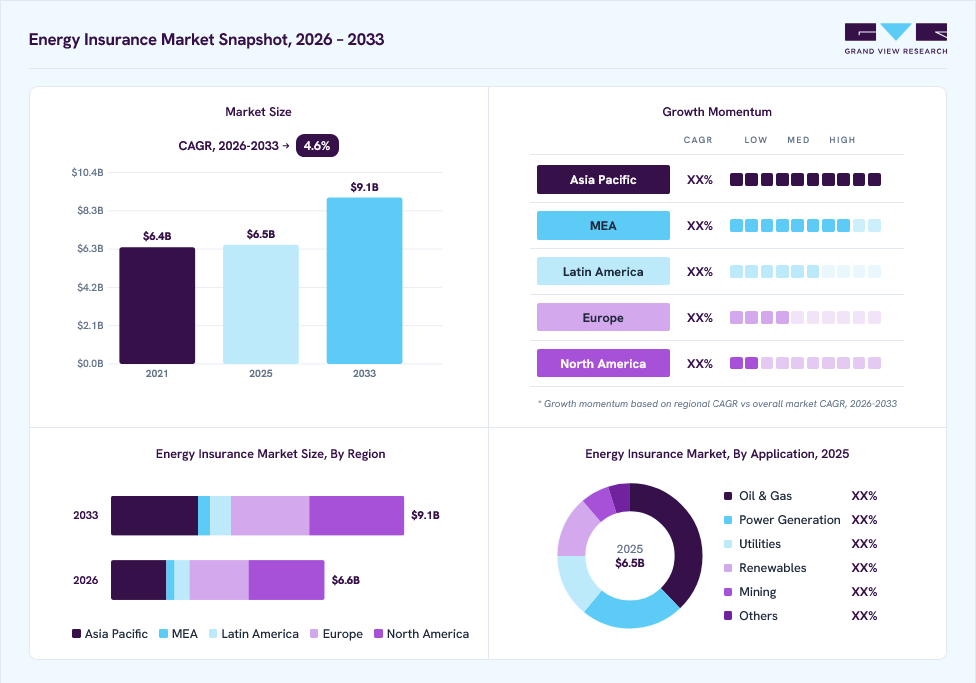
The global energy insurance market size was valued at USD 6.5 billion in 2025 and is projected to grow from USD 6.6 billion in 2026 to USD 9.1 billion by 2033, at a CAGR of 4.6% from 2026 to 2033. North America dominated the market, accounting for 36.1% of the revenue share in 2025. Increasing investment in renewable energy infrastructure is growing demand for insurance coverage to protect energy assets and manage operational risks.

Request a free sample copy or view report summary:
https://www.grandviewresearch.com/industry-analysis/energy-insurance-market-report/request/rs1
Key Market Trends & Insights
- By type: Property insurance segment led the market and accounted for 39.4% of the global revenue in 2025.
- By application: Oil & gas segment led the market with the largest revenue share in 2025.
Regional Highlights
- Largest regional market: North America (36.1% revenue share, 2025)
- Fastest-growing regional market: Asia Pacific (fastest CAGR, 2026-2033)
- By country: The U.S. held the largest share of North America in 2025.
Market Size & Forecast
- Market size in 2025: USD 6.5 Billion
- Estimated market size in 2026: USD 6.6 Billion
- Projected market size by 2033: USD 9.1 Billion
- CAGR (2026-2033): 4.6%
Extreme weather events are increasing risks for energy infrastructure and creating greater chances of physical damage and operational disruption. Changing weather patterns can increase the exposure of energy assets to storms, floods, wildfires, and extreme temperatures. Such events can lead to equipment damage, repair costs, and disruptions to energy operations. As these risks become more difficult to predict, energy companies are seeking stronger financial protection against potential losses. This is driving demand for energy insurance coverage across the energy sector.
Artificial intelligence is improving risk assessment by enabling insurers to analyze large volumes of data more efficiently. AI helps identify risk patterns and supports faster and more consistent underwriting decisions. This improves risk evaluation, pricing accuracy, claims assessment, and operational efficiency. As energy-related risks become more complex, insurers are increasingly adopting AI-based analytics for underwriting and risk management. The growing integration of AI into insurance processes is supporting technology advancement in the energy insurance market.