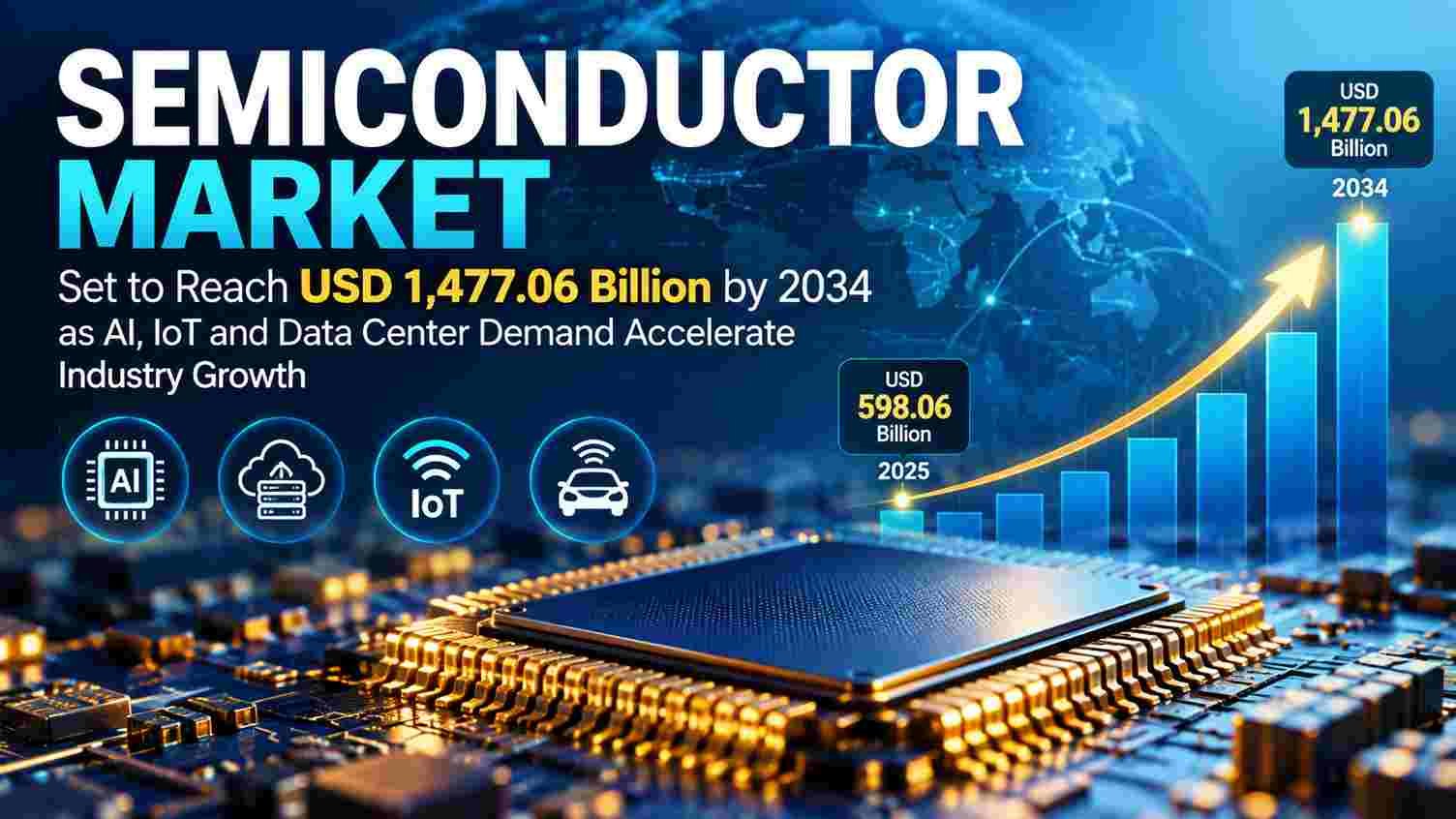
Semiconductor Market Set to Reach USD 1,477.06 Billion by 2034 as AI, IoT and Data Center Demand Accelerate Industry Growth
The global semiconductor market is entering a period of substantial expansion, supported by the increasing adoption of artificial intelligence (AI), Internet of Things (IoT), connected devices, advanced computing infrastructure, and semiconductor-enabled technologies across industries.
According to the latest market analysis by Fortune Business Insights, the global semiconductor market was valued at USD 598.06 billion in 2025 and is projected to grow from USD 659.66 billion in 2026 to USD 1,477.06 billion by 2034, registering a compound annual growth rate (CAGR) of 10.60% during 2026–2034.
Semiconductors are fundamental components of modern electronic systems and are widely used across networking and communications, data centers, industrial automation, consumer electronics, automotive systems, and government applications. Increasing electronic integration and demand for higher processing capabilities are creating new opportunities throughout the semiconductor value chain.
AI and IoT Adoption Strengthen Semiconductor Demand
The rapid development of AI, machine learning, IoT, big data analytics, and wireless communication technologies is reshaping demand for advanced semiconductor components.
AI-powered applications require increasingly sophisticated processing and memory capabilities, while IoT devices depend on highly integrated chipsets capable of supporting connectivity, computation, and energy-efficient operation. The continued expansion of connected devices and data-intensive applications is therefore expected to support semiconductor demand over the forecast period.
The growing deployment of advanced computing infrastructure and data centers is also contributing to demand for high-performance memory and processing technologies. As organizations process increasing volumes of data, semiconductor manufacturers are focusing on solutions designed to improve processing speed, efficiency, connectivity, and system performance.
Consumer Electronics Remain a Major Growth Catalyst
The widespread use of semiconductors in smartphones, televisions, household appliances, personal electronics, and connected devices continues to support industry expansion.
Modern consumer products increasingly incorporate integrated circuits and other semiconductor components to deliver enhanced functionality, connectivity, automation, and energy efficiency. Continued innovation in consumer electronics is expected to create sustained demand for increasingly advanced semiconductor technologies.
Automotive applications are also contributing to semiconductor demand as vehicles incorporate more electronic systems for safety, infotainment, power management, connectivity, and other functions. The broader transition toward software-defined and increasingly connected vehicles is creating additional opportunities for semiconductor suppliers.
Memory Devices Hold a Significant Market Position
By component, the semiconductor market includes memory devices, logic devices, analog ICs, microprocessor units (MPUs), microcontroller units (MCUs), discrete power devices, sensors, and other components.
Memory devices are projected to account for 24.59% of the global semiconductor market in 2026, according to Fortune Business Insights. Demand for memory technologies is being supported by applications including cloud computing, gaming, data-intensive computing, and other digital technologies.
Logic devices, analog ICs, MPUs, MCUs, sensors, and power semiconductor components are also expected to benefit from the continued integration of electronics across industrial, automotive, communications, and consumer applications.
Networking and Communications Lead Application Demand
By application, the market encompasses networking and communications, data centers, industrial applications, consumer electronics, automotive, and government.
The networking and communications segment is projected to account for 32.64% of the global market in 2026, making it the leading application segment. Rising data consumption, expanding communications infrastructure, increasing bandwidth requirements, and growing numbers of connected devices are contributing to demand for semiconductor-based networking technologies.
Data centers represent another important area of opportunity as cloud computing, e-commerce, artificial intelligence, and data processing applications increase the need for high-performance computing and memory infrastructure.
Asia Pacific Maintains Market Leadership
Asia Pacific remains a central hub for the global semiconductor industry. The region accounted for 51.00% of the global semiconductor market in 2025, with a market value of approximately USD 304.87 billion.
North America represented 21.90% of the global market in 2025, while Europe accounted for 12.70%. The United States semiconductor market is projected to reach approximately USD 114.04 billion in 2026, while Japan is projected to reach approximately USD 41.86 billion during the same year.
The geographic distribution reflects the importance of semiconductor manufacturing, design capabilities, electronics production, technology investment, and downstream demand across major global markets.
Industry Faces Capital and Supply Chain Challenges
Despite strong long-term demand, semiconductor companies continue to face challenges associated with high capital requirements, rapidly evolving technologies, manufacturing complexity, and supply-chain conditions.
Advanced semiconductor manufacturing requires significant investment in production facilities, equipment, research, development, and technology upgrades. At the same time, changes in international trade conditions and sourcing requirements can influence manufacturing costs and supply-chain strategies.
These factors are encouraging semiconductor companies and governments to focus on strengthening manufacturing capabilities, improving supply-chain resilience, and investing in next-generation semiconductor technologies.
Outlook for the Semiconductor Industry
The semiconductor industry is expected to remain closely connected to the development of emerging technologies. AI, IoT, cloud computing, advanced networking, connected vehicles, industrial automation, and data-intensive applications are expanding the number and complexity of semiconductor-enabled systems.
With the global market projected to increase from USD 598.06 billion in 2025 to USD 1,477.06 billion by 2034, the semiconductor industry is positioned for significant expansion during the forecast period.
The latest findings are presented in Fortune Business Insights’ “Semiconductor Market Size, Share & Industry Analysis, By Component … By Application … & Regional Forecast, 2026–2034” report, which examines market trends, segmentation, regional developments, growth drivers, restraints, and competitive dynamics.