Software Defined Radio Market growing at a CAGR of 8.8% from 2026 to 2033
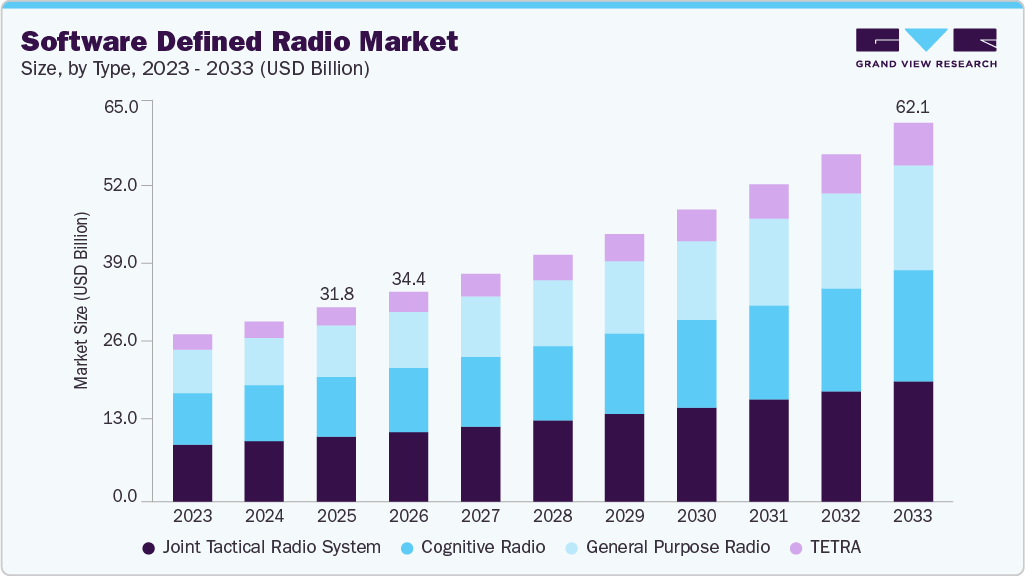
The global software defined radio market size was estimated at USD 31,850.8 million in 2025 and is projected to reach USD 62,088.7 million by 2033, growing at a CAGR of 8.8% from 2026 to 2033. The demand for flexible, multi-frequency, and interoperable communication solutions across the defense, telecommunications, and public safety sectors drives the market growth.
Key Market Trends & Insights
- North America dominated the global software defined radio market with the largest revenue share of over 34.0% in 2025.
- The U.S. software defined radio industry led North America, with the largest revenue share in 2025.
- By type, the joint tactical radio system segment led the market, with the largest revenue share of over 33.0% in 2025.
- By component, the hardware segment led the market, with the largest revenue share of over 41.0% in 2025.
- By end use, the aerospace & defense segment led the market, with the largest revenue share of over 24.0% in 2025.
Market Size & Forecast
- 2025 Market Size: USD 31,850.8 Million
- 2033 Projected Market Size: USD 62,088.7 Million
- CAGR (2026-2033): 8.8%
- North America: Largest Market in 2025
- Asia Pacific: Fastest growing market
Request Free Sample Report: https://www.grandviewresearch.com/industry-analysis/software-defined-radio-sdr-market/request/rs1
The versatility of software-defined radio (SDR) technology in seamlessly operating across different frequencies and protocols is expected to drive market growth. The growth of the software defined radio industry is driven by the rapid convergence of advanced waveform agility, edge-based signal processing, and AI-enabled spectrum analytics, which significantly enhance radio performance beyond traditional hardware-defined systems. The integration of cognitive and generative AI techniques further accelerates this evolution, enabling software defined radio (SDR) platforms to autonomously interpret spectrum environments, optimize modulation schemes, and predict interference patterns in real-time. The intelligence-driven flexibility is reshaping global communication architectures, fueling robust adoption across military modernization, next-generation wireless infrastructure, and connected industrial ecosystems.
The rapid development of wireless communication technologies, including 5G, IoT, and satellite communication, is driving the market growth. SDRs offer flexibility to support multiple communication standards through software-based modulation techniques, making them ideal for a wide range of telecommunications applications. Additionally, there is a growing emphasis on interoperability among different communication systems. SDRs are designed to facilitate seamless integration with both legacy and modern communication networks, enhancing operational effectiveness, which is further driving the adoption of market growth.
Governments are significantly increasing their defense budgets, resulting in higher investments in modernizing military communication systems. This surge in funding is largely driven by the need to enhance operational capabilities in an increasingly complex security environment, where rapid technological advancements and evolving threats require agile and resilient communication infrastructures. Moreover, the integration of commercial technologies, including 5G and artificial intelligence, into military communications is expected to improve data transmission speeds and enhance overall network reliability, thereby driving the expansion of the software defined radio industry.
The growing need for dynamic spectrum access is propelling the adoption of SDRs. These systems enable users to maximize spectrum utilization and adapt to changing radio frequency environments, which is crucial in military, public safety, and commercial applications where effective spectrum management is essential. This trend is expected to boost the market growth.
Moreover, companies are heavily investing in R&D to innovate and enhance SDR capabilities. This includes improving processing power and software functionalities to meet evolving communication standards and emerging threats in defense scenarios. Additionally, companies are exploring the integration of artificial intelligence (AI) within SDR platforms to facilitate real-time data analysis and informed decision-making. This AI-driven trend is expected to drive market growth in the coming years.
Software Defined Radio Market Report Scope
|
Report Attribute |
Details |
|
Market size value in 2026 |
USD 34,430.7 million |
|
Revenue forecast in 2033 |
USD 62,088.7 million |
|
Growth rate |
CAGR of 8.8% from 2026 to 2033 |
|
Base year for estimation |
2025 |
|
Historical data |
2021 – 2024 |
|
Forecast period |
2026 – 2033 |
|
Quantitative units |
Revenue in USD million/billion and CAGR from 2026 to 2033 |
|
Report coverage |
Revenue forecast, company ranking, competitive landscape, growth factors, and trends |
|
Segments covered |
Type, component, frequency band, platform, end-use, region |
|
Regional scope |
North America; Europe; Asia Pacific; Latin America; Middle East & Africa |
|
Country scope |
U.S.; Canada; UK; Germany; France; China; Japan; India; South Korea; Australia; Brazil; Mexico; Saudi Arabia; UAE; South Africa |
|
Key companies profiled |
L3Harris Technologies, Inc.; RTX Corporation; Thales Group; General Dynamics Corporation; Northrop Grumman Corporation; BAE Systems Plc; Elbit Systems Ltd.; Leonardo S.p.A.; Collins Aerospace; Rafael Advanced Defense Systems Ltd. |
|
Customization scope |
Free report customization (equivalent to up to 8 analyst’s working days) with purchase. Addition or alteration to country, regional & segment scope. |
|
Pricing and purchase options |
Avail customized purchase options to meet your exact research needs. Explore purchase options |