Smart Card Market growing at a CAGR of 6.1% from 2025 to 2030
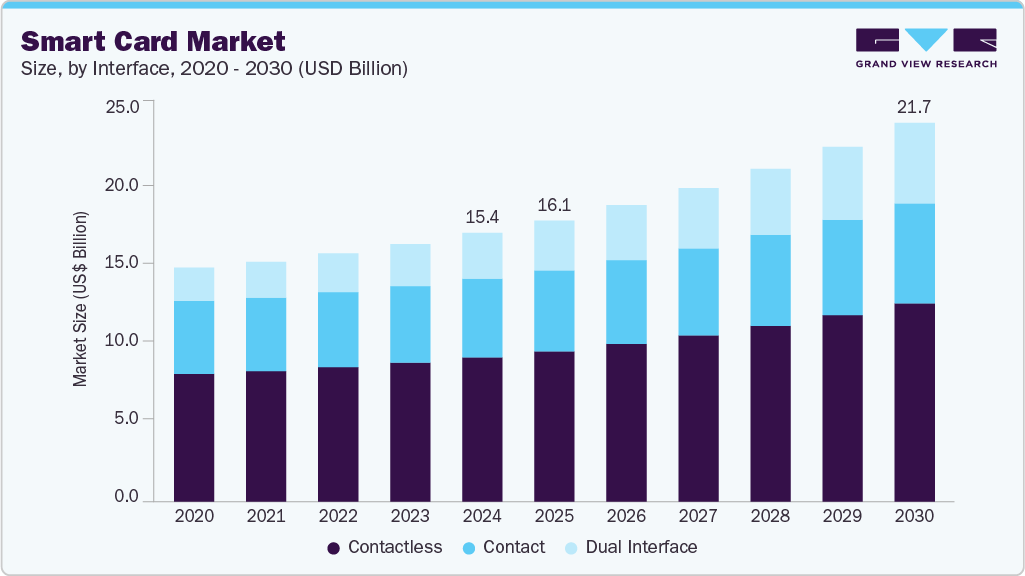
The global smart card market size was estimated at USD 15.40 billion in 2024 and is projected to reach USD 21.73 billion by 2030, growing at a CAGR of 6.1% from 2025 to 2030. A smart card is a tangible card that houses embedded memory or a microcontroller within a contact pad.
Market Size & Trends:
- The smart card industry in the Asia Pacific region dominated the market in 2024, accounting for over 38% share of the global revenue.
- The U.S. smart card industry is expected to grow significantly in 2024.
- By type, the MPU microprocessor segment led the market in 2024, accounting for over 60% share of the global revenue.
- By interface, the contactless segment accounted for the largest market revenue share in 2024.
- By Functionality, the communication segment accounted for the largest market revenue share in 2024.
Key Market Statistics:
- 2024 Market Size: $15.40 Billion
- 2030 Estimated Market Size: $21.73 Billion
- CAGR: 6.1% (2025-2030)
- Asia Pacific: Largest market in 2024
- North America: Fastest growing region
Request a free sample copy or view report summary: https://www.grandviewresearch.com/industry-analysis/smart-card-industry/request/rs1
It establishes a connection with a reader via short-range wireless technologies or direct physical contact methods like radio-frequency identification (RFID) or near-field communication (NFC). Smart cards use encryption to provide safety for in-memory information and are generally developed to be tamper-resistant. Those equipped with a microcontroller chip can perform on-card processing tasks and manage data stored in the chip’s memory.
The market is anticipated to grow significantly over the forecast period. The expansion is fueled by multiple factors, including an upsurge in cashless transactions, rapid digitalization, and increased demand across diverse industry verticals, all of which collectively propel the advancement of the smart card industry. Moreover, the emergence of a novel information security paradigm for users, made possible by blockchain technology, is poised to unlock new avenues for the market. Smart cards’ adept handling of cryptographic keys facilitates secure and seamless transactions within blockchain applications.
The major factors influencing the growth of the smart card industry are the increasing demand for payment systems that offer both security and convenience, coupled with the rising necessity for robust identification and authentication methods. Smart cards play a key role in serving as effective tools for access control, secure login procedures, and digital signatures, all of which are extensively utilized for identification and authentication. As various industries increasingly require stringent identity verification measures, the demand for smart cards is projected to grow significantly.
Type Insights
The MPU microprocessor segment led the market in 2024, accounting for over 60% share of the global revenue. The MPU microprocessor provides higher processing power, allowing the smart card to execute more sophisticated applications and perform complex computations. Smart cards with MPU microprocessors enhance their functionality, security, and versatility, enabling them to handle more complex tasks and applications than traditional smart cards with simpler microcontrollers. Furthermore, as contactless payments gain popularity, smart cards must support near-field communication (NFC) technology. MPUs can integrate NFC capabilities to facilitate secure and convenient contactless transactions.
The memory segment is estimated to grow significantly over the forecast period. This high growth is attributed to the increasing demand for secure data storage, the proliferation of contactless payment systems, and the widespread adoption of smart cards for various identification and authentication applications. Memory-based smart cards offer efficient and secure storage solutions for sensitive information, making them a preferred choice for enterprises and sectors requiring reliable data management and protection. These cards are often used in high-volume applications where the primary requirement is data storage and retrieval, such as transportation cards, loyalty cards, and basic access control cards.
Smart Card Market Report Scope
|
Report Attribute |
Details |
|
Market size value in 2025 |
USD 16.13 billion |
|
Revenue forecast in 2030 |
USD 21.73 billion |
|
Growth rate |
CAGR of 6.1% from 2025 to 2030 |
|
Actual data |
2017 – 2023 |
|
Forecast period |
2025 – 2030 |
|
Quantitative units |
Revenue in USD billion/million and CAGR from 2025 to 2030 |
|
Report coverage |
Revenue forecast, company ranking, competitive landscape, growth factors, and trends |
|
Segments covered |
Technology, application, functionality, type, interface, region |
|
Regional scope |
North America; Europe; Asia Pacific; Latin America; MEA |
|
Country scope |
U.S.; Canada; Mexico; Germany; ; France; China; India; Japan; Australia; South Korea; Brazil; UAE; South Africa; KSA |
|
Key companies profiled
|
Block, Inc.; CardLogix Corporation; CPI Card Group Inc.; Giesecke+Devrient GmbH; HID Global Corporation; IDEMIA; INTELIGENSA; Samsung; Sony Corporation; Thales Group |
|
Customization scope |
Free report customization (equivalent up to 8 analysts working days) with purchase. Addition or alteration to country, regional & segment scope. |
|
Pricing and purchase options |
Avail customized purchase options to meet your exact research needs. Explore purchase options |