Digital Advertising Display Market growing at a CAGR of 8.1% from 2025 to 2033
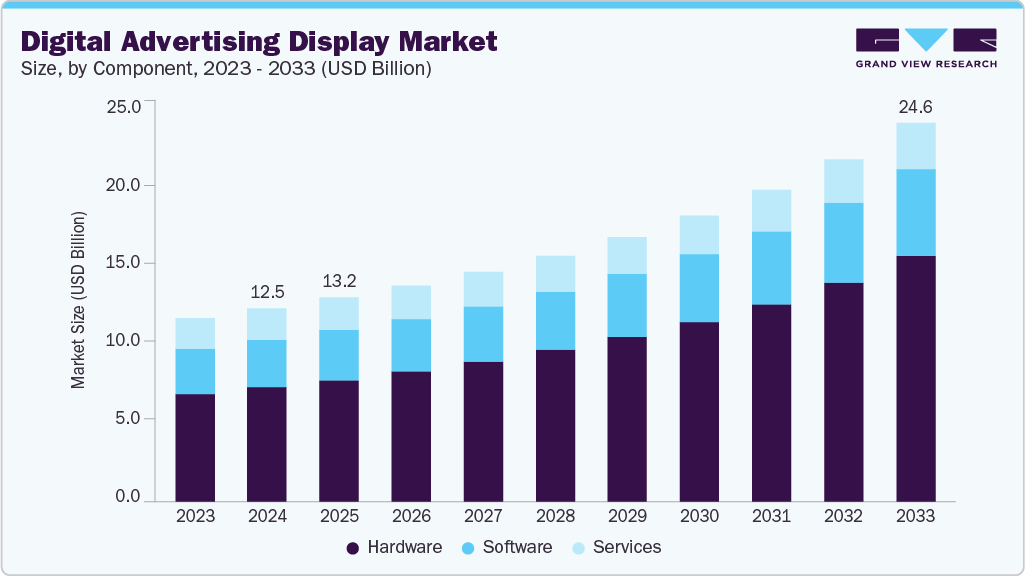
The global digital advertising display market size was estimated at USD 12.54 billion in 2024 and is projected to reach USD 24.60 billion by 2033, growing at a CAGR of 8.1% from 2025 to 2033. The rise of smart cities and the proliferation of connected infrastructure are driving the market growth.
Key Market Trends & Insights
- North America held a 35.4% revenue share of the global digital advertising display market in 2024.
- In the U.S., advancements in display technologies, such as LED, OLED, and high-definition LCD panels, are accelerating the demand for digital advertising display systems.
- By component, the hardware segment held the largest revenue share of 59.2% in 2024.
- By product type, the digital billboards segment held the largest revenue share in 2024.
- By technology, the LED segment held the largest revenue share in 2024.
Market Size & Forecast
- 2024 Market Size: USD 12.54 Billion
- 2033 Projected Market Size: USD 24.60 Billion
- CAGR (2025-2033): 8.1%
- North America: Largest market in 2024
- Asia Pacific: Fastest growing market
Request a free sample copy or view report summary: https://www.grandviewresearch.com/industry-analysis/digital-advertising-display-market-report/request/rs1
The digital advertising display industry represents a dynamic and evolving space within the broader advertising ecosystem. It encompasses a wide range of display solutions that deliver promotional content in visually engaging formats, often integrating interactivity, motion graphics, and real-time updates to capture audience attention. These displays are used across various environments, from bustling urban centers and transport hubs to retail spaces and corporate settings, serving as a direct channel for brands to connect with their target audiences in high-visibility locations.
The growth of the digital advertising display market is fueled by the rapid expansion of omnichannel marketing strategies, where brands seek to create seamless and consistent messaging across multiple touchpoints. Digital displays play a central role in this approach by acting as highly visible, adaptable mediums that can be synchronized with online campaigns, mobile applications, and social media content. This integration allows advertisers to create cohesive narratives that guide consumers from digital engagement to physical interaction, such as visiting a store or scanning a QR code for promotions. The ability to instantly adapt messaging based on campaign performance metrics or external conditions, such as weather or traffic flow, makes digital advertising displays far more responsive than static signage, amplifying their demand for time-sensitive marketing efforts.
Increasing use of in-store digital displays to influence purchasing decisions at the point of sale is driving the market growth. Retailers are deploying these displays to showcase product demonstrations, run limited-time offers, and promote cross-selling opportunities, leveraging the medium’s ability to capture shoppers’ attention during critical decision-making moments. In hospitality and quick-service restaurants, digital menu boards and promotional displays are enhancing customer experience by offering dynamic, visual content that can be updated instantly. Similarly, in transportation hubs such as airports and metro stations, advertisers are using digital displays to target large, diverse audiences with location-relevant messages, increasing campaign impact.
Application Insights
The indoor segment dominated the digital advertising display industry in 2024. The rising trend of interactive advertising is a major factor driving segment growth. Indoor displays are often paired with technologies such as augmented reality, QR codes, gesture control, and mobile integration to create engaging, personalized brand experiences. This interactivity captures attention and encourages direct consumer participation, deepening brand engagement. As businesses continue to prioritize immersive, targeted, and adaptable marketing strategies, the indoor segment is expected to remain one of the most vibrant and fast-evolving areas of the market.
The outdoor segment is projected to grow at the fastest CAGR from 2025 to 2033. The rising popularity of programmatic digital out-of-home (DOOH) advertising is driving the segment growth. With the growing availability of 5G connectivity, outdoor displays receive and update content instantly, enabling advertisers to run time-sensitive campaigns, react to live events, or personalize messages for different times of day. Combined with the sheer scale and visibility of outdoor formats, this agility offers advertisers a powerful way to maximize campaign relevance and impact. As display costs continue to decrease and data-driven targeting capabilities advance, the outdoor segment is expected to grow in the forthcoming years.
End Use Insights
The retail segment dominated the market in 2024. The shift toward experiential shopping environments is driving the adoption of the retail segment’s growth. Brick-and-mortar stores are embracing technology to compete with e-commerce by offering interactive and sensory-rich experiences that cannot be replicated online. Video walls, touch-enabled kiosks, and LED shelf-edge displays are being deployed to engage shoppers, tell brand stories, and create emotional connections with products. The integration of augmented reality and artificial intelligence into digital displays allows for personalized product recommendations, virtual try-ons, and targeted promotions based on customer demographics or purchasing history, further enhancing the customer journey and boosting sales conversion rates.
The transportation segment is projected to grow the fastest from 2025 to 2033. The transportation segment of the digital advertising display market is growing rapidly, fueled by the high visibility and captive audience opportunities found in airports, train stations, bus terminals, subways, and other transit hubs. These locations experience consistent, high-volume foot traffic, making them ideal for delivering impactful advertising messages to diverse audiences. Passengers often spend considerable waiting times in these environments, providing advertisers with extended exposure periods and increasing the likelihood of engagement. Digital displays in transportation settings can showcase vibrant, motion-rich content that captures attention even in busy, distraction-filled spaces, giving brands a powerful platform for both mass awareness and targeted messaging.
Digital Advertising Display Market Report Scope
|
Report Attribute |
Details |
|
Market size value in 2025 |
USD 13.24 billion |
|
Revenue forecast in 2033 |
USD 24.60 billion |
|
Growth rate |
CAGR of 8.1% from 2025 to 2033 |
|
Actual data |
2021 – 2024 |
|
Forecast period |
2025 – 2033 |
|
Quantitative units |
Revenue in USD million/billion and CAGR from 2025 to 2033 |
|
Report coverage |
Revenue forecast, company share, competitive landscape, growth factors, and trends |
|
Segments covered |
Component, product type, technology, resolution, application, end use, region |
|
Regional scope |
North America; Europe; Asia Pacific; Latin America; MEA |
|
Country scope |
U.S.; Canada; Mexico; UK; Germany; France; China; India; Japan; Australia; South Korea; Brazil; UAE; Saudi Arabia; South Africa |
|
Key companies profiled |
Daktronics Dr.; BrightSign, LLC; LG Electronics; Panasonic Corporation; Samsung Electronics Co., Ltd.; Scala; Barco; Lamar Advertising Company; Leyard Group; Adonmo-Acumen; Armagard Ltd.; Allsee Technologies Limited; STRATACACHE; Shining International Co., Ltd.; COX MEDIA, LLC |
|
Customization scope |
Free report customization (equivalent to 8 analysts working days) with purchase. Addition or alteration to country, regional & segment scope. |
|
Pricing and purchase options |
Avail customized purchase options to meet your exact research needs. Explore purchase options |