Small Wind Market growing at a CAGR of 4.3% from 2025 to 2030
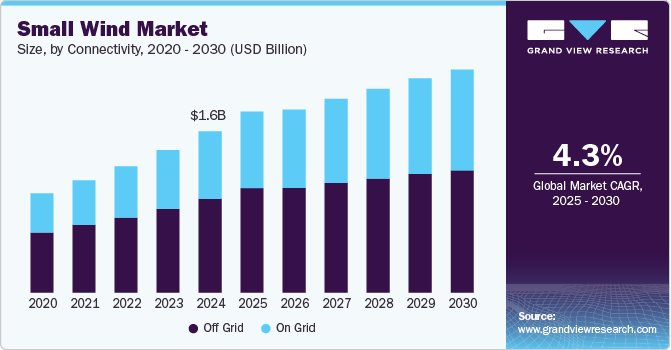
The global small wind market size was estimated at USD 1,601.7 million in 2024 and is projected to reach USD 2,213.9 million by 2030, growing at a CAGR of 4.3% from 2025 to 2030. The market is primarily driven by the increasing demand for renewable energy sources amid global environmental concerns and the depletion of non-renewable resources.
Key Market Trends & Insights
- The Europe small wind market dominated globally and accounted for the largest revenue share of over 38.5% in 2024.
- The Germany small wind market is characterized by a strong commitment to renewable energy and government initiatives that promote decentralized power generation.
- Based on connectivity, the off grid segment dominated the market with the largest revenue share of 51.9% in 2024.
- In terms of connectivity, the on-grid segment is expanding within the renewable energy landscape, characterized by small wind turbines connected to the utility grid.
- On the basis of axis, the horizontal axis wind turbine dominated the market with the largest revenue share of 69.7% in 2024.
Market Size & Forecast
- 2024 Market Size: USD 1,601.7 million
- 2030 Projected Market Size: USD 2,213.9 million
- CAGR (2025-2030): 4.3%
- Europe: Largest market in 2024
Request Free Sample Report: https://www.grandviewresearch.com/industry-analysis/small-wind-market/request/rs1
Rapid industrialization and urbanization are amplifying the need for sustainable energy solutions, particularly in remote areas where small wind systems can provide reliable electricity.
Government initiatives, including financial incentives and regulations aimed at reducing carbon emissions, further propel market growth. In addition, advancements in technology and the rising interest from the commercial sector seeking to lower operational costs and enhance sustainability contribute significantly to the expansion of the market.
Drivers, Opportunities & Restraints
A key driver of the market is the growing awareness and acceptance of decentralized energy systems. As consumers and businesses increasingly prioritize energy independence, small wind turbines offer an effective solution for generating on-site power, reducing reliance on traditional grid systems. The integration of smart technologies, such as energy management systems and battery storage, enhances the efficiency and reliability of small wind installations.
Government incentives and favorable policies further enhance adoption, particularly in regions facing energy crises. In addition, technological advancements in turbine efficiency and grid connectivity are expected to facilitate market expansion, making small wind solutions an attractive option for both residential and commercial applications.
The market faces several restraints, primarily including high manufacturing costs and limited economies of scale, which hinder widespread adoption. In addition, the lack of specific legal frameworks and support schemes in many regions restricts market growth. Competition from alternative energy sources, particularly solar power, further complicates the landscape by offering lower costs and easier installation options, making it challenging for small wind solutions to compete effectively.
Connectivity Insights
Based on connectivity, the off grid segment dominated the market with the largest revenue share of 51.9% in 2024. The off grid segment is a vital component of the renewable energy landscape, particularly for providing electricity in remote and rural areas where grid access is limited or non-existent. These systems are designed to operate independently, making them ideal for applications such as powering homes, farms, and telecommunication stations. The growing demand for sustainable energy solutions, coupled with advancements in turbine technology, has enhanced the efficiency and reliability of off-grid small wind systems.
The on-grid segment is expanding within the renewable energy landscape, characterized by small wind turbines connected to the utility grid. This connectivity allows users to generate electricity for residential and commercial applications while contributing excess power back to the grid, thereby enhancing energy security and reducing electricity costs. The market is gaining traction due to increasing government initiatives aimed at improving grid connectivity and promoting renewable energy adoption through financial incentives such as tax credits and feed-in tariffs.
Small Wind Market Report Scope
|
Report Attribute |
Details |
|
Market size value in 2025 |
USD 1,796.2 million |
|
Revenue forecast in 2030 |
USD 2,213.9 million |
|
Growth rate |
CAGR of 4.3% from 2025 to 2030 |
|
Historical data |
2018 – 2023 |
|
Base Year |
2024 |
|
Forecast period |
2025 – 2030 |
|
Quantitative units |
Revenue in USD million/billion and CAGR from 2025 to 2030 |
|
Report coverage |
Revenue forecast, competitive landscape, growth factors, and trends |
|
Segments covered |
Connectivity, axis, region |
|
Regional scope |
North America; Europe; Asia Pacific; Central & South America; Middle East & Africa |
|
U.S.; Canada; Mexico; Germany; France; UK; Italy; Spain; Russia; China; India; Japan; Australia; Brazil; Argentina; Saudi Arabia; South Africa; UAE |
|
|
Key companies profiled |
Envergate Energy AG; Kingspan Group; Kliux Energies; superwind GmbH; Bergey Windpower Co.; EOCYCLE; Shanghai Zhiyuan Green Energy Co. Ltd.; Northern Power Systems; XZERES Corp. |
|
Customization scope |
Free report customization (equivalent up to 8 analyst’s working days) with purchase. Addition or alteration to country, regional & segment scope |
|
Pricing and purchase options |
Avail customized purchase options to meet your exact research needs. Explore purchase options |