Pharma 5.0 Market (2026 – 2033)
Pharma 5.0 Market Summary
The global pharma 5.0 market size was valued at USD 7.9 billion in 2025 and is projected to grow from USD 9.4 billion in 2026 to USD 37.6 billion by 2033, at a CAGR of 21.9% from 2026 to 2033. North America dominated the market, accounting for a revenue share of 43.1% in 2025. The market growth is driven by the increasing adoption of AI, digital twins, advanced robotics, genomics, intelligent supply chain solutions, and sustainable manufacturing technologies to enhance pharmaceutical innovation, operational efficiency, and patient-centric care.
Key Market Trends & Insights
- By type: Software segment held the largest market share of 56.3% in 2025.
- By technology: Artificial intelligence (AI) & generative AI segment held the largest market share of 28.9% in 2025.
- By application: Drug discovery & development segment held the largest market share of 29.5% in 2025.
- By end-use: Pharmaceutical companies held the largest market revenue share of 42.0% in 2025.
Regional Highlights
- Largest regional market: North America (43.1% revenue share, 2025)
- Fastest-growing regional market: Asia Pacific (highest CAGR, 2026-2033)
- By country: The U.S. held the largest market share in 2025.
Market Size & Forecast
- Market size in 2025: USD 7.9 Billion
- Estimated market size in 2026: USD 9.4 Billion
- Projected market size by 2033: USD 37.6 Billion
- CAGR (2026-2033): 21.9%
Market Dynamics
The Pharma 5.0 market is witnessing rapid growth, driven by the increasing adoption of artificial intelligence, generative AI, advanced robotics, genomics, multi-omics, and intelligent automation across the pharmaceutical value chain. Rising investments in digital transformation, growing demand for personalized medicine, and increasing integration of AI-powered technologies in drug discovery and clinical development are supporting market expansion. Moreover, the growing focus on sustainable manufacturing, supply chain resilience, human-machine collaboration, and patient-centric healthcare is expected to sustain market growth over the forecast period.
The increasing adoption of digital twins and process simulation technologies is driving the growth of the Pharma 5.0 industry by enabling pharmaceutical companies to create virtual representations of manufacturing processes, facilities, and equipment. These technologies allow manufacturers to simulate process conditions, optimize production workflows, predict performance, and identify potential bottlenecks before physical implementation. Consequently, digital twins help reduce development time, minimize material waste, improve process quality, and support faster scale-up from laboratory to commercial production, aligning with the Pharma 5.0 focus on intelligent and sustainable operations.
The growing adoption of these technologies is also reflected in recent developments across the pharmaceutical manufacturing sector. For instance, in July 2026, Siemens highlighted the use of simulation and executable digital twins to accelerate pharmaceutical process design, manufacturing scale-up, and time-to-market. Such advancements are expected to support the transition toward more predictive, connected, and increasingly autonomous pharmaceutical manufacturing environments, thereby contributing to the adoption of Pharma 5.0 technologies.
Market Concentration & Characteristics
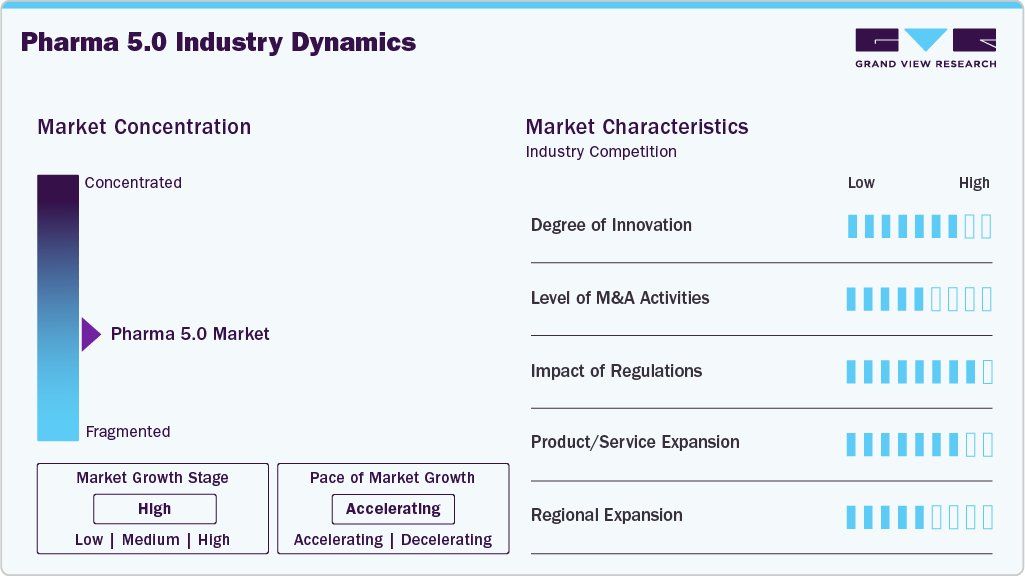
The Pharma 5.0 market is characterized by a high degree of innovation, driven by the integration of artificial intelligence, generative AI, robotics, genomics, automation, and connected technologies across pharmaceutical R&D and manufacturing. Companies are increasingly developing intelligent solutions to accelerate drug discovery, enhance production efficiency, enable personalized medicine, and improve patient outcomes. For instance, in January 2026, NVIDIA and Lilly announced an expanded collaboration to establish an AI co-innovation laboratory focused on advancing AI applications in drug discovery and pharmaceutical research, highlighting the growing role of AI in transforming the pharmaceutical industry.
The Pharma 5.0 market is witnessing a moderate to high level of M&A and strategic collaborations, as companies seek to strengthen their digital capabilities, expand AI-driven drug discovery platforms, and enhance automation and data analytics offerings. Strategic partnerships also enable pharmaceutical companies and technology providers to combine domain expertise with advanced digital technologies. For instance, in June 2025, XtalPi acquired Liverpool ChiroChem (LCC) to strengthen its AI- and robotics-enabled drug discovery capabilities, reflecting the industry’s focus on integrating advanced technologies to accelerate pharmaceutical innovation.