Natural Fiber Composites Market growing at a CAGR of 12.1% from 2026 to 2033
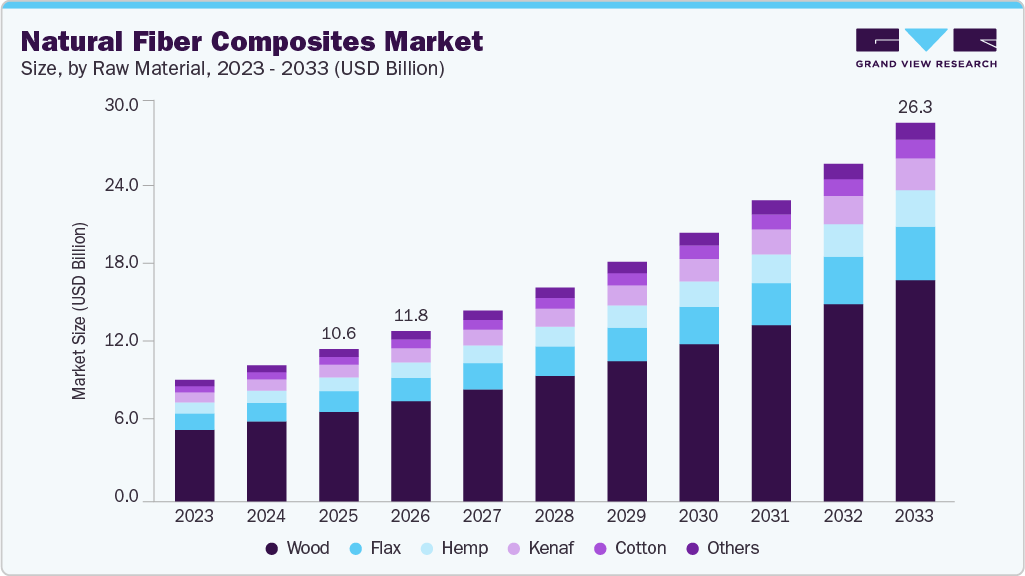
The global natural fiber composites market size was estimated at USD 10.57 billion in 2025 and is projected to reach USD 26.31 billion by 2033, growing at a CAGR of 12.1% from 2026 to 2033. Chief among market drivers is the heightened focus on sustainability and environmental awareness. As consumers and industries prioritize reducing their ecological impact, the demand for eco-friendly materials has risen significantly.
Key Market Trends & Insights
- North America dominated the natural fiber composites (NFC) market with the largest revenue share of 48.4% in 2025.
- By raw material, the hemp segment is expected to grow at the fastest CAGR of 12.9% over the forecast period.
- By matrix, the natural polymer segment is expected to grow at the fastest CAGR of 12.5% over the forecast period.
- By technology, the injection molding segment is expected to grow at the fastest CAGR of 12.8% over the forecast period.
- By application, the sporting goods segment is expected to grow at the fastest CAGR of 13.8% over the forecast period.
Market Size & Forecast
- 2025 Market Size: USD 10.57 Billion
- 2033 Projected Market Size: USD 26.31 Billion
- CAGR (2026-2033): 12.1%
- North America: Largest market in 2025
- Asia Pacific: Fastest market in 2025
Request Free Sample Report: https://www.grandviewresearch.com/industry-analysis/natural-fiber-composites-market/request/rs1
Natural fibers, being biodegradable and renewable, offer a compelling alternative to less sustainable traditional synthetic composites, enhancing the appeal of natural fiber composites (NFC) across various sectors.
Governments worldwide have implemented stricter environmental regulations and launched initiatives to promote sustainable manufacturing practices. This policy framework is particularly influential in industries such as automotive and construction, where compliance with environmental standards is paramount. These regulations incentivize the use of natural fiber composites and reinforce the market’s momentum as companies seek to align their operations with evolving legal requirements.
With superior strength, stiffness, and excellent thermal and acoustic insulation, NFCs are well-suited for a variety of applications, ranging from automotive parts to construction materials and consumer goods. Manufacturers are keen to leverage these attributes, knowing that integrating natural fiber composites into their product offerings can enhance performance while maintaining a commitment to sustainability.
Natural fibers often offer a more economical option than synthetic alternatives, enabling manufacturers to balance performance with budgetary constraints. This economic advantage is particularly pertinent as the automotive industry pivots towards lightweight materials to enhance fuel efficiency and reduce emissions. Coupled with rising consumer preferences for sustainable products, the natural fiber composites market stands poised for continued expansion, reflecting both an evolution in material preferences and a commitment to environmentally responsible practices.
Market Concentration & Characteristics
The NFC market exhibits moderate concentration, with a mix of global leaders and smaller innovative players shaping competitive dynamics. Major companies like FlexForm, UPM, TECNARO, and Trex hold notable market shares, especially in regions with high sustainability demand. However, the industry remains open to new entrants due to diverse raw material sources and growing global adoption. North America historically has the largest share, supported by strong manufacturing infrastructure and early adoption of bio-composites, while the Asia Pacific is rapidly gaining ground due to expanding automotive and construction activity.
The principal substitutes for natural fiber composites are synthetic fiber composites (e.g., glass fiber and carbon fiber) and traditional materials such as metals and plastics. While synthetic composites often outperform NFCs in absolute mechanical strength, their higher environmental impact and regulatory challenges create opportunities for NFC adoption. The threat from substitutes persists primarily in high-performance applications where durability and uniformity are critical. Nonetheless, ongoing innovations in NFC formulations and hybrid composites are steadily narrowing this performance gap, reducing the substitution threat over time.
Raw Material Insights
Wood dominated the market and accounted for a share of 58.8% in 2025, owing to its abundant availability, cost-effectiveness, and favorable mechanical properties. As a renewable resource, wood composites are increasingly preferred in the construction and automotive sectors due to their superior strength-to-weight ratio, appealing to both environmentally conscious consumers and manufacturers.
Hemp is expected to grow at the fastest CAGR of 12.9% over the forecast period, driven by hemp’s exceptional strength, lightweight characteristics, and eco-friendliness. Its versatility enables broad applications in the automotive and construction industries, while heightened consumer awareness of sustainable materials further accelerates hemp’s adoption as a leading natural fiber composite.
Matrix Insights
Inorganic compounds held the largest revenue share of 41.8% in 2025 due to superior thermal stability and mechanical strength, which are essential in demanding applications within the construction and automotive sectors. These characteristics underscore their preference in industries where performance and durability are critical.
Natural polymer is expected to register the fastest CAGR of 12.5% over the forecast period, driven by its biodegradability and compatibility with diverse natural fibers. As industries increasingly seek sustainable alternatives to synthetic polymers, natural polymers present an attractive solution that satisfies regulatory requirements while advancing environmental sustainability.
Technology Insights
Compression molding led the market with a revenue share of 76.4% in 2025, owing to its efficiency in producing complex shapes with minimal waste. This method enables high-volume production while maintaining consistent quality, making it particularly appealing for manufacturers aiming to meet the escalating demand across various applications, especially in the automotive and construction sectors.
Injection molding is expected to register the fastest CAGR of 12.8% over the forecast period. Injection molding helps produce intricate designs with high precision and reduced cycle times. As manufacturers increasingly adopt this innovative technology for sustainable product development, injection molding emerges as the preferred choice for creating high-performance components across diverse industries.
Natural Fiber Composites (NFC) Market Report Scope
|
Report Attribute |
Details |
|
Market size value in 2026 |
USD 11.83 billion |
|
Revenue forecast in 2033 |
USD 26.31 billion |
|
Growth rate |
CAGR of 12.1% from 2026 to 2033 |
|
Base year for estimation |
2025 |
|
Historical data |
2021 – 2024 |
|
Forecast period |
2026 – 2033 |
|
Quantitative units |
Volume in kilotons, revenue in USD million/billion and CAGR from 2026 to 2033 |
|
Report coverage |
Volume and revenue forecast, company ranking, competitive landscape, growth factors, trends |
|
Segments covered |
Raw material, matrix, technology, application, region |
|
Regional scope |
North America; Europe; Asia Pacific; Latin America; Middle East & Africa |
|
Country scope |
U.S.; Canada; Mexico; UK; Germany; France; Italy; Spain; China; Japan; India |
|
Key companies profiled |
Flexform SpA; Procotex; TECNARO GMBH; UPM; Trex Company, Inc.; Bcomp; Polyvlies Franz Beyer GmbH; Green Dot Bioplastics |
|
Customization scope |
Free report customization (equivalent up to 8 analysts working days) with purchase. Addition or alteration to country, regional & segment scope. |
|
Pricing and purchase options |
Avail customized purchase options to meet your exact research needs. Explore purchase options |