Garden Seeds Market growing at a CAGR of 5.4% from 2025 to 2033
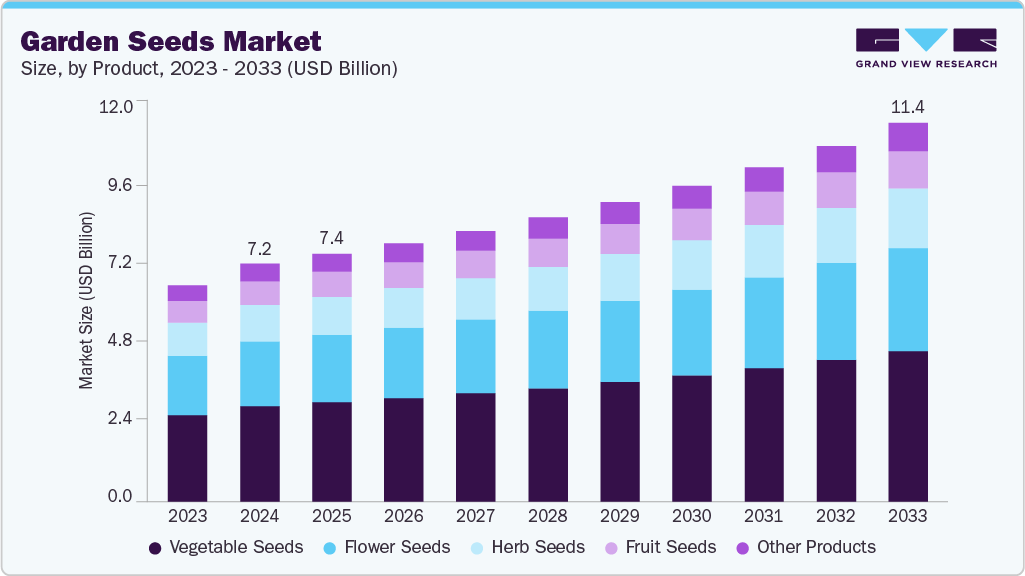
The global garden seeds market size was estimated at USD 7,153.0 million in 2024 and is projected to reach USD 11,382.5 million by 2033, growing at a CAGR of 5.4% from 2025 to 2033. The market is primarily driven by the robust adoption of home gardening and urban horticulture, fueled by increasing consumer awareness of the benefits of healthy eating and sustainable lifestyles.
Key Market Trends & Insights
- North America dominated the garden seeds market with the largest revenue share of 31.5% in 2024.
- The market in China is expected to grow at the fastest CAGR of 5.9% from 2025 to 2033.
- By product, the herb seeds segment is expected to grow at the fastest CAGR of 5.8% from 2025 to 2033 in terms of revenue.
- By product, the vegetable seeds segment held the largest revenue share of 40.3% in 2024 in terms of value.
- By seed type, the hybrid seeds segment held the largest revenue share of 46.3% in 2024 in terms of value.
Market Size & Forecast
- 2024 Market Size: USD 7,153.0 Million
- 2033 Projected Market Size: USD 11,382.5 Million
- CAGR (2025-2033): 5.4%
- North America: Largest market in 2024
- Asia Pacific: Fastest-growing region from 2025 to 2033
Request Free Sample Report: https://www.grandviewresearch.com/industry-analysis/garden-seeds-market-report/request/rs1
The growing preference for high-yield hybrid seeds and organically certified varieties is further propelling demand, while technological advancements in seed breeding, including disease-resistant and climate-resilient seeds, enhance productivity and quality. The expansion of e-commerce platforms has facilitated convenient access to seeds, enabling broader consumer reach and stimulating market growth. Significant opportunities exist in the market through the rapid expansion of organic and specialty seeds, catering to health-conscious and environmentally aware consumers. Urbanization and the growth of vertical, rooftop, and container gardening present new avenues for product innovation and adoption. Emerging markets in the Asia Pacific and Latin America offer substantial growth potential due to increasing disposable incomes, favorable climatic conditions, and government initiatives promoting horticulture. Strategic collaborations, mergers, and the development of region-specific seed varieties provide additional avenues to strengthen market presence and diversify portfolios.
The market faces challenges related to climate variability, which can impact seed yield and quality, creating uncertainties for both producers and end-users. High research and development costs, particularly for hybrid and genetically modified seeds, restrict market entry for smaller players. The stringent regulatory frameworks governing genetically modified and certain hybrid seeds in key regions can limit commercialization, while competition from locally adapted seed varieties adds further pressure on global players. Supply chain disruptions and fluctuations in raw material availability also pose operational challenges for market participants.
Market Concentration & Characteristics
The market is moderately consolidated, dominated by a mix of multinational agribusiness giants and specialized regional players. Leading companies, such as Corteva, Bayer Group, BASF SE, and Syngenta, hold substantial market shares, leveraging their robust research and development capabilities to introduce high-yield, disease-resistant, and hybrid seed varieties. These players benefit from well-established distribution networks, strong brand recognition, and strategic collaborations with local distributors and e-commerce platforms to expand their global reach. Product innovation, particularly in organic and genetically modified seeds, remains a critical differentiator among key market participants.
Regional and niche players, including Johnny’s Selected Seeds, Bucktown Seed Company, Fruition Seeds LLC, and Fedco Seeds, Inc., cater to specialized segments such as organic, heirloom, and open-pollinated varieties, addressing growing consumer demand for sustainable and locally adapted gardening solutions. Competitive strategies in the market are centered on expanding product portfolios, strategic mergers and acquisitions, and partnerships to enhance geographic reach and technological capabilities. Companies are increasingly leveraging digital marketing, direct-to-consumer channels, and subscription-based seed programs to enhance customer engagement and capitalize on emerging market opportunities, particularly in the urban gardening and home horticulture segments.