Downstream Processing Market Will Reach US$ 166.13 billion by 2034
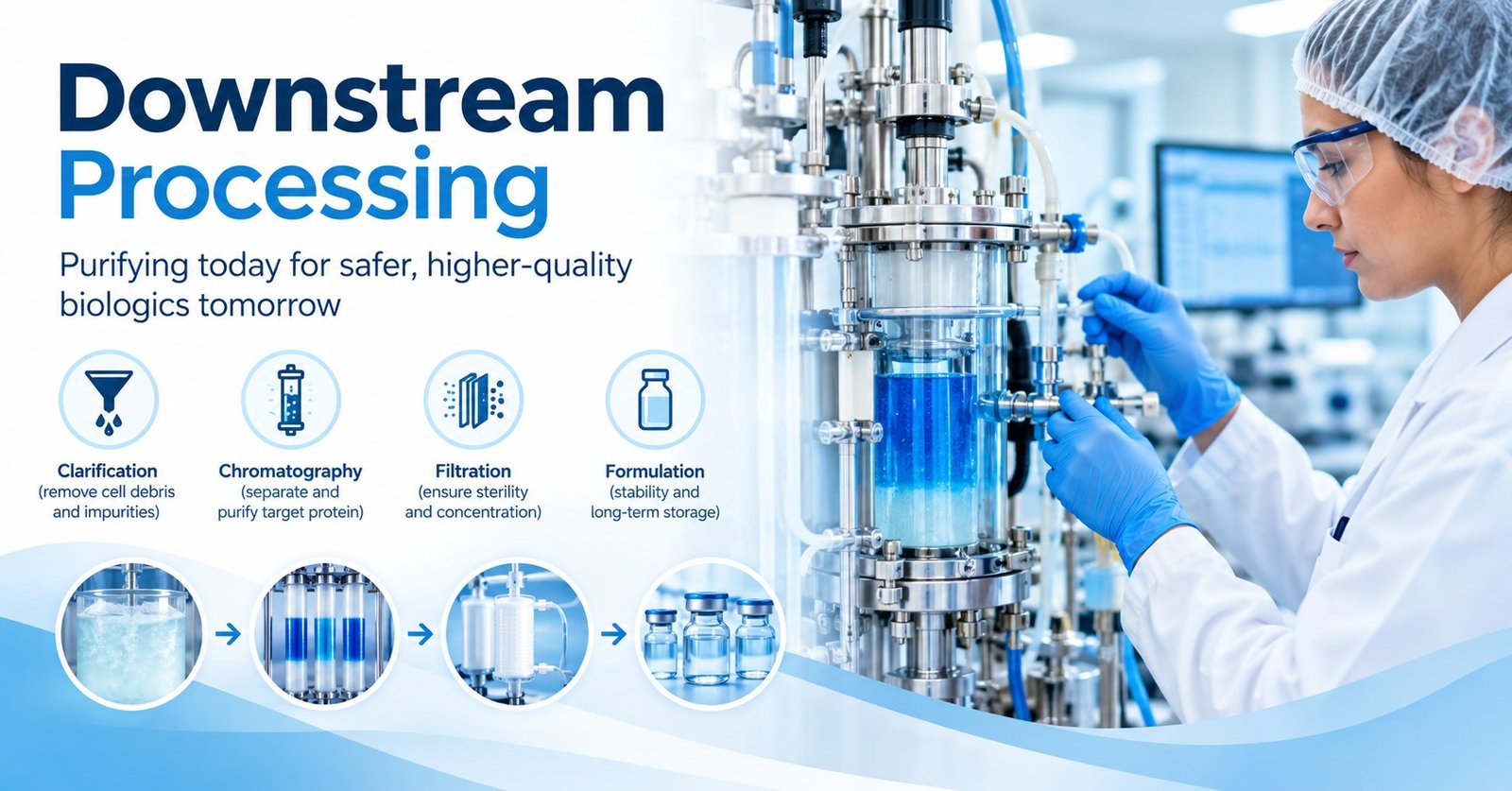
The Global Downstream Processing Market was valued at US$ 46.91 billion in 2025 and is projected to reach US$ 166.13 billion by 2034, expanding at a CAGR of 15.09% during 2026–2034. The rapid expansion of biopharmaceutical manufacturing, increasing biologics pipelines, adoption of single-use technologies, and growing investments in process intensification are reshaping the industry. Downstream processing has become a critical commercial component of biomanufacturing because manufacturers must efficiently recover, purify, concentrate, and formulate biological products while maintaining quality, yield, and regulatory compliance.
Market Opportunities
The Downstream Processing Market is benefiting from a fundamental shift in biopharmaceutical manufacturing toward flexible, scalable, and highly integrated production systems. Increasing production of monoclonal antibodies, recombinant proteins, vaccines, biosimilars, and advanced therapies is creating demand for purification technologies capable of handling higher product titers and increasingly complex molecules.
Key industry opportunities include:
- Single-use purification systems: Disposable equipment can reduce cleaning and sterilization requirements while supporting faster facility changeovers.
- Process intensification: Manufacturers are seeking higher throughput with lower buffer consumption, shorter processing cycles, and smaller facility footprints.
- Continuous downstream processing: Integrated workflows can reduce intermediate hold times and improve manufacturing cadence.
- Advanced chromatography: Higher-capacity resins and membrane chromatography are being developed to improve purification productivity.
- Digital process control: Automation, process analytical technology, and data analytics are improving process visibility and consistency.
- Cell and gene therapy manufacturing: Complex therapeutic modalities are creating demand for specialized downstream purification platforms.
These opportunities are particularly important as biopharmaceutical manufacturers attempt to increase output without proportionally increasing capital expenditure and manufacturing complexity.
Download Sample PDF: https://www.theinsightpartners.com/sample/TIPBT00002217
Biopharmaceutical Manufacturing Drives Market Expansion
The strongest demand for downstream processing technologies comes from the expanding biopharmaceutical manufacturing industry. Biologics typically require multiple purification stages following upstream production, making downstream processing essential to commercial manufacturing.
Monoclonal antibodies remain an important application area, while the pipeline is increasingly populated by more complex modalities, including bispecific antibodies, antibody-drug conjugates, antibody fragments, and Fc-fusion proteins. This changing product mix is increasing the need for purification processes that can be adapted to different molecular characteristics. Thermo Fisher Scientific notes that next-generation antibody modalities are challenging the conventional assumptions surrounding standardized Protein A purification workflows.
For manufacturers, the commercial priority is no longer simply achieving purification at laboratory scale. Processes must demonstrate reproducibility during technology transfer and scale-up while maintaining yield, impurity clearance, and product quality.
Downstream Processing Is Becoming a Manufacturing Bottleneck
Increasing upstream productivity is placing greater pressure on downstream operations. Higher cell densities and titers can generate larger product and impurity loads that downstream systems must handle efficiently.
Industry developments indicate that downstream processing is increasingly being treated as a strategic manufacturing constraint rather than a collection of independent unit operations. Thermo Fisher Scientific highlights the importance of coordinating harvest, clarification, purification, and automation when scaling intensified monoclonal antibody manufacturing.
The economic significance is substantial. According to Sartorius, downstream operations can account for approximately half of monoclonal antibody manufacturing cost of goods, while chromatography alone can contribute around 25%–30%.
This creates a strong business case for investments that can improve purification capacity, reduce processing time, and lower consumable and facility requirements.
Single-Use Technology Reshapes Facility Economics
Single-use technology is becoming increasingly important across downstream manufacturing. Disposable filtration assemblies, bags, connectors, and chromatography systems can support flexible production while reducing dependence on fixed stainless-steel infrastructure.
For multi-product manufacturing facilities, the ability to change campaigns rapidly can have significant operational value. Single-use systems can also reduce cleaning and sterilization requirements, which can shorten turnaround periods.
Current industry developments show that single-use technology is increasingly being combined with continuous processing and modular facility design. Thermo Fisher Scientific identifies flexible single-use systems as an important tool for reducing cleaning requirements, accelerating changeovers, and enabling modular scalability.
Process Intensification Creates New Commercial Value
Process intensification is one of the most significant technology trends influencing the Downstream Processing Market. Rather than simply increasing equipment size, manufacturers are exploring ways to increase productivity within existing or smaller footprints.
Technologies being evaluated and deployed include:
- High-capacity chromatography resins
- Membrane chromatography
- Rapid-cycling purification
- Continuous virus inactivation
- Automated buffer management
- Integrated filtration systems
- Connected downstream workflows
Sartorius reports that integrated process intensification approaches can potentially improve productivity while reducing cost of goods and manufacturing footprint. The company has also reported a 72-hour operation of multiple connected downstream modules as part of its work toward continuous processing.
For manufacturers, these developments are commercially relevant because lower cycle times and better equipment utilization can improve facility economics.
Cell and Gene Therapies Expand the Addressable Industry
The growth of cell and gene therapy manufacturing is creating another important avenue for downstream processing technology providers. These products can require specialized purification and concentration approaches that differ from conventional monoclonal antibody manufacturing.
Manufacturers increasingly require flexible platforms capable of supporting smaller batches, customized workflows, and stringent quality requirements. As advanced therapies move toward commercial production, downstream technology suppliers have opportunities to develop systems tailored to these specialized manufacturing environments.
Competitive Landscape
The Downstream Processing Market includes major life sciences, bioprocessing, and technology companies supplying purification equipment, filtration systems, chromatography solutions, single-use components, and integrated manufacturing platforms.
Key companies include:
- Thermo Fisher Scientific Inc.
- GE HealthCare Technologies Inc.
- Merck KGaA
- Danaher Corporation
- 3M Company
- Repligen Corporation
- Lonza Group AG
- Eppendorf SE
- Corning Incorporated
- Sartorius AG
Competition is increasingly centered on technology performance, scalability, consumable efficiency, automation capabilities, system integration, and the ability to support customers from process development through commercial manufacturing.
Purchase a Copy of this report: https://www.theinsightpartners.com/buy/TIPBT00002217
Future Outlook
The future of the Downstream Processing Market will be shaped by the industry’s transition toward more flexible, automated, intensified, and connected biomanufacturing. Manufacturers are increasingly evaluating downstream operations based on their contribution to overall production economics rather than treating purification as an isolated process step.
Single-use technologies are expected to remain important for flexible facilities, while continuous processing and process intensification are likely to gain further attention as manufacturers seek greater throughput and improved asset utilization. Advanced chromatography, membrane-based purification, automation, and real-time analytics will continue to support the evolution of downstream workflows.
1. What is driving the growth of the Downstream Processing Market?
The market is primarily driven by increasing biopharmaceutical production, rising demand for monoclonal antibodies and other biologics, expansion of biosimilar manufacturing, adoption of single-use systems, and growing investments in advanced purification technologies.
2. How are single-use and continuous processing technologies influencing the Downstream Processing Market?
Single-use systems can improve manufacturing flexibility by reducing cleaning and sterilization requirements, while continuous processing can support higher productivity and more streamlined workflows. Together, these technologies are helping biopharmaceutical manufacturers optimize production efficiency, facility utilization, and operational costs.
3. What is the projected market size of the Downstream Processing Market by 2034?
The Downstream Processing Market is projected to reach US$ 166.13 billion by 2034, compared with US$ 46.91 billion in 2025, representing a CAGR of 15.09% during 2026–2034.
Also Available in: Korean | German | Japanese | French | Chinese | Italian | Spanish
Related Reports:
Technetium-99m Market Share, Demand & Forecast 2031
Natural Albumin Market Opportunities & Forecast to 2031
About Us
The Insight Partners is a one-stop provider of actionable industry research and intelligence. We help our clients get solutions to their research requirements through our syndicated and consulting research services. We specialize in industries such as Semiconductor and Electronics, Aerospace and Defense, Automotive and Transportation, Healthcare IT, Manufacturing and Construction, Medical Devices, Technology, Media and Telecommunications, Food and Beverages, Consumer Goods, and Chemicals and Materials.
Contact Us
Contact Person: Ankit Mathur
Phone: +1-646-491-9876
E-mail : sales@theinsightpartners.com