Bio-Based Construction Polymer Market (2026 – 2033)
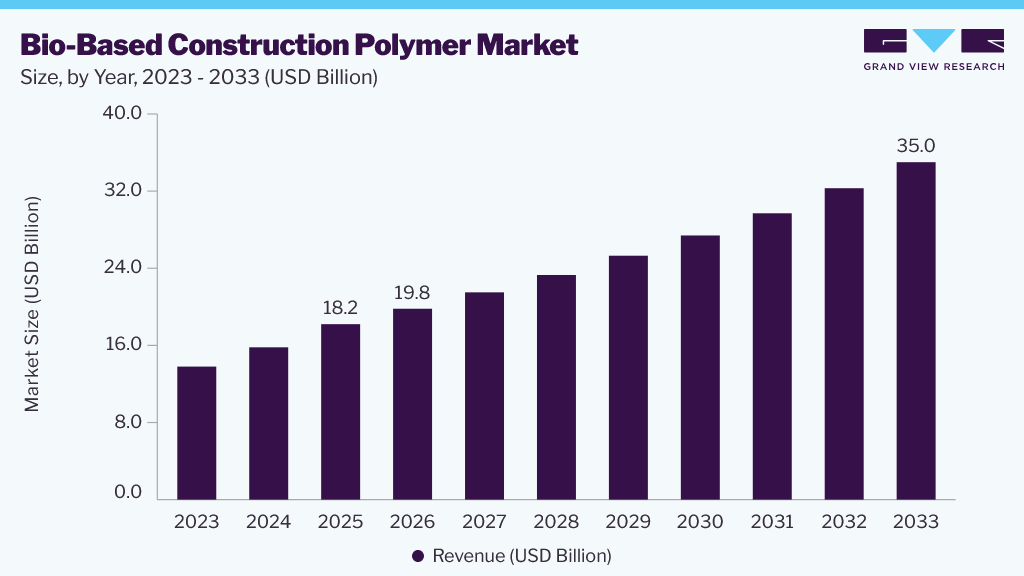
Bio-based Construction Polymers Market Summary
The global bio-based construction polymer market size was valued at USD 18.2 billion in 2025 and is projected to grow from USD 19.8 billion in 2026 to USD 35.0 billion in 2033, at a CAGR of 8.3% from 2026 to 2033. Asia Pacific dominated the market, accounting for a revenue share of 37.0% in 2025. This anticipated growth can be attributed to the strategic utilization of renewable resources. Manufacturers have increasingly utilized biomass, agricultural waste, and other renewable feedstock as raw materials for bio-based polymers. This has aligned with sustainable construction practices, including green building solutions.
Key Market Trends & Insights
- By product: The polyethylene terephthalate (PET) segment held the largest market share of around 49.0% in 2025.
- By application: The pipes segment held the largest market share in 2025.
Regional Highlights
- Largest regional market: Asia Pacific (37.0% revenue share, 2025)
Market Size & Forecast
- Market size in 2025: USD 18.2 Billion
- Estimated market size in 2026: USD 19.8 Billion
- Projected market size by 2033: USD 35.0 Billion
- CAGR (2026-2033): 8.3%
Request a free sample copy or view report summary: https://www.grandviewresearch.com/industry-analysis/bio-based-construction-polymers-market/request/rs1
In addition, the increasing emphasis on sustainability and environmental consciousness has significantly propelled the demand for bio-based polymers. The polymers derived from natural sources offer an eco-friendly alternative to traditional petroleum-based plastics. The production of bio-based polymers emits fewer greenhouse gases compared to petroleum-based plastics. This reduction in carbon footprint is crucial for mitigating climate change. Additionally, bio-based polymers exhibit biodegradability and compostability as they break down naturally without leaving persistent microplastics.
Furthermore, governments and organizations’ increasing prioritization of waste reduction with LEED certification has resulted in the increased usage of bio-based construction polymers. Government investments have increased in research and development to create environmentally friendly, renewable products, further leading to the increased utilization of bio-based polymers in the construction industry.
However, high production costs and underdeveloped global supply chains may impede further growth. Despite growing demand for bio-based products, the market has yet to fully capitalize on economies of scale and compete with well-established petroleum-based alternatives.
Product Insights
Polyethylene terephthalate (PET) dominated the market, with 49.0% of the share in 2025. This is attributable to the continued volatility in petroleum prices, which has driven manufacturers and consumers toward sustainable alternatives. Bio-based PET, derived from renewable feedstocks, offers a relatively more stable, eco-friendly option than petroleum-based plastics. Moreover, as environmental awareness grows, manufacturers increasingly utilize bio-based PET as a recyclable, biodegradable, and renewable material for construction.
Polyurethane (PU) is expected to grow substantially during the forecast period, owing to the increasing demand for rigid foam. These materials have excellent thermal insulation properties, which contribute to energy efficiency and reduce the negative impact on the environment. Moreover, the material’s superior qualities, including corrosion resistance, strength, and lightweight design, have made it an ideal option for applications in pipes, panels, flooring, and roofing.
Application Insights
Pipes accounted for the dominant market share in 2025 as bio-based polymers are extensively applied in pipe insulation and fittings. With regulations tightening around energy conservation, the market witnessed a significant demand for bio-based polymers for their thermal properties to enhance energy efficiency in pipes and panels that are essential components in buildings. In addition, the shift toward bio-based materials aligns with global efforts to reduce carbon emissions. The construction industry increasingly seeks eco-friendly materials, including bio-based polymers, as a renewable alternative to traditional plastics, which makes them ideal for pipe applications.
Insulation is expected to emerge as the fastest-growing segment during the forecast period. This can be credited to the increasing demand for polyurethane, which has insulation properties. These materials are mainly applied in coatings, paints, adhesives, and other construction polymers, particularly in Europe and the U.S.
Regional Insights
The North America bio-based construction polymer market held a share of 22.0% in 2025. The region’s escalating construction activities and rapid urbanization have primarily driven the demand for sustainable building materials, including bio-based polymers. Moreover, North American governments have actively promoted green practices with initiatives aimed at reducing carbon footprints to encourage renewable alternatives.
Bio-Based Construction Polymer Market Report Scope
|
Report Attribute |
Details |
|
Market size in 2025 |
USD 18.2 billion |
|
Estimated market size in 2026 |
USD 19.8 billion |
|
Projected market size by 2033 |
USD 35.0 billion |
|
Growth rate |
CAGR of 8.3% from 2026 to 2033 |
|
Base year for estimation |
2025 |
|
Historical data |
2021 – 2024 |
|
Forecast period |
2026 – 2033 |
|
Quantitative units |
Revenue in USD billion, and CAGR from 2026 to 2033 |
|
Report coverage |
Revenue forecast, company ranking, competitive landscape, growth factors, and trends |
|
Segments covered |
Product, application, region |
|
Regional scope |
North America; Europe; Asia Pacific; Latin America; MEA |
|
Country scope |
U.S.; Canada; Mexico; Germany; UK; France; Italy; Spain; Russia; Denmark; Sweden; Norway; China; Japan; India; South Korea; Australia; Indonesia; Vietnam; Brazil; Argentina; Saudi Arabia; UAE; South Africa; Kuwait |
|
Key companies profiled |
BASF; Evonik Industries AG; MITSUBISHI GAS CHEMICAL COMPANY, INC.; NatureWorks LLC.; BIO ON SpA; TOYOBO CO., LTD.; DuPont; TEIJIN LIMITED; Avient Corporation; Tate & Lyle; Zhejiang Hisun Biomaterials Co., Ltd; KANEKA CORPORATION; SK chemicals; BEWI; Green Dot Bioplastics Inc.; Solvay; Trinseo; WorldCentric.com |
|
Customization scope |
Free report customization (equivalent up to 8 analysts working days) with purchase. Addition or alteration to country, regional & segment scope. |
|
Pricing and purchase options |
Avail of customized purchase options to meet your exact research needs. Explore purchase options |