AI in Medical Diagnostics Market to Reach US$ 106.36 Billion by 2033 at 44.6% CAGR
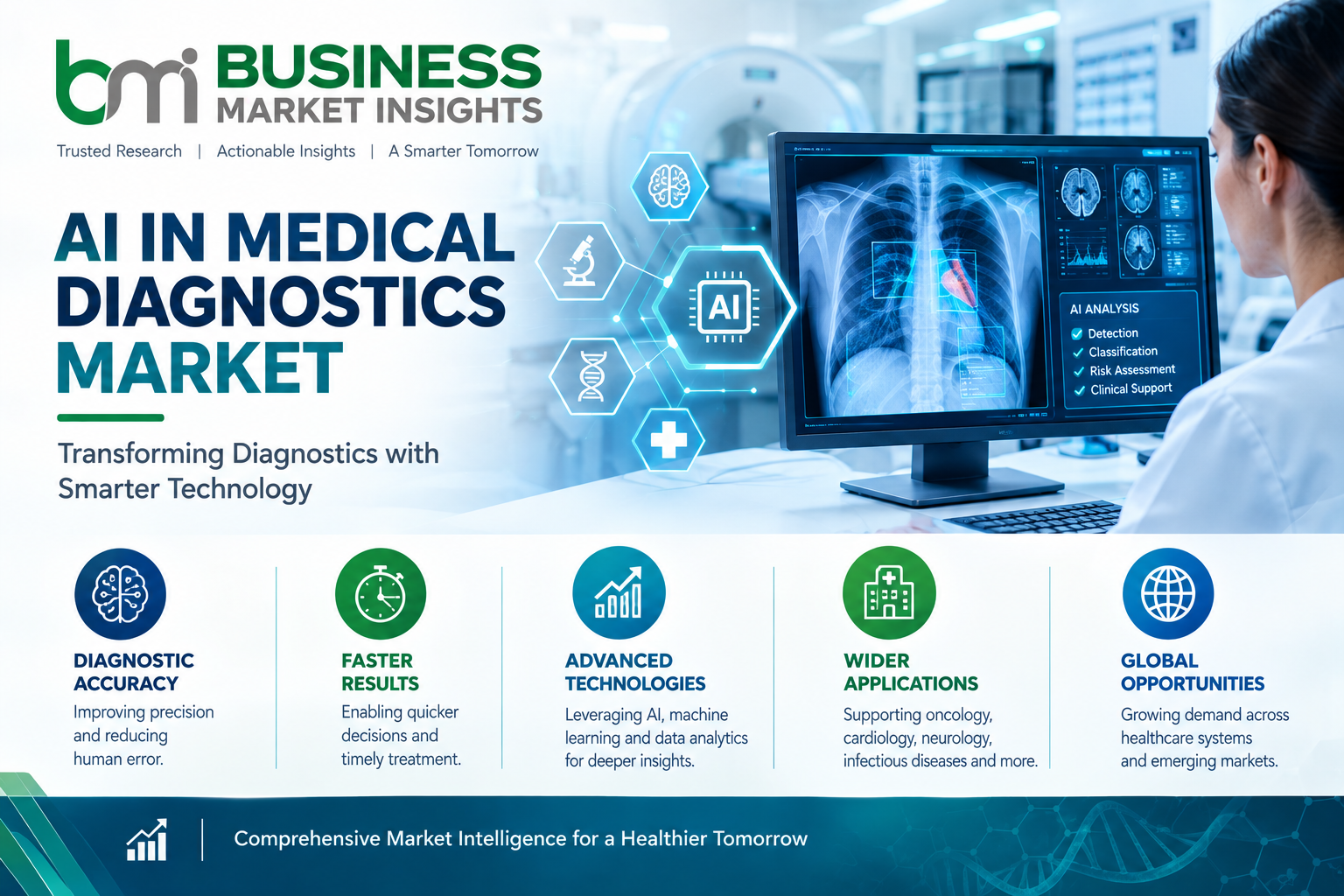
The AI in Medical Diagnostics Market size was valued at US$ 5.57 billion in 2025 and is projected to reach US$ 106.36 billion by 2033, growing at a CAGR of 44.6% during 2026–2033. Growth is driven by increasing adoption of artificial intelligence in healthcare, rising demand for early disease detection, expanding integration of AI-powered imaging analysis tools, growing clinical workload pressures, and advancements in machine learning and deep learning technologies.
AI in medical diagnostics uses artificial intelligence technologies to analyze medical images, clinical information, pathology data, and other healthcare datasets to support disease detection, diagnosis, risk assessment, and clinical decision-making. Increasing healthcare digitization and the availability of large clinical datasets are supporting the development of AI-enabled diagnostic platforms across hospitals, diagnostic centers, laboratories, and other healthcare settings.
Market Overview
The global AI in Medical Diagnostics Market is expanding rapidly as healthcare organizations seek technologies capable of improving diagnostic efficiency, supporting clinicians, and managing increasing volumes of medical data. AI-powered solutions are being integrated into radiology, pathology, oncology, neurology, and clinical decision-support workflows.
The market is projected to increase from US$ 5.57 billion in 2025 to US$ 106.36 billion by 2033, representing a CAGR of 44.6% during the forecast period. Solutions/Software accounted for 72%–76% of the market in 2025 and is projected to grow at a CAGR of 44.8%–45.6%. Oncology represented 28%–32% of market revenue and is expected to register a CAGR of 46.2%–47.0% through 2033.
Sample PDF
Explore detailed market insights, regional analysis, segment-level forecasts, and competitive information in the sample report:
https://www.businessmarketinsights.com/sample/BMIPUB00036161
Key Market Drivers
Rising Adoption of AI-Assisted Diagnostic Imaging
Diagnostic imaging is one of the major areas of artificial intelligence adoption in healthcare. AI-powered imaging solutions can assist clinicians with image interpretation, abnormality detection, case prioritization, and workflow optimization. Growing imaging volumes and demand for faster reporting are supporting adoption across hospitals and diagnostic centers.
Growing Demand for Early Disease Detection
Early detection is increasingly important for cancer, cardiovascular conditions, neurological disorders, and other chronic diseases. AI technologies can analyze large datasets and identify patterns that support earlier detection and clinical assessment. Healthcare systems are therefore increasing their focus on AI-enabled diagnostic technologies that can support preventive and proactive care.
Increasing Integration of AI into Clinical Workflows
Hospitals and healthcare organizations are integrating AI tools into clinical workflows to automate repetitive activities, analyze patient information, and provide actionable insights. Integration with electronic health records, imaging systems, and hospital information platforms is supporting broader deployment of AI-powered diagnostic solutions.
Key Market Trends
A major trend is the growing use of AI-powered diagnostic platforms across radiology and pathology. These solutions can process large volumes of medical images and pathology slides, supporting disease classification, abnormality detection, and clinical workflow management.
Another important trend is the integration of AI with precision medicine. Healthcare organizations are increasingly combining clinical, imaging, and other healthcare data with machine learning technologies to support more personalized diagnostic and treatment pathways.
The market is also moving toward cloud-based and scalable AI platforms. Cloud infrastructure can support access to computational resources and facilitate deployment across multiple healthcare facilities, while edge AI technologies can support localized processing for selected diagnostic applications.
Technological Advancements
Machine learning remains a core technology supporting AI-enabled diagnostics, particularly in pattern recognition, medical image analysis, disease prediction, and clinical decision support. Natural language processing is increasingly used to extract information from electronic health records, physician notes, pathology reports, and other clinical documentation.
Other technological developments include deep learning, computer vision, neural networks, predictive analytics, and AI-enabled workflow automation. These technologies are expanding the ability of diagnostic platforms to process complex healthcare datasets and generate clinically relevant insights.
Global Market Insights
North America accounted for 39%–42% of global revenue in 2025 and is projected to grow at a CAGR of 43.0%–43.8% during 2026–2033. The United States represented 34%–37% of global revenue and is projected to register a CAGR of 43.2%–44.0%. Advanced healthcare infrastructure, digital health investment, increasing imaging volumes, and widespread adoption of AI-enabled healthcare technologies are supporting regional growth.
Europe represented 26%–29% of global revenue in 2025 and is expected to expand at a CAGR of 43.5%–44.3%. Germany remains a leading market, while Poland is projected to register the fastest country-level growth at a CAGR of 44.5%–45.3%. Healthcare digitization, AI-assisted imaging adoption, and investments in precision healthcare are supporting regional expansion.
Asia Pacific accounted for 24%–27% of global revenue in 2025 and is projected to remain the fastest-growing region, registering a CAGR of 46.5%–47.4%. China represents the largest market in the region, while India is projected to record the highest growth at 47.1%–48.0%. Healthcare digitization, increasing patient volumes, rising chronic disease prevalence, and expanding AI investment are supporting adoption.
Rest of World represented 5%–8% of global revenue in 2025 and is projected to grow at a CAGR of 42.5%–43.3%. Healthcare modernization, expanding digital infrastructure, and increasing awareness of AI-enabled diagnostics are contributing to market development.
Explore additional industry insights and market perspectives at:
https://www.businessmarketinsights.com/industry-overview/ai-in-medical-diagnostics-market
Market Segmentation
The AI in Medical Diagnostics Market is segmented by:
Component:
- Solutions/Software
- Services
Technology:
- Machine Learning
- Natural Language Processing
- Others
Specialty:
- Oncology
- Neurology
- Pathology
- Others
End User:
- Hospitals & Clinics
- Diagnostics & Imaging Centers
- Others
Solutions/Software accounted for 72%–76% of market revenue in 2025 and remains the leading component segment. Oncology represented 28%–32% of the market and is projected to record the fastest growth among the specialties covered in the report.
Key Market Opportunities
Rising Adoption in Pathology and Radiology
The digitization of pathology and radiology is creating opportunities for AI-powered image analysis and diagnostic support. Healthcare organizations are deploying AI to process medical images and pathology slides, improve workflow efficiency, and assist specialists with disease classification and abnormality detection.
Expansion of AI Diagnostics in Emerging Markets
Emerging healthcare markets are investing in digital infrastructure and AI technologies to improve access to diagnostic services. AI-assisted platforms can support healthcare systems facing increasing diagnostic workloads and shortages of specialized healthcare professionals.
Growth of Point-of-Care AI Diagnostic Solutions
AI-enabled point-of-care diagnostic solutions offer opportunities for faster assessment closer to patients. Portable platforms, cloud computing, mobile healthcare technologies, and edge AI are supporting the development of diagnostic solutions for urban, remote, and decentralized healthcare settings.
Challenges
Stringent Regulatory Approval Requirements
Factor: AI-powered medical diagnostic solutions must meet regulatory requirements related to patient safety, accuracy, transparency, clinical effectiveness, and product validation.
Impact: Regulatory processes can increase development timelines and commercialization costs. Companies must invest in clinical evidence, quality management, validation, and compliance activities before bringing solutions to market.
Limited Availability of High-Quality Clinical Data
Factor: AI models require large, diverse, accurate, and well-annotated clinical datasets to develop reliable diagnostic capabilities.
Impact: Limited data availability can affect model performance and generalizability across patient populations. Data access, interoperability, privacy requirements, and standardization can also influence development and deployment timelines.
Recent Developments
- July 2026: Philips launched the Alturion ultrasound system featuring AI-powered workflows, advanced imaging, and automated measurement capabilities for high-volume healthcare environments.
- July 2026: CellCarta launched its Global Digital Pathology and AI Consortium to support biomarker discovery, patient stratification, and AI-enabled drug development.
- May 2026: NVIDIA Corporation announced a partnership with Foxconn and leading medical centers in Taiwan to deploy coordinated agentic and physical AI workforces for AI-driven health systems.
- March 2026: Roche announced an expansion of its global AI infrastructure through deployment of a large-scale AI factory powered by NVIDIA accelerated computing to support development of therapeutics and diagnostics solutions.
Premium Research Report
https://www.businessmarketinsights.com/buy/BMIPUB00036161
Strategic Analysis
Competition in the AI in Medical Diagnostics Market involves global technology companies, healthcare AI specialists, diagnostic software providers, cloud technology companies, and medical imaging solution developers. Companies are focusing on machine learning algorithms, medical imaging analytics, digital pathology, predictive diagnostics, and clinical decision-support technologies.
Strategic activity is increasingly centered on integrating AI with healthcare information systems, imaging workflows, precision medicine platforms, and clinical data environments. Partnerships between technology companies and healthcare organizations are also supporting the development and deployment of AI-powered diagnostic solutions.
Market Forecast by 2033
The AI in Medical Diagnostics Market is projected to reach US$ 106.36 billion by 2033 from US$ 5.57 billion in 2025, expanding at a CAGR of 44.6% during 2026–2033. Market development will be supported by AI-assisted imaging, early disease detection, clinical workflow integration, healthcare digitization, and continued advances in machine learning and related technologies.
Trending Related Reports
- Precision Diagnostics Market — Covers advanced diagnostic technologies, molecular testing, genomic applications, and precision healthcare.
- Cancer Diagnostics Market — Covers diagnostic technologies supporting cancer detection, assessment, and clinical management.
- Medical Lasers Market — Covers medical laser technologies and their applications across healthcare settings.
- Medical Robotic Systems Market — Covers robotic-assisted healthcare technologies, surgical robotics, rehabilitation systems, and hospital automation.
About Us
Business Market Insights is a market research platform that provides subscription service for industry and company reports. Our research team has extensive professional expertise in domains such as Electronics & Semiconductor; Aerospace & Defense; Automotive & Transportation; Energy & Power; Healthcare; Manufacturing & Construction; Food & Beverages; Chemicals & Materials; and Technology, Media, & Telecommunications.
Contact us:
If you have any questions about this report or would like further information, please contact us:
Contact person: Ankit Mathur
Email: sales@businessmarketinsights.com
Phone: +16467917070