Agricultural Genotyping Market to Reach US$ 11.84 Billion by 2034 as Genomic Technologies Accelerate Crop Breeding and Climate-Resilient Agriculture
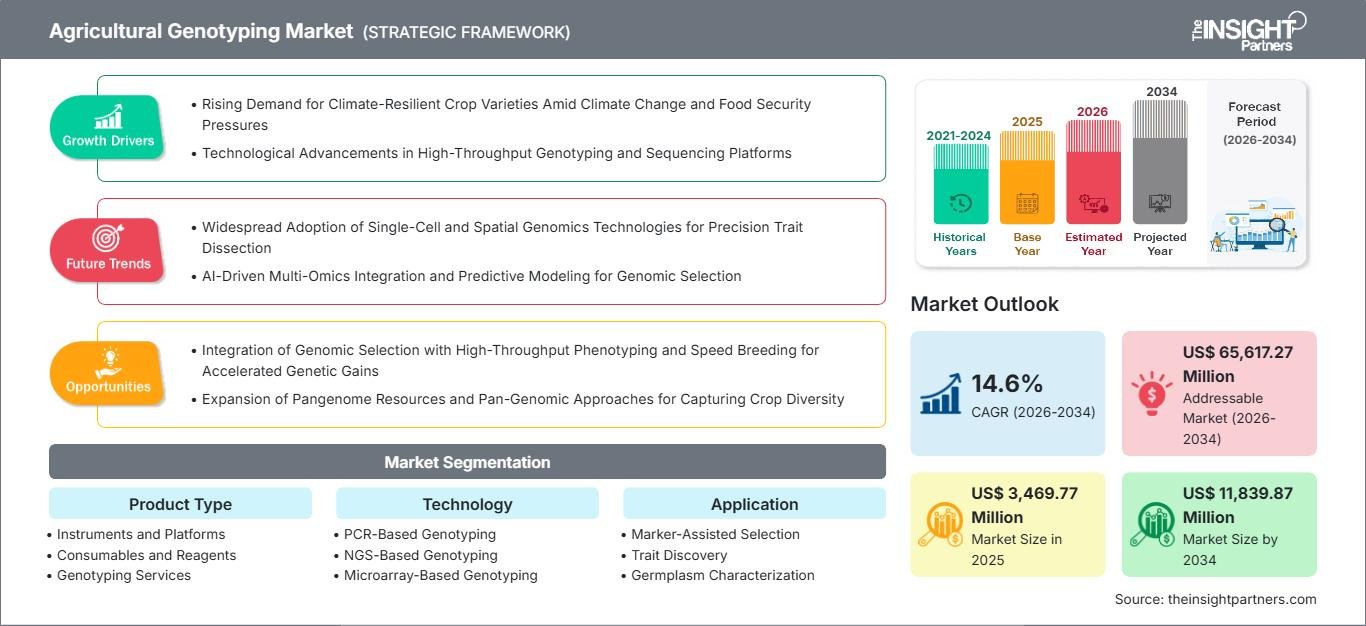
Agricultural Genotyping Market is projected to grow from US$ 3.47 billion in 2025 to US$ 11.84 billion by 2034, expanding at a CAGR of 14.6% from 2026 to 2034
The global Agricultural Genotyping Market is expanding rapidly as agricultural biotechnology companies, commercial seed producers, research institutions, and government agencies increasingly adopt molecular technologies to accelerate crop improvement and strengthen genetic quality control. According to the latest market analysis published by The Insight Partners, the Agricultural Genotyping Market was valued at approximately US$ 3,469.77 million in 2025 and is projected to reach US$ 11,839.87 million by 2034, registering a 14.6% CAGR from 2026 to 2034.
The increasing application of molecular markers, sequencing technologies, automated laboratory workflows, and bioinformatics is transforming conventional crop breeding. Agricultural genotyping enables breeders to identify desirable genetic traits, validate them, characterize germplasm, test genetic purity, and accelerate selection of breeding material. These capabilities are becoming increasingly important as the agriculture industry responds to climate variability, food-security requirements, disease pressure, and the need to develop higher-performing crop varieties.
Download Sample PDF @ https://www.theinsightpartners.com/sample/TIPRE00043819
Growing Demand for Faster and More Precise Crop Breeding
One of the primary factors supporting the Agricultural Genotyping Market growth is the increasing need to shorten breeding cycles while improving the accuracy of selection. Traditional breeding programs can require extensive field evaluation over multiple growing seasons. Genotyping allows breeders to identify genetic markers associated with desirable traits at an earlier stage, helping reduce the number of plants requiring detailed phenotypic evaluation.
Commercial seed companies are increasingly integrating genomic information into breeding pipelines to support parental selection, trait validation, genetic purity assessment, and genomic selection. As breeding programs process larger populations, demand is also increasing for scalable laboratory workflows capable of handling high sample volumes with consistent turnaround times.
The market is moving beyond individual laboratory assays toward integrated workflows covering sample preparation, DNA analysis, sequencing, genotyping, quality control, bioinformatics, and data interpretation. This transition is creating opportunities for technology providers and service companies offering comprehensive genotyping solutions.
Climate-Resilient Agriculture Creates New Growth Opportunities
Climate change and increasing environmental variability are encouraging agricultural researchers and seed developers to focus on drought tolerance, heat resistance, salinity tolerance, disease resistance, and yield stability. Genotyping technologies can help identify favorable alleles associated with these characteristics and support the development of crop varieties adapted to changing environmental conditions.
The growing emphasis on climate-resilient agriculture is expanding demand for marker panels capable of evaluating multiple traits. Agricultural biotechnology companies and breeding organizations are therefore looking for flexible and scalable genotyping workflows that can accommodate different crops, breeding populations, marker densities, and research objectives.
Genotyping is also becoming increasingly relevant to food security initiatives. Public research programs and agricultural institutions are using genomic information to characterize genetic resources, identify useful traits, and support crop improvement programs suited to local environmental conditions.
NGS-Based Genotyping and Advanced Genomic Workflows Gain Momentum
The Agricultural Genotyping Market includes several technologies, including PCR-based genotyping, next-generation sequencing (NGS)-based genotyping, microarray-based genotyping, SNP genotyping, genotyping-by-sequencing (GBS), and other approaches.
PCR-based genotyping continues to provide a cost-effective option for targeted, high-volume screening. Meanwhile, NGS-based genotyping is gaining importance for high-density genetic characterization, marker discovery, and complex genomic analysis.
According to The Insight Partners, NGS-based genotyping represented approximately 17–21% of the market in 2025 and is projected to register a CAGR of 17.5–18.5% through 2034, making it a significant high-growth technology segment.
The increasing availability of sequencing infrastructure, targeted sequencing workflows, automation, and analytical tools is expected to further support adoption. Genotyping-by-sequencing is also valuable for breeding programs working with diverse germplasm or populations where comprehensive reference resources may be limited.
Get Full Copy @ https://www.theinsightpartners.com/buy/TIPRE00043819
Consumables and Reagents Represent a Significant Market Segment
Based on product type, the Agricultural Genotyping Market is categorized into instruments and platforms, consumables and reagents, and genotyping services.
Consumables and reagents represented approximately 43–47% of the market in 2025, supported by recurring requirements for assay chemistry, primers, probes, enzymes, library preparation materials, plates, and other laboratory supplies. The segment is expected to expand at a CAGR of 13.8–14.7% through 2034.
Genotyping services are also gaining importance as organizations seek access to specialized sequencing, assay development, laboratory processing, and bioinformatics capabilities without making equivalent investments in internal infrastructure.
North America Maintains a Leading Position
North America accounted for approximately 38–40% of Agricultural Genotyping Market revenue in 2025. The region benefits from established commercial seed companies, advanced agricultural biotechnology capabilities, university research programs, and mature laboratory infrastructure.
The US represents approximately 64–68% of North American demand, supported by extensive corn, soybean, cotton, wheat, and specialty crop breeding activities. Demand is being supported by applications including marker-assisted selection, trait discovery, genetic purity testing, and disease-resistance screening.
Europe represented approximately 25–27% of market revenue in 2025, with Germany, the UK, France, Italy, and Spain contributing to regional demand through agricultural research, seed development, biotechnology, and crop improvement programs.
Asia Pacific Emerges as a High-Growth Regional Market
Asia Pacific accounted for approximately 23–25% of the Agricultural Genotyping Market in 2025 and is projected to register a CAGR of 16.0–17.0% through 2034. China, Japan, India, South Korea, and Australia are key markets supporting regional expansion.
The region’s growth is associated with increasing investment in agricultural biotechnology, crop improvement programs, food-security initiatives, and sequencing capabilities. India and China, in particular, offer opportunities for localized agricultural genomics capacity, while Australia has significant requirements related to grain production and drought-resilient crop development.
Integration With Digital Breeding Platforms Opens New Opportunities
The integration of genotyping results with digital breeding systems is emerging as an important industry trend. Breeders increasingly need to combine genotype data with pedigree information, phenotypic observations, environmental data, and field-trial results.
Artificial intelligence is also expected to influence the interpretation of genomic and phenotypic datasets. AI-enabled systems can support data analysis, identify relationships between genetic markers and traits, and assist breeding teams in converting large molecular datasets into actionable breeding information.
The development of interoperable data formats, automated quality-control systems, cloud-based analysis, and integrated laboratory workflows is expected to create additional opportunities for market participants.
Key Companies Operating in the Agricultural Genotyping Market
The competitive landscape includes major life sciences, genomics, agricultural biotechnology, and specialized genotyping companies. Companies analyzed in the report include Agilent Technologies Inc., LGC Biosearch Technologies, Thermo Fisher Scientific Inc., Illumina, Inc., Bio-Rad Laboratories, Inc., Standard BioTools Inc., BGI Genomics, Neogen Corporation, Eurofins Scientific SE, QIAGEN N.V., Bayer AG, Syngenta AG, BASF SE, MolBreeding Biotech, AgriPlex Genomics, Ag-Biotech, Inc., Orion Genomics, Plant Sciences Genetics, MGI Tech Co., Ltd., 3CR Bioscience Ltd., Advanta Seeds, Nutrien Ag Solutions, Inc., and KWS SAAT SE & Co. KGaA.
Recent industry developments highlighted by the report include Illumina’s February 2026 launch of TruPath Genome, Agilent Technologies’ December 2025 opening of an India Refurbishment Center in Manesar, Haryana, and Neogen Corporation’s March 2026 announcement regarding the sale of its Genomics business to Zoetis.
Future Outlook
The future of the Agricultural Genotyping Market is closely linked to the continued digitization of crop breeding and the growing requirement for faster, scalable, and data-driven genetic analysis. The expansion of localized genomics capabilities in emerging agricultural economies is expected to create opportunities for sequencing providers, genotyping service companies, laboratory technology suppliers, and agricultural biotechnology firms.
Integrated platforms combining marker technologies, automated sample processing, bioinformatics, and breeding-management systems are also expected to gain importance. As commercial and public breeding organizations increasingly seek to connect molecular data with field and environmental information, suppliers capable of supporting end-to-end workflows may find expanding opportunities across the agricultural value chain.
The global Agricultural Genotyping Market is expected to remain an important component of modern crop improvement, supporting the development of productive, genetically characterized, and climate-resilient crop varieties.
About Us
The Insight Partners, we provide comprehensive analysis and insights into market trends that empower businesses to make informed decisions. Our reports are designed to equip stakeholders with the necessary information to navigate the complexities of various industries, including healthcare, technology, and finance. We are dedicated to delivering high-quality research that enables our clients to achieve their strategic objectives.
Contact Us:
Contact Person: Ankit Mathur
E-mail: ankit.mathur@theinsightpartners.com
Phone: +1-646-491-9876