High Flow Nasal Cannula Market Growth Accelerates at 9.81% CAGR
The High Flow Nasal Cannula Market is gaining momentum as hospitals and critical care facilities increasingly adopt non-invasive respiratory support for patients with acute respiratory distress and hypoxemia. The High Flow Nasal Cannula Market size is expected to reach US$ 19.43 Billion by 2034 from US$ 8.37 Billion in 2025, registering a CAGR of 9.81% during 2026–2034. Growing demand for respiratory support, advances in heated and humidified oxygen delivery, increasing intensive care capacity, and expanding applications beyond conventional critical care are contributing to market growth.
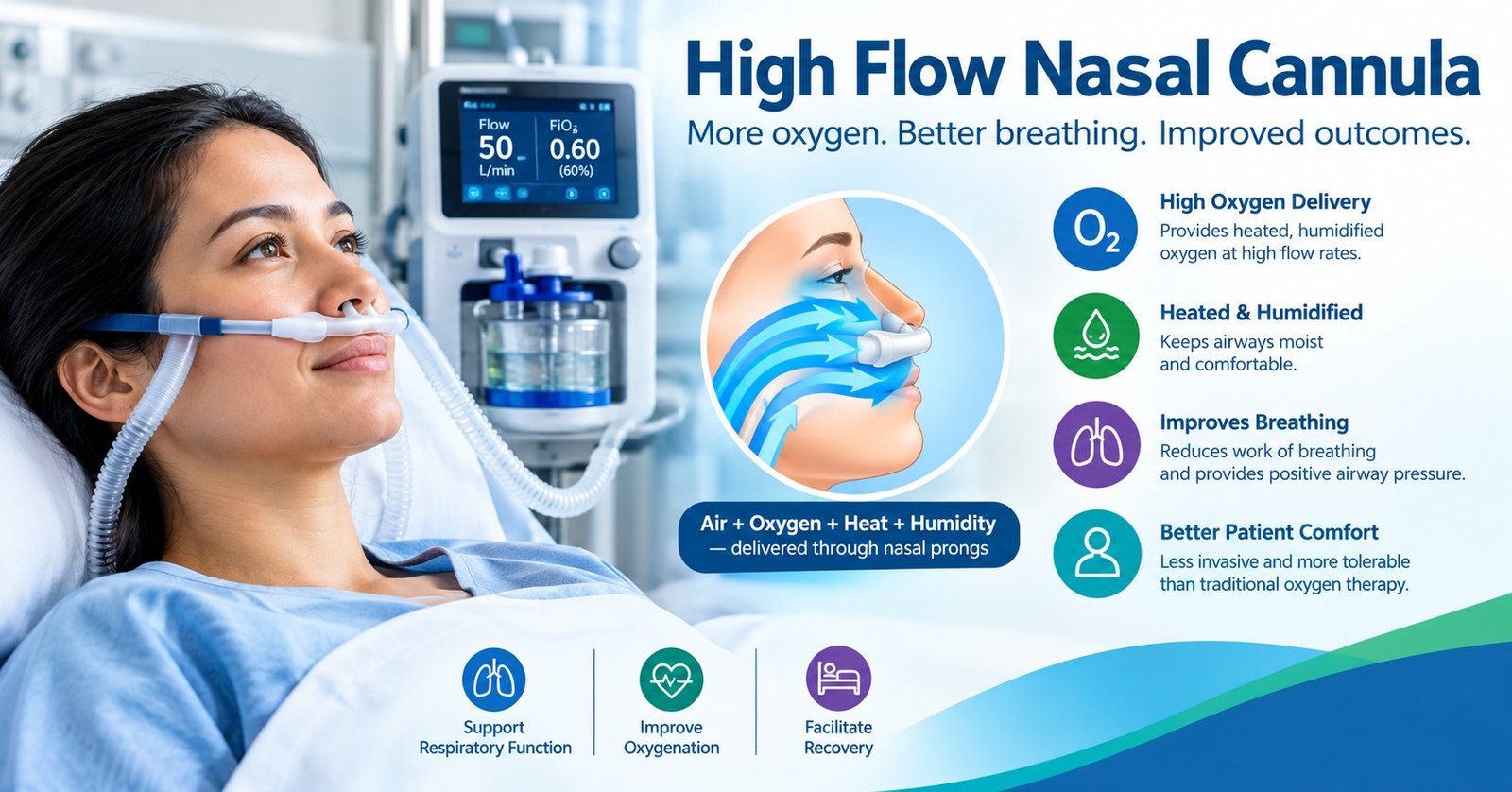
High flow nasal cannula, also known as high flow nasal oxygen, delivers heated and humidified respiratory gases through a nasal interface at substantially higher flow rates than conventional oxygen therapy. The technology can provide a more consistent fraction of inspired oxygen while improving patient comfort compared with some mask-based respiratory-support approaches. The US Food and Drug Administration classify high flow humidified oxygen delivery devices as medical devices intended to deliver high flow and/or high velocity oxygen with humidification, including systems using high flow nasal cannula.
What Is Driving the High Flow Nasal Cannula Market?
The increasing incidence of acute respiratory conditions is a major factor supporting demand for advanced oxygen-delivery technologies. High flow nasal cannula is used in intensive care units, emergency departments, postoperative care, respiratory wards, and other settings where patients require more respiratory support than conventional oxygen therapy can provide.
Another important factor is the technology’s ability to deliver warmed and humidified gases. This can improve tolerance and help reduce some of the discomfort associated with high oxygen flows.
Clinical evidence continues to shape the role of high-flow nasal cannula. A large multicenter trial published in 2026 compared high-flow oxygen with standard oxygen in patients with acute hypoxemic respiratory failure. Among 1,110 patients included in the analysis, mortality at 28 days was identical at 14.6% in both groups, while intubation occurred in 42.4% of patients receiving high-flow oxygen compared with 48.4% receiving standard oxygen.
Download Sample PDF: https://www.theinsightpartners.com/sample/TIPMD00002292
How Are Clinical Applications Expanding?
High flow nasal cannula has traditionally been associated with acute hypoxemic respiratory failure, but research is increasingly evaluating its usefulness in other settings.
A 2026 randomized clinical trial investigated high flow nasal cannula during endoscopic retrograde cholangiopancreatography, a procedure performed under sedation where hypoxemia can become a concern. The study found that high flow nasal cannula improved pulmonary gas exchange during the procedure.
Another 2026 randomized crossover study examined high flow nasal cannula during endobronchial ultrasound procedures. Researchers evaluated whether the technology could reduce the need for ventilatory support during the procedure, adding to evidence around its use in procedural respiratory management.
These applications broaden the addressable opportunity for manufacturers beyond intensive care. Procedural areas, emergency medicine, postoperative care, and respiratory wards could increasingly contribute to demand where clinically appropriate.
What Does Recent Evidence Say About High Flow Nasal Cannula?
The evidence base is becoming more nuanced. Recent research suggests that high flow nasal cannula can provide physiological benefits while also highlighting circumstances where non-invasive ventilation may remain preferable.
A 2026 systematic review and meta-analysis examining high flow nasal cannula in hypercapnic respiratory failure included 11 randomized controlled trials involving 1,069 participants. The analysis found broadly similar intubation and mortality outcomes between high flow nasal cannula and bilevel positive airway pressure, while bilevel positive airway pressure provided modest physiological advantages and high flow nasal cannula demonstrated better comfort and fewer certain complications.
Interface design is another area of innovation. A 2026 randomized crossover study found that both symmetrical and asymmetrical high flow nasal cannula interfaces reduced respiratory muscle workload compared with baseline. The asymmetrical interface produced greater reductions in respiratory rate and breathing power in some patient groups.
Such research may encourage manufacturers to focus on cannula geometry, patient comfort, humidification, flow management, and interface design rather than competing solely on oxygen-delivery performance.
Why Is Patient Comfort Important?
Patient tolerance can influence whether respiratory support is successfully maintained. Masks used for non-invasive ventilation may cause claustrophobia, pressure-related discomfort, or difficulty communicating for some patients.
High flow nasal cannula uses a nasal interface, allowing patients to remain more engaged with their surroundings and potentially communicate and eat more easily in appropriate circumstances. However, comfort does not eliminate the need for clinical monitoring.
The World Health Organization’s living guideline for severe or critical COVID-19 recommends high-flow nasal oxygen over standard oxygen therapy for hospitalized patients with acute hypoxemic respiratory failure who do not require emergent intubation. The guideline also emphasizes patient-specific considerations and acknowledges uncertainty when comparing high flow nasal oxygen with continuous positive airway pressure or non-invasive ventilation.
What Challenges Could Affect Market Growth?
Despite increasing adoption, manufacturers and healthcare providers face several challenges.
Clinical selection remains critical. High flow nasal cannula is not appropriate for every patient or every form of respiratory failure. Delayed escalation in patients who are deteriorating can have serious consequences, making monitoring and clinical protocols essential.
Device safety and reliability are also important. FDA adverse-event reports in 2026 have included reports involving high flow nasal cannula interfaces, including material damage and low oxygen saturation. These reports do not establish that the technology as a whole is unsafe, but they demonstrate the importance of device quality, inspection, maintenance, and appropriate monitoring.
Hospitals must also consider oxygen infrastructure, device costs, staff training, humidification requirements, consumables, and infection-prevention practices when expanding high flow respiratory support.
Who Are the Key Companies in the High Flow Nasal Cannula Market?
The competitive landscape includes medical-device manufacturers specializing in respiratory care, oxygen therapy, ventilation, and patient interfaces. Key companies include:
- Fisher & Paykel Healthcare Limited
- ResMed
- Great Group Medical Co., Ltd.
- Salter Labs
- TNI Medical AG
- Mek-Ics Co., Ltd.
- Flexicare Medical Limited
- Vapotherm
- Teleflex Incorporated
- Hamilton Medical
Competition is expected to center on device performance, patient comfort, humidification systems, cannula design, portability, connectivity, and integration with broader respiratory-support platforms.
Purchase a Copy of this report: https://www.theinsightpartners.com/buy/TIPMD00002292
What Is the Future of the High Flow Nasal Cannula Market?
The future of high flow nasal cannula technology is likely to be shaped by a combination of clinical evidence and product innovation. Rather than replacing conventional oxygen therapy or non-invasive ventilation across all situations, high flow nasal cannula is increasingly being positioned as one component of a broader respiratory-support strategy.
Research into interface design, respiratory muscle workload, procedural applications, and patient comfort could lead to more specialized products. At the same time, clinical protocols may become more sophisticated in identifying which patients are most likely to benefit and when escalation to other forms of respiratory support is necessary.
For manufacturers, opportunities extend beyond the cannula itself to heated humidifiers, breathing circuits, monitoring systems, disposable interfaces, and integrated respiratory-care platforms. For hospitals, the technology offers another tool for managing patients who need enhanced oxygen support without immediately proceeding to invasive ventilation.
As respiratory-care systems continue to prioritize effective, patient-centered, and flexible support, high flow nasal cannula is likely to remain an important technology within modern respiratory medicine. Its continued development will depend on evidence-based clinical use, reliable device performance, and innovations that improve both physiological support and patient experience.
Also Available in: Korean | German | Japanese | French | Chinese | Italian | Spanish
Related Reports:
Diagnostic ENT Devices Market Growth, Share & Trends by 2034
Therapeutic ENT Devices Market Share, Size & Demand by 2034
About Us
The Insight Partners is a one-stop provider of actionable industry research and intelligence. We help our clients get solutions to their research requirements through our syndicated and consulting research services. We specialize in industries such as Semiconductor and Electronics, Aerospace and Defense, Automotive and Transportation, Healthcare IT, Manufacturing and Construction, Medical Devices, Technology, Media and Telecommunications, Food and Beverages, Consumer Goods, and Chemicals and Materials.
Contact Us
Contact Person: Ankit Mathur
Phone: +1-646-491-9876
E-mail : sales@theinsightpartners.com