
Digital Signage Market to Reach US$ 56.61 Billion by 2033 at 8.9% CAGR
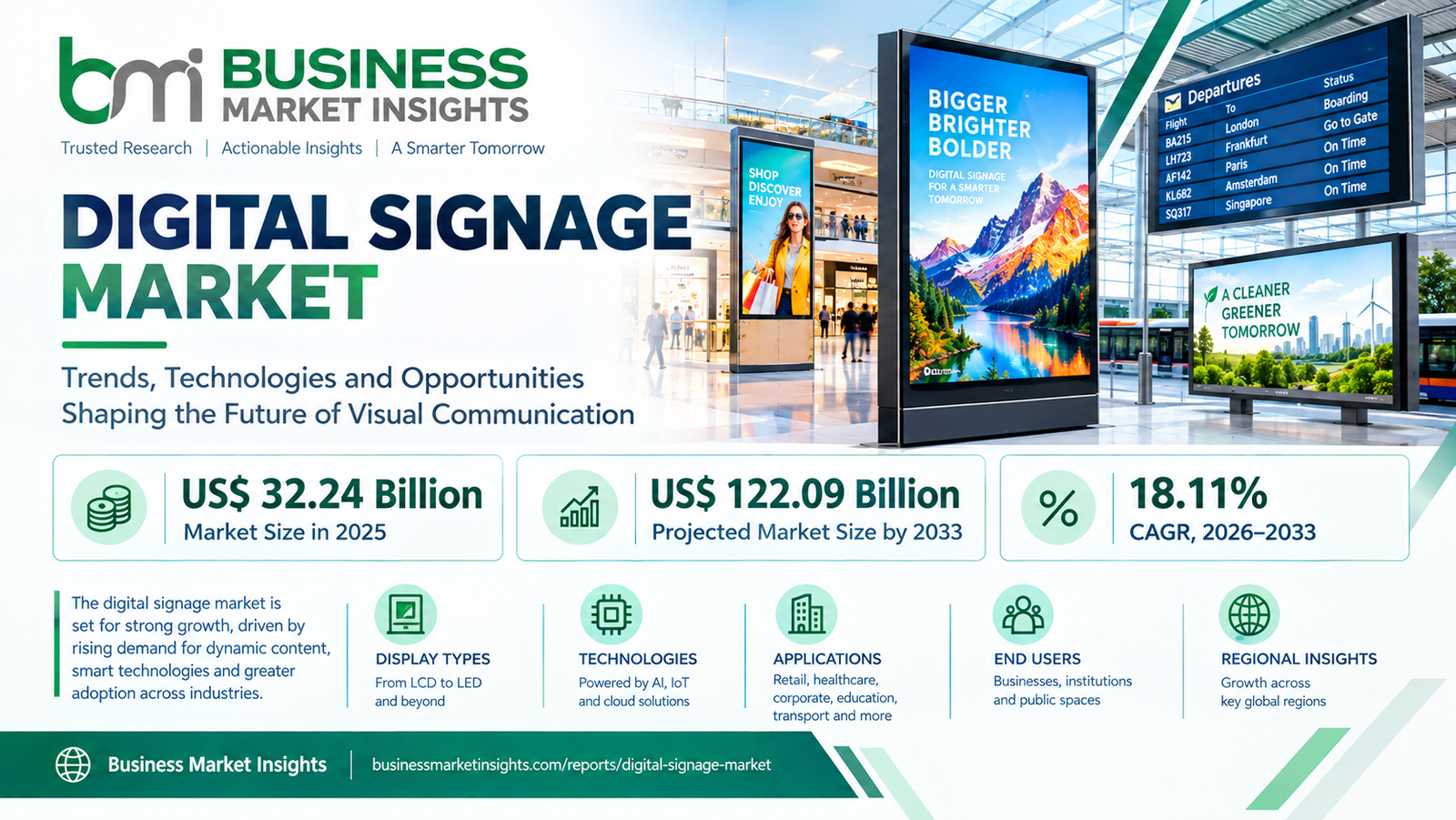
The Digital Signage Market size was valued at US$ 28.45 billion in 2025 and is projected to reach US$ 56.61 billion by 2033, growing at a CAGR of 8.9% during 2026–2033. Market expansion is driven by the growing adoption of smart retail displays, rising demand for interactive customer engagement, increasing investments in smart city projects, and the growing integration of cloud-based content management, advanced display technologies, and IoT-enabled solutions.
Digital signage comprises electronic display solutions used to deliver advertising, information, entertainment, navigation, and communication content across retail, corporate, hospitality, transportation, education, healthcare, sports, and entertainment environments. The market includes hardware, software, content, and services, with both on-premise and cloud deployment models supporting organizations across multiple locations.
Market Overview
The global Digital Signage Market is expanding as organizations replace static communication methods with dynamic and centrally managed digital displays. Advancements in commercial display technologies, cloud platforms, AI, IoT, and analytics are enabling businesses to improve customer engagement, personalize communication, and manage display networks more efficiently.
The market is projected to increase from US$ 28.45 billion in 2025 to US$ 56.61 billion by 2033. Hardware accounted for 47%–50% of market revenue in 2025 and is projected to grow at a CAGR of 8.6%–9.0%. Cloud deployment represented 37%–40% of market revenue and is projected to register a CAGR of 10.4%–10.9% during the forecast period.
Sample PDF
Access the detailed sample report covering market insights, segmentation, regional analysis, competitive landscape, and forecasts:
https://www.businessmarketinsights.com/sample/BMIPUB00036169
Key Market Drivers
Growing Adoption of Smart Retail Displays
Retailers are increasingly deploying digital signage to improve customer engagement, deliver personalized offers, support omnichannel experiences, and provide dynamic promotional content. AI-powered displays, digital menu boards, self-service kiosks, and interactive merchandising are expanding the use of digital signage across retail environments.
Rising Demand for Interactive Customer Engagement
Businesses across hospitality, healthcare, transportation, education, and corporate environments are adopting interactive displays to improve communication and customer experiences. Touchscreens, wayfinding applications, QR codes, gesture recognition, and AI-driven content personalization are increasing the functionality of digital signage systems.
Increasing Investments in Smart City Projects
Governments and infrastructure operators are integrating digital signage into smart city environments for passenger information, emergency announcements, traffic management, public safety communication, and tourism services. Connected displays supported by IoT, 5G, and cloud-based analytics are further expanding these applications.
Key Market Trends
A major trend is the transition from standalone displays toward connected digital signage ecosystems. Cloud-based platforms allow organizations to centrally manage content, schedule campaigns, monitor devices, and update multiple locations remotely.
AI and analytics are also becoming increasingly important. Intelligent signage platforms can support audience analysis, personalized content delivery, device monitoring, and data-driven campaign optimization.
Another important trend is the adoption of advanced display technologies such as 4K, 8K, OLED, MiniLED, and MicroLED across premium retail, transportation, hospitality, entertainment, and corporate environments.
Technological Advancements
Digital signage technology is advancing through high-resolution displays, AI-enabled content management, cloud platforms, IoT connectivity, advanced analytics, and remote device monitoring. These technologies allow organizations to create more flexible, responsive, and data-driven communication environments.
MicroLED, OLED, 4K, and 8K technologies are improving image quality and visual impact, while cloud-native platforms simplify content administration across geographically distributed display networks. AI and analytics are also enabling more targeted communication and improved operational monitoring.
Global Market Insights
North America accounted for 34%–36% of the Digital Signage Market in 2025 and is projected to grow at a CAGR of 8.4%–8.8% during 2026–2033. The United States contributed 28%–30% of global revenue and is expected to register a CAGR of 8.3%–8.7%, supported by digital transformation across retail, education, healthcare, transportation, and corporate environments.
Europe represented 24%–26% of global market revenue in 2025 and is projected to grow at a CAGR of 8.6%–9.0%. Germany leads the regional market, while Spain records the fastest growth. Commercial digitalization, sustainability initiatives, and smart transportation investments are supporting adoption.
Asia Pacific accounted for 29%–31% of global revenue in 2025 and is projected to register the fastest CAGR of 9.8%–10.3% during 2026–2033. China leads regional demand, while India records the fastest growth, supported by retail expansion, smart city projects, and digital infrastructure investment.
Rest of the World accounted for 10%–12% of global market revenue in 2025 and is expected to expand at a CAGR of 9.0%–9.4%. Commercial modernization and smart infrastructure development are supporting market adoption across the region.
Explore additional industry insights and market perspectives:
https://www.businessmarketinsights.com/industry-overview/digital-signage-market
Market Segmentation
The Digital Signage Market is segmented by:
Component:
- Hardware
- Software
- Content
- Services
Deployment:
- On-Premise
- Cloud
Location:
- Indoor
- Outdoor
Product Type:
- Video Walls
- Digital Posters
- Kiosks
- Billboards
- Others
Industry Vertical:
- Retail
- Corporate
- Hospitality
- Transportation
- Education
- Healthcare
- Sports and Entertainment
- Others
Hardware remains the largest component segment, supported by demand for commercial displays, LED panels, media players, touchscreens, and related infrastructure. Cloud deployment is experiencing strong growth due to centralized management, remote accessibility, scalability, and simplified maintenance.
Key Market Opportunities
Rising Use of Cloud-Based Content Management
Cloud-based content management enables centralized scheduling, remote updates, multi-location administration, and real-time performance monitoring. The model is creating opportunities for providers of cloud-based and AI-enabled digital signage solutions.
Increasing Deployment of 4K and 8K Displays
Growing demand for high-resolution visual communication is creating opportunities across premium retail, transportation, corporate, hospitality, and entertainment applications. MiniLED, MicroLED, OLED, and 8K technologies are expanding the capabilities of commercial display systems.
Growing Integration of IoT and Analytics
Connected displays can collect audience insights, monitor device health, support maintenance scheduling, and optimize content delivery. The integration of IoT, AI, and analytics is therefore creating opportunities across retail, transportation, healthcare, and enterprise applications.
Challenges
High Initial Installation and Maintenance Costs
Factor: Large-scale digital signage deployment requires investment in displays, media players, networking infrastructure, software, installation, and maintenance.
Impact: High initial costs can delay adoption among small and medium-sized organizations. Subscription-based software and managed cloud services can help reduce upfront infrastructure requirements.
Data Security and Privacy Concerns
Factor: Cloud platforms, remote management, IoT connectivity, and audience analytics increase the amount of data handled by digital signage networks.
Impact: Organizations need secure network infrastructure, encryption, identity management, software updates, and appropriate cybersecurity measures to protect connected signage environments.
Recent Developments
- February 2026: Samsung Electronics expanded its commercial display offerings with the global launch of Samsung Spatial Signage at Integrated Systems Europe 2026 in Barcelona, including AI-powered content capabilities through Samsung VXT.
- September 2025: LG Electronics introduced advanced Transparent OLED Signage and ultra-premium Micro LED display technologies for immersive digital experiences.
- February 2025: Samsung Electronics expanded its next-generation digital signage portfolio with display solutions for classrooms, corporate offices, museums, hotels, and retail spaces.
- January 2024: Sharp NEC Display Solutions introduced the new generation Sharp-branded MultiSync ME Series for professional environments.
Key Players
The major companies profiled in the Digital Signage Market include:
- Samsung Electronics Co., Ltd.
- LG Electronics Inc.
- Sharp NEC Display Solutions, Ltd.
- Sony Group Corporation
- Panasonic Holdings Corporation
- AUO Corporation
- PPDS (TP Vision Europe B.V.)
- Leyard Optoelectronic Co., Ltd.
- Daktronics, Inc.
- Barco NV
Premium Research Report
Access the complete Digital Signage Market study for detailed forecasts, regional estimates, segment-level analysis, competitive benchmarking, company profiles, and downloadable datasets:
https://www.businessmarketinsights.com/buy/BMIPUB00036169
Strategic Analysis
Competition in the Digital Signage Market is centered on advanced display technologies, cloud-based software, AI-enabled content management, IoT connectivity, interactive displays, and managed services. Companies are expanding their digital signage capabilities through display innovation, software development, partnerships, and integrated solutions.
The competitive landscape is increasingly focused on integrated ecosystems combining displays, content management, analytics, connectivity, and remote monitoring. Strategic collaborations between display manufacturers, software providers, and technology companies are supporting the development of connected signage networks.
Market Forecast by 2033
The Digital Signage Market is projected to reach US$ 56.61 billion by 2033 from US$ 28.45 billion in 2025, expanding at a CAGR of 8.9% during 2026–2033. Growth will be supported by smart retail adoption, interactive customer engagement, smart city investments, cloud-based content management, advanced display technologies, and IoT and AI integration.
Trending Related Reports
- Interactive Kiosk Market — Covers hardware, software and services, bank kiosks, self-service kiosks, vending kiosks, and applications across retail, healthcare, banking, transportation, hospitality, and other sectors.
- Display Market — Covers LCD, LED, OLED, Quantum Dot, MicroLED, MiniLED, and E-Paper technologies across multiple display applications.
- Transparent Display Market — Covers transparent display technologies across retail, hospitality, automotive, transportation, healthcare, aerospace, and industrial applications.
- Video Wall Market — Covers video wall displays and installation across advertising, retail, corporate, transportation, entertainment, healthcare, and other applications.
About Us
Business Market Insights is a market research platform that provides subscription service for industry and company reports. Our research team has extensive professional expertise in domains such as Electronics & Semiconductor; Aerospace & Defense; Automotive & Transportation; Energy & Power; Healthcare; Manufacturing & Construction; Food & Beverages; Chemicals & Materials; and Technology, Media, & Telecommunications.
Contact us:
If you have any questions about this report or would like further information, please contact us:
Contact person: Ankit Mathur
Email: sales@businessmarketinsights.com
Phone: +16467917070