CBD Hemp Oil Market Growth Accelerates: US$ 38.44 Billion Opportunity by 2034
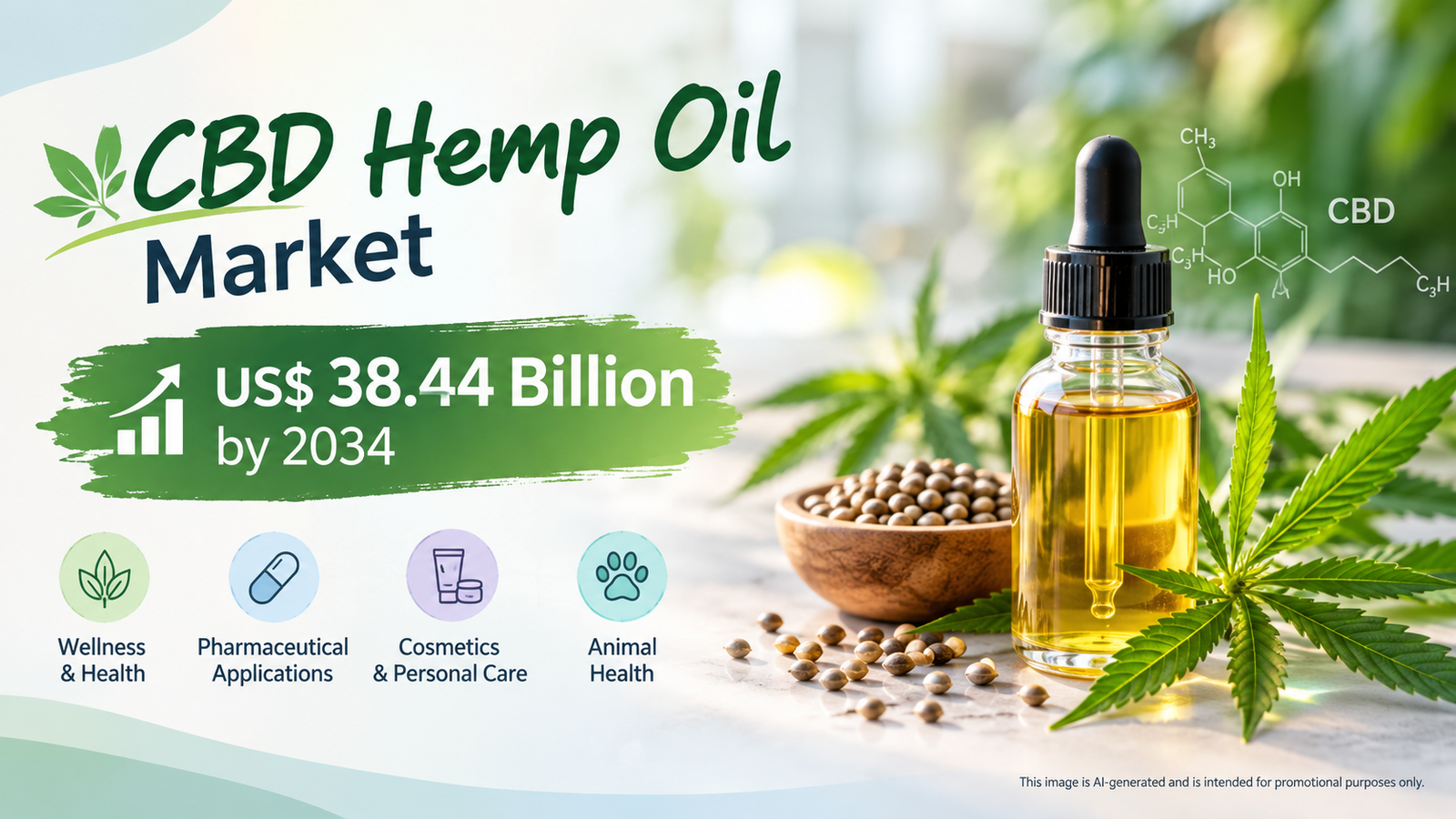
The CBD Hemp Oil Market was valued at US$ 9.6 Billion in 2025 and is expected to reach US$ 38.44 Billion by 2034, registering a CAGR of 16.67% during 2026–2034. CBD hemp oil is derived primarily from hemp and contains cannabidiol (CBD), a non-intoxicating cannabinoid that has attracted growing interest across wellness, personal care, and specialized therapeutic applications. Market expansion is supported by increasing consumer awareness of cannabinoid-based products, product innovation, expanding distribution channels, and continued research into CBD applications. At the same time, regulatory requirements concerning product composition, health claims, labeling, and safety remain important factors shaping the market.
What is driving the market?
Growing interest in plant-based wellness products and the expansion of CBD-based formulations are major factors supporting the CBD Hemp Oil Market.
Consumers are increasingly exploring hemp-derived products in formats such as oils, tinctures, capsules, topicals, and other wellness formulations. Manufacturers are responding by developing products with different CBD concentrations, formulations, delivery methods, and combinations with other botanical ingredients. E-commerce has also become an important channel for reaching consumers, enabling brands to provide product information and offer a broad portfolio of CBD-based products.
Get a Sample PDF- https://www.theinsightpartners.com/sample/TIPRE00013756
Product quality and formulation consistency are becoming increasingly important as the market matures. Manufacturers are investing in extraction technologies, purification processes, analytical testing, and standardized formulations to improve consistency and transparency. The development of broad-spectrum, full-spectrum, and CBD isolate products allows companies to target different consumer preferences.
Research and medical interest also contribute to market development, although the regulatory distinction between approved CBD medicines and commercially marketed CBD products remains important. In the US, the FDA states that it has approved one CBD-containing prescription drug, while it has not approved other CBD products currently available on the market.
Which region leads?
North America represents a significant market for CBD hemp oil, supported by established hemp cultivation, product availability, consumer awareness, and a growing ecosystem of CBD-focused companies.
The US remains an important market because of the widespread availability of hemp-derived products and the development of specialized CBD brands. However, regulatory considerations continue to influence how CBD products can be formulated, marketed, and distributed. The FDA maintains that the 2018 Farm Bill removed qualifying hemp from the federal definition of marijuana, while preserving FDA authority over products containing cannabis-derived compounds.
Europe is also an important market, with growing interest in cannabinoid-based wellness and personal-care products. Market development varies across individual countries because requirements for CBD products can differ according to product category and intended use.
Asia Pacific is emerging as an opportunity area as awareness of hemp-derived ingredients increases and companies explore applications in wellness, cosmetics, and other consumer products. Increasing investment in hemp processing and product development may further support regional expansion.
Which segment leads?
CBD hemp oil products used in wellness and personal-care applications represent an important segment of the market, while oils and tinctures remain prominent delivery formats.
Oils and tinctures offer flexible dosage formats and can be incorporated into different consumer routines, supporting their continued presence across retail and online channels. Topical formulations, including creams, balms, and lotions, are also gaining attention because they allow companies to position CBD within personal-care and wellness categories.
The market can also be segmented according to product type, source, concentration, application, distribution channel, and end user. Full-spectrum products contain multiple naturally occurring hemp compounds, while broad-spectrum formulations are designed to contain multiple cannabinoids without detectable or intentionally added THC, depending on formulation and regulatory requirements. CBD isolate products focus on cannabidiol as the primary cannabinoid.
Growing demand for product transparency is encouraging manufacturers to provide information regarding CBD concentration, ingredients, extraction methods, and laboratory testing. This trend is particularly relevant as consumers become more attentive to product quality and consistency.
Which companies are prominent?
The competitive landscape includes established cannabis companies, specialist CBD manufacturers, and vertically integrated hemp-product businesses competing through product development, branding, extraction capabilities, and distribution networks.
- CBD American Shaman, LLC
- Aurora Cannabis Inc.
- Endoca BV
- Folium Biosciences, LLC
- NuLeaf Naturals, LLC
- Canopy Growth Corporation
- Elixinol Wellness Limited
- Medical Marijuana, Inc.
- CV Sciences, Inc.
- Tilray Brands, Inc., successor to Aphria Inc.
Companies are focusing on expanding product portfolios, improving extraction and purification capabilities, strengthening online and retail distribution, and developing formulations targeted toward specific consumer needs. Brand differentiation is increasingly based on sourcing, formulation, testing, traceability, and product positioning. Partnerships and geographic expansion can also help companies access new consumer markets while navigating differing regulatory requirements.
What is changing in 2026?
Regulatory oversight, product quality, scientific evidence, and greater emphasis on transparent CBD formulations are shaping the CBD Hemp Oil Market in 2026.
Regulatory compliance is becoming increasingly important as authorities continue to evaluate how CBD-containing products should be regulated. In the US, the FDA has stated that existing food and dietary-supplement frameworks are not appropriate for CBD and has called for a new regulatory pathway.
The FDA also continues to distinguish hemp seed-derived food ingredients from CBD. Certain hemp seed-derived ingredients, including hemp seed oil, have received FDA “no questions” responses to GRAS notices for specified food uses; these determinations do not extend to adding CBD or THC to food.
Consequently, companies are placing greater emphasis on testing, documentation, ingredient traceability, and responsible product claims. Scientific research is another important area of development, particularly as manufacturers and researchers seek stronger evidence regarding the safety, pharmacological characteristics, and potential applications of CBD.
Get Full Copy of This Report @ https://www.theinsightpartners.com/buy/TIPRE00013756
What are the major investment opportunities?
Investment opportunities are emerging across CBD extraction, standardized formulations, testing infrastructure, specialized wellness products, and technology-enabled distribution.
Advanced extraction and purification technologies can create opportunities for companies seeking greater consistency and scalable production. Investments in third-party testing and quality-control infrastructure may also become increasingly relevant as consumers and regulators demand greater transparency regarding cannabinoid concentrations and product composition.
Specialized formulations represent another potential opportunity, particularly products designed for clearly defined wellness or personal-care applications. Companies capable of developing differentiated formulations while maintaining consistent quality may strengthen their positions as the market becomes more competitive.
Geographic expansion across markets with developing hemp and cannabinoid frameworks can also create opportunities for established manufacturers. However, investors and companies need to account for differences in national regulations, permitted product categories, labeling requirements, and restrictions on health-related claims. The FDA continues to emphasize that most commercially available CBD products have not been approved as drugs and that safety questions remain for consumer CBD use.
Related Reports @
Cannabidiol Oil Market Demand, Share & Growth by 2034
Cannabidiol Supplements Market Demand, Trends & Forecast by 2034
About Us –
The Insight Partners provides comprehensive syndicated and tailored market research services in the healthcare, technology, and industrial domains. Renowned for delivering strategic intelligence and practical insights, the firm empowers businesses to remain competitive in ever-evolving global markets.
Contact Us:
Contact Person: Ankit Mathur
E-mail: ankit.mathur@theinsightpartners.com
Phone: +1-646-491-9876
Also Available in : Korean German Japanese French Chinese Italian Spanish