Cardiac Color Ultrasound Diagnostic Equipment Market to Reach US$7.56 Billion by 2034 as AI and Advanced Cardiac Imaging Gain Momentum
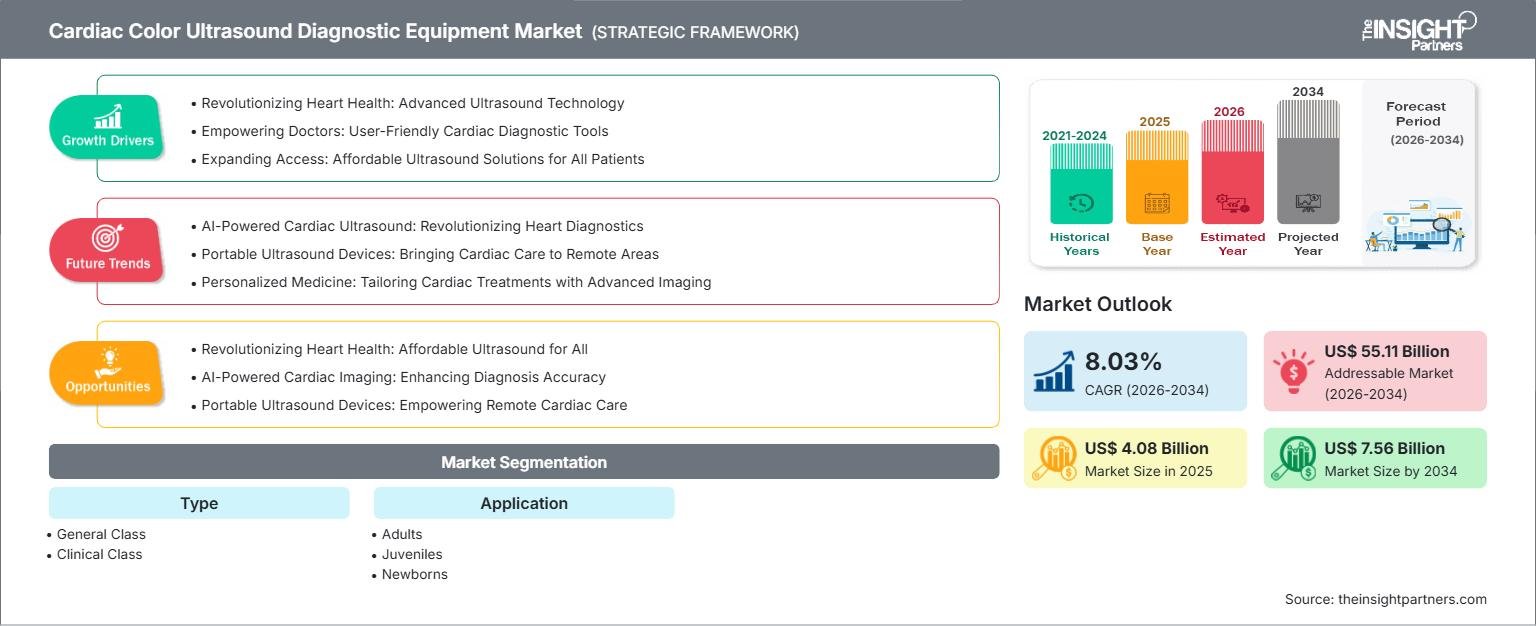
The global Cardiac Color Ultrasound Diagnostic Equipment Market is experiencing steady expansion as healthcare providers increasingly adopt advanced echocardiography systems for cardiovascular diagnosis, monitoring, and treatment planning. According to The Insight Partners, the market was valued at US$4.08 billion in 2025 and is projected to reach US$7.56 billion by 2034, registering a CAGR of 8.03% from 2026 to 2034. Rising cardiovascular disease prevalence, growing echocardiography volumes, adoption of color Doppler technology, and investments in artificial intelligence-enabled cardiac imaging are supporting market development.
Modern cardiac ultrasound equipment has evolved beyond conventional two-dimensional imaging to incorporate color Doppler, three-dimensional imaging, strain analysis, automated cardiac quantification, and AI-supported applications. Healthcare providers are increasingly looking for systems that deliver reproducible examinations, rapid workflows, high-resolution imaging, and flexibility across adult, pediatric, and neonatal applications.
Download Sample PDF @ https://www.theinsightpartners.com/sample/TIPRE00011639
Rising Cardiovascular Disease Burden Drives Demand
The increasing global burden of cardiovascular disease remains one of the primary factors supporting demand for cardiac imaging technologies. According to data cited by The Insight Partners from the World Health Organization, cardiovascular diseases caused approximately 19.8 million deaths in 2022, representing about 32% of deaths worldwide. This disease burden is increasing the need for non-invasive methods capable of evaluating heart anatomy, blood flow, ventricular function, and valvular abnormalities.
Cardiac color ultrasound provides clinicians with real-time visualization of cardiac structures and blood flow without exposing patients to ionizing radiation. Its applications span cardiology departments, emergency care, intensive care, surgical procedures, outpatient diagnostics, and preventive cardiovascular screening.
Artificial Intelligence Enhances Echocardiography Workflows
Artificial intelligence is becoming increasingly important in cardiac ultrasound systems. AI-enabled technologies can automate measurements, support image acquisition, assist with chamber quantification, and improve consistency across examinations.
The integration of AI is particularly relevant as healthcare systems face increasing diagnostic volumes and shortages of experienced sonographers. Automated workflows can reduce repetitive manual tasks while helping clinicians maintain standardized examination protocols. The Insight Partners notes that AI regulation will also require manufacturers to demonstrate algorithm performance, address bias, maintain cybersecurity, and conduct appropriate post-market surveillance.
These developments are encouraging manufacturers to invest in validated algorithms, clinical applications, data governance, and software capabilities alongside improvements in ultrasound hardware.
Portable Ultrasound Expands Cardiac Imaging Access
The increasing adoption of portable cardiac ultrasound systems is extending echocardiography beyond conventional diagnostic laboratories. Compact systems can be deployed in emergency departments, intensive care units, ambulatory care centers, rural hospitals, and community screening programs.
Portable equipment can enable clinicians to conduct cardiac assessments closer to the patient and reduce the need for transfers between departments. Color Doppler functionality further enhances the usefulness of these systems by enabling rapid assessment of blood flow and valve function.
Manufacturers are therefore focusing on balancing portability with image quality, battery performance, display capabilities, infection-control requirements, cybersecurity, and software connectivity.
Clinical-Class Equipment Represents a High-Growth Segment
The market is segmented by type into general class and clinical class equipment. Clinical-class systems accounted for approximately 56% to 59% of the market in 2025 and are projected to grow at a CAGR of approximately 8.5% to 9.1% during 2026 to 2034. Their growth is supported by increasing adoption of advanced echocardiography capabilities.
Clinical-class platforms provide advanced functionality such as strain imaging, three-dimensional assessment, automated quantification, and support for complex valvular and structural-heart applications. These systems are particularly relevant to tertiary hospitals, academic medical centers, and dedicated cardiology facilities.
General-class systems continue to serve routine cardiac examinations where affordability, usability, portability, and dependable color Doppler functionality are important purchasing considerations.
Adult Applications Account for the Largest Market Share
By application, the market includes adults, juveniles, and newborns. Adult examinations represented approximately 72% to 75% of the market in 2025 and are projected to grow at a CAGR of approximately 7.6% to 8.1% through 2034.
The large adult segment is associated with the broad use of cardiac ultrasound for assessing heart failure, coronary disease, cardiomyopathy, valve disorders, hypertension-related cardiac changes, and treatment response.
Juvenile and newborn applications require specialized probes, optimized imaging presets, age-specific measurements, and congenital-heart protocols. These requirements are creating opportunities for manufacturers capable of developing dedicated pediatric and neonatal solutions.
North America Maintains a Significant Market Position
North America accounted for an estimated 34% to 36% share of the market in 2025 and is expected to register a CAGR of approximately 7.4% to 7.9% between 2026 and 2034. Established echocardiography laboratories, cardiovascular disease volumes, hospital equipment replacement cycles, and adoption of AI-assisted imaging are supporting regional demand.
The US represented approximately 81% to 84% of North American revenue in 2025. Growing outpatient echocardiography capacity and the use of cardiac ultrasound across emergency, critical care, intervention, and outpatient settings are expected to support continued market development.
Asia Pacific Emerges as a High-Growth Region
Asia Pacific represented approximately 25% to 27% of the global market in 2025 and is projected to record a CAGR of 9.2% to 9.8% from 2026 to 2034, making it one of the fastest-growing regional markets. China, Japan, India, and South Korea are identified as key markets driving procurement.
Growth in the region is supported by hospital expansion, increasing cardiac diagnostic capacity, domestic medical equipment production, equipment replacement, and broader adoption of advanced imaging technologies.
India presents significant opportunities as cardiac diagnostic capabilities expand beyond major metropolitan areas. Hospital development and increased access to specialized cardiovascular services can further support demand for both clinical-class and portable cardiac ultrasound platforms.
Europe Supports Advanced Cardiac Imaging Adoption
Europe accounted for approximately 27% to 29% of the market in 2025 and is forecast to grow at a CAGR of 7.1% to 7.6% through 2034. Germany, the UK, France, Italy, and Spain represent important markets in the region.
European healthcare providers are increasingly considering interoperability, automated measurements, energy efficiency, maintenance requirements, clinical validation, and integration with electronic medical records and image archives when purchasing cardiac imaging equipment.
Software-Defined Platforms Create New Opportunities
The transition toward software-defined ultrasound platforms is expected to influence future product development. Systems capable of receiving software upgrades without requiring complete hardware replacement can provide healthcare organizations with greater flexibility as clinical requirements evolve.
The market is also seeing potential opportunities around subscription-based applications, remote technical support, centralized fleet management, and software-based workflow enhancements. These developments could shift competition from hardware specifications alone toward application ecosystems, interoperability, cybersecurity, clinical evidence, and lifecycle support.
Get Full Copy @ https://www.theinsightpartners.com/buy/TIPRE00011639
Competitive Landscape
The competitive landscape includes global medical imaging companies as well as specialized ultrasound manufacturers. Companies analyzed in The Insight Partners report include Shanghai Aohua Photoelectricity Endoscope Co., Ltd., FUJIFILM Holdings Corporation, Guangdong Goworld Co., Ltd., GE HealthCare Technologies Inc., Shenzhen Mindray Bio-Medical Electronics Co., Ltd., Olympus Corporation, RICOH IMAGING COMPANY, LTD., Koninklijke Philips N.V., Siemens Healthineers AG, and SonoScape Medical Corp.
Competition is increasingly centered on advanced cardiac applications, AI-enabled workflows, innovative transducers, portable equipment, software capabilities, cybersecurity, and service networks. Suppliers are also investing in modular system architectures and remote diagnostics to improve lifecycle support.
Recent Industry Developments
In August 2025, GE HealthCare Technologies Inc. launched the Vivid Pioneer cardiovascular ultrasound system following CE Mark approval and US FDA 510(k) clearance. The platform introduced cSound Pioneer architecture, enhanced two-dimensional, four-dimensional, and color-flow imaging, new probes, and AI capabilities for adult and pediatric cardiac examinations.
In August 2025, Koninklijke Philips N.V. released Transcend Plus for its EPIQ CVx and Affiniti CVx cardiovascular ultrasound systems. The update included two-dimensional and three-dimensional image-quality enhancements, AI-enabled applications, and 2D Auto EF Advanced functionality.
In March 2025, Shenzhen Mindray Bio-Medical Electronics Co., Ltd. presented its Resona A20 premium ultrasound platform at the European Congress of Radiology. The system incorporates Acoustic Intelligence Technology, advanced transducers, multiparametric imaging, and AI tools.
Future Outlook
The Cardiac Color Ultrasound Diagnostic Equipment Market is expected to continue evolving as cardiovascular diagnostic volumes rise and healthcare providers seek faster, more reproducible, and increasingly automated imaging workflows. The market’s projected expansion from US$4.08 billion in 2025 to US$7.56 billion by 2034 reflects the growing role of advanced cardiac ultrasound in cardiovascular care.
Future product development is expected to focus on multimodal AI, automated cardiac quantification, portable imaging, software-defined platforms, remote capabilities, specialized pediatric and neonatal applications, and improved interoperability. At the same time, manufacturers will need to address regulatory requirements, cybersecurity, algorithm validation, clinician training, and service availability.
Emerging healthcare systems in Asia Pacific, the Middle East, and other developing markets are likely to create additional opportunities through hospital expansion, localized cardiac imaging networks, and decentralized diagnostic services. Suppliers combining advanced imaging technology with reliable service infrastructure, clinical education, and flexible software capabilities can address the changing requirements of healthcare providers worldwide.
About Us
The Insight Partners, we provide comprehensive analysis and insights into market trends that empower businesses to make informed decisions. Our reports are designed to equip stakeholders with the necessary information to navigate the complexities of various industries, including healthcare, technology, and finance. We are dedicated to delivering high-quality research that enables our clients to achieve their strategic objectives.
Contact Us:
Contact Person: Ankit Mathur
E-mail: ankit.mathur@theinsightpartners.com
Phone: +1-646-491-9876
Also Available in :Korean German Japanese French Chinese Italian Spanish