Grid Connected PV System Market (2026 – 2033)
Grid Connected PV System Market Summary
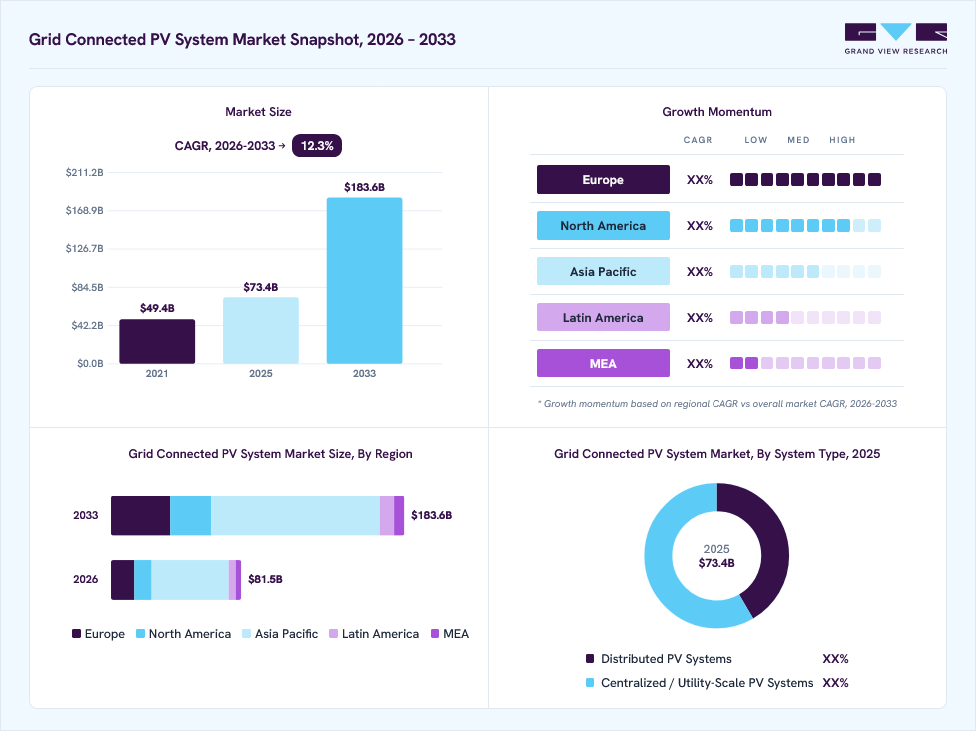
The global grid connected PV system market size was valued at USD 73.4 billion in 2025 and is projected to grow from USD 81.5 billion in 2026 to USD 183.6 billion by 2033, at a CAGR of 12.3% from 2026 to 2033. Asia Pacific dominated the market, accounting for a revenue share of 59.4% in 2025. Government policies across the Asia-Pacific region, including renewable energy targets, subsidies, auctions, and rooftop solar programs, are accelerating solar PV adoption by reducing costs and attracting investment.
Key Market Trends & Insights
- By system: Centralized/utility-scale PV systems segment held the largest market share of 58.4% in 2025.
- By end use: Utility-scale segment held the largest market share of 56.5% in 2025.
- By component: Solar modules segment held the largest market share of 51.2% in 2025.
- By PV module type: Monocrystalline segment held the largest revenue share of 80.9% in 2025.
Regional Highlights
- Largest regional market: Asia Pacific (59.4% revenue share, 2025)
- Fastest-growing regional market: Europe (highest CAGR, 2026-2033)
- By country: China held the largest market share in 2025.
Market Size & Forecast
- Market size in 2025: USD 73.4 Billion
- Estimated market size in 2026: USD 81.5 Billion
- Projected market size by 2033: USD 183.6 Billion
- CAGR (2026-2033): 12.3%
Three ways to get this report
Buy it, customize it, or ask a question.
Ask an Analyst
A direct answer, usually in 1 working day
- AccessReport author, directly
- Reply timeWithin 1 working day
- No sales callDirect answer only
- FormatEmail reply
- CostFree, no cost
What the study covers
- FormatsPDF · Excel · Dashboard
- Timeline2026–2033 annual, 2025 base
- Coverage20+ countries, 5 regions
- Companies10+ key players profiled
- IncludeCountries, segments, points
- TailorTo your product definition
- ExtendDeeper competitor detail
- OrA fully bespoke study
- Turnaround5–10 working days
Falling costs of solar PV modules, inverters, mounting structures, and other balance-of-system components are improving the economic attractiveness of utility-scale and grid-connected solar projects. Technological advancements, manufacturing scale, supply-chain efficiencies, and intense competition among PV manufacturers have contributed to lower equipment prices.
Higher-efficiency and higher-power modules also enable greater electricity generation from the same project footprint, improving overall project economics. Lower upfront capital expenditure reduces the levelized cost of electricity (LCOE), making solar increasingly competitive with conventional power sources such as coal and natural gas. As project returns improve and payback periods shorten, utilities, independent power producers, and commercial investors are more willing to develop new grid-connected PV capacity.
Market Dynamics
The grid connected PV market is experiencing growing demand as governments, utilities, independent power producers, commercial organizations, and households seek to expand renewable electricity generation and reduce dependence on fossil-fuel-based power. Grid-connected photovoltaic systems supply solar electricity directly to the grid, supporting large-scale utility generation as well as residential, commercial, and industrial applications. The growing global emphasis on decarbonization, net-zero targets, renewable-energy deployment, and energy security is significantly accelerating PV adoption worldwide. Furthermore, declining solar module, inverter, and balance-of-system costs, coupled with improvements in module efficiency, bifacial technology, tracking systems, and power-conversion technologies, are improving project economics and reducing the levelized cost of electricity. The increasing integration of battery energy storage, smart inverters, digital monitoring, and advanced grid management technologies is also enabling greater penetration of variable solar generation. Growing corporate renewable-energy procurement, expansion of utility-scale solar parks, development of distributed rooftop PV, and increasing investments in transmission and grid modernization are further supporting market growth.
The growing focus on renewable energy targets and decarbonization initiatives is a major driver of the global market, as governments worldwide seek to expand solar power generation and reduce dependence on fossil fuels. Countries are introducing renewable-energy auctions, feed-in tariffs, tax incentives, subsidies, net-metering programs, and long-term power purchase agreements to encourage grid-connected PV deployment. Furthermore, national net-zero commitments and policies aimed at improving energy security are accelerating investments in utility-scale and distributed solar projects. The increasing electricity demand from industrialization, urbanization, electrification, and data centers is further driving the need for additional renewable generation capacity. These supportive policies and growing electricity requirements are expected to accelerate global grid-connected PV installations.
Market Concentration & Characteristics
The grid-connected PV system market is moderately fragmented, with competition among global solar module manufacturers, inverter suppliers, electrical equipment companies, renewable energy developers, and integrated solar-system providers. Major participants include JinkoSolar, LONGi, Trina Solar, JA Solar, Canadian Solar, First Solar, Sungrow, Huawei, SMA Solar Technology, Enphase Energy, and Schneider Electric, as well as numerous regional and specialized providers. Entry barriers are moderate to high because competitive offerings require photovoltaic technology, power-conversion and inverter capabilities, grid-integration expertise, compliance with electrical and grid standards, supply-chain scale, project execution capabilities, and established relationships with utilities, developers, and commercial and industrial customers.
The market is in a rapid expansion phase, supported by the increasing deployment of utility-scale, commercial, and residential solar PV systems to meet rising renewable energy targets and reduce dependence on conventional power generation. Adoption is shifting from standalone solar installations to integrated, grid-connected systems that incorporate advanced inverters, energy management, battery storage, smart grid technologies, and monitoring platforms. Competitive differentiation is increasingly shifting from basic PV generation capabilities toward higher conversion efficiency, grid stability and support functions, intelligent energy management, advanced monitoring, cybersecurity, storage integration, power-quality management, and grid-forming capabilities.
Analyst Perspective
The grid-connected PV market is a key enabler of the global energy transition, driven by rising renewable energy adoption, falling solar PV costs, supportive policies, and increasing electrification. Utilities, commercial and industrial users, households, and renewable energy developers are investing in grid-connected PV systems to lower energy costs, enhance energy security, and achieve decarbonization goals. Market growth is further supported by utility-scale solar projects, rooftop installations, distributed generation, and hybrid solar-plus-storage systems. Advances in PV module efficiency, inverters, grid integration, and digital monitoring continue to improve system performance. Competitive advantage will increasingly depend on the ability to deliver integrated solutions combining high-efficiency PV modules, intelligent energy management, grid-stability capabilities, predictive maintenance, and battery storage integration. Vendors offering reliable, scalable, cost-effective, and grid-responsive solutions are expected to lead the market over the long term.
System Insights
The centralized/utility-scale PV systems segment led the market with the largest revenue share of 58.4% in 2025. Declining costs of solar modules, inverters, mounting structures, trackers, and other balance-of-system components are improving the economic attractiveness of utility-scale PV projects. Technological advancements, economies of scale, manufacturing efficiencies, and increasing competition among solar equipment suppliers have contributed to lower system costs. Higher-efficiency modules and advanced tracking technologies also enable greater electricity generation from the same land area, improving project returns. Reduced upfront investment improves project economics, enabling solar projects to achieve more attractive returns and accelerating new capacity additions by utilities and independent power producers.
The distributed PV systems segment is anticipated to grow at the fastest CAGR during the forecast period. Increasing retail electricity tariffs are improving the financial attractiveness of distributed and rooftop PV systems. As grid electricity becomes more expensive, households and businesses can reduce their electricity bills by generating and consuming solar power onsite. Higher tariffs increase the savings from self-consumption and can shorten PV system payback periods. Therefore, the rising electricity costs are encouraging residential, commercial, and industrial customers to invest in grid-connected rooftop solar installations.
Component Insights
The solar modules segment led the market with the largest revenue share of 51.2% in 2025 and is anticipated to grow at the fastest CAGR during the forecast period. The adoption of larger wafer sizes and higher-power solar modules is improving the economics of grid-connected PV projects. Larger modules can deliver greater power output per unit, reducing the number of modules required to achieve a specific project capacity. This can lower requirements for mounting structures, cables, connectors, and installation labor. Consequently, developers can reduce balance-of-system costs, simplify installation, improve land utilization, and lower overall project costs, particularly for large utility-scale solar installations.
The PCU/Inverters segment is anticipated to grow at a significant CAGR during the forecast period. The expansion of utility-scale solar farms is increasing demand for high-capacity inverter solutions. Large PV projects require inverters capable of converting substantial amounts of DC electricity generated by thousands of solar modules into grid-compatible AC electricity. Central and high-power string inverters enable efficient power conversion while supporting grid management and monitoring.
PV Module Type Insights
The monocrystalline segment accounted for the largest market revenue share of 80.9% in 2025 and is anticipated to grow at the fastest CAGR during the forecast period. Monocrystalline modules offer higher power output per unit area than lower-efficiency PV technologies. This makes them particularly valuable where available rooftop or land space is limited. Residential buildings, commercial facilities, and urban industrial sites can generate more electricity without requiring larger installation areas. Similarly, utility-scale developers can maximize energy generation from constrained land parcels. Higher power density also reduces the number of modules, mounting structures, cables, and installation components required for a given capacity, helping improve overall system economics and project efficiency.
The polycrystalline segment is expected to grow at a significant CAGR during the forecast period. Polycrystalline solar cells are manufactured by melting silicon and casting it into blocks, which are then sliced into wafers. This process is generally simpler and involves fewer processing steps than producing high-purity monocrystalline wafers. Lower manufacturing complexity can reduce equipment, energy, and production costs. Subsequently, polycrystalline modules can remain attractive in price-sensitive markets and solar projects where minimizing upfront investment is more important than achieving the highest possible efficiency.