Smart Lighting Market (2026 – 2033)
Smart Lighting Market Summary
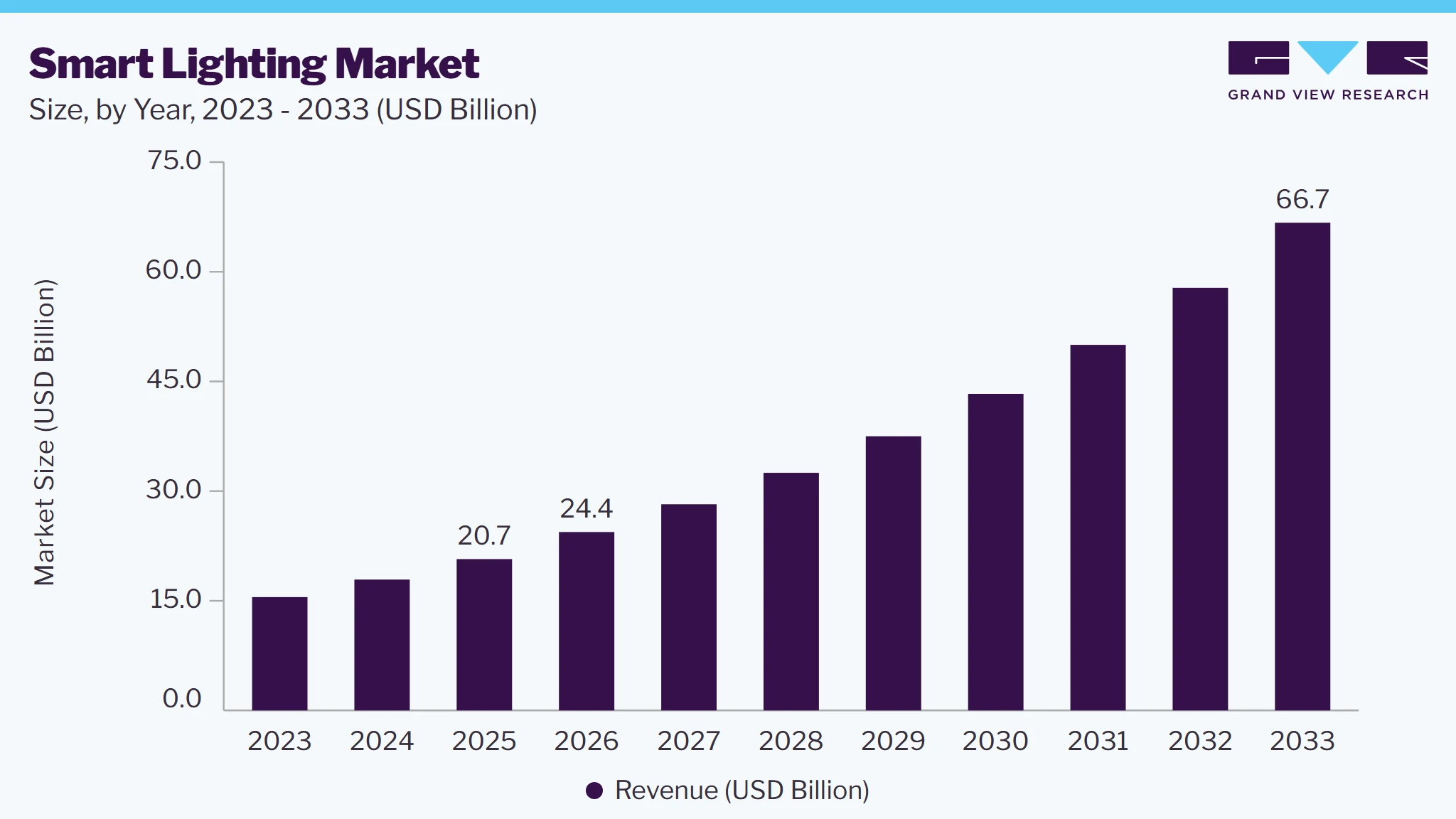
The global smart lighting market size was valued at USD 20.7 billion in 2025 and is projected to grow from USD 24.4 billion in 2026 to USD 66.7 billion by 2033, at a CAGR of 15.5% from 2026 to 2033. Europe dominated the market and accounted for the largest revenue share of 39.0% in 2025. The ability of lights to connect with IoT devices and create a variety of ambient lighting using just smartphones or tablets has increased their popularity and demand across commercial and residential spaces.
Key Market Trends & Insights
- By component: The hardware segment led the market with a revenue share of 57.1% in 2025.
- By connectivity: The wired segment accounted for the largest revenue share of 65.3% in 2025.
- By application: The indoor segment accounted for the largest revenue share of 65.7% in 2025.
Regional Highlights
- Largest regional market: Europe (39.0% revenue share, 2025)
- Fastest-growing regional market: Asia Pacific (highest CAGR, 2026-2033)
Market Size & Forecast
- Market size in 2025: USD 20.7 Billion
- Estimated market size in 2026: USD 24.4 Billion
- Projected market size by 2033: USD 66.7 Billion
- CAGR (2026-2033): 15.5%
Three ways to get this report
Buy it, customize it, or ask a question.
Ask an Analyst
A direct answer, usually in 1 working day
- AccessReport author, directly
- Reply timeWithin 1 working day
- No sales callDirect answer only
- FormatEmail reply
- CostFree, no cost
Get the Full Report
What the study covers
- FormatsPDF · Excel · Dashboard
- Timeline2026–2033 annual, 2025 base
- Coverage20+ countries, 5 regions
- Companies10+ key players profiled
Customize the Report
20% free customization
- IncludeCountries, segments, points
- TailorTo your product definition
- ExtendDeeper competitor detail
- OrA fully bespoke study
- Turnaround5–10 working days
Smart lighting is also termed connected lighting, as it can be seamlessly integrated into the IT network in a building or city infrastructure to share information regarding the status of the operation. For instance, smart street lights in city parking lots or roads ensure safety by providing wide coverage, environmental monitoring, parking and traffic management information, and city surveillance through connectivity with IoT devices. Smart lights are often integrated with sensors, turning them into intelligent devices that gather information on activity patterns, daylight levels, occupancy, changes in temperature, and humidity. This information is vital for government departments to take appropriate actions and monitor the city for unwarranted activity.
The adoption of smart lights is expected to increase owing to benefits such as controlled power usage, longer lifespans, multiple light settings in a single lamp/luminaire, and the availability of a wide range of modern decorative lighting products. The adoption of smart lighting in the residential, commercial, and industrial sectors is yet to reach its full potential. Hence, various government initiatives to promote the use of LED-based smart lights are expected to boost their demand over the forecast period. Moreover, countries such as China, Brazil, Colombia, Mexico, France, Spain, and Germany have imposed a complete ban on the sale of incandescent lamps to encourage the adoption of LED light, wherein high-income groups are leaning towards LED-based smart lights.
Smart lights consist of several networked components, including lighting fixtures that collect information about the physical environment and allow users to control or adjust devices based on their requirements. The advent of the Internet of Things (IoT) and its rising set of applications in lighting systems has contributed to the growth of the market. Moreover, advancements in technology that enable the easy integration of functions such as ambient sensing and voice control into lighting systems have widened and diversified the scope of smart lighting applications.
Smart lighting systems use wired and wireless communication protocols such as Bluetooth, Wi-Fi, ZigBee, DALI, EnOcean, and Sigfox to network the necessary components. Lighting control modules receive real-time information about the lighting environment and transmit signals to the lighting system or luminaires to perform actions such as switching lights on or off and adjusting brightness. For instance, Hue Lighting by Philips is a smart home lighting system that provides an entire range of lights that can be controlled using the Hue app on smartphones. The emergence of such integrated lighting systems has boosted the demand for smart lamps and smart fixtures.
Market Dynamics
Reduced energy consumption enabled by smart lighting has been attracting a large number of users. Inclusion of IoT sensors and AI-powered product features based on factors such as occupancy in the room, sunlight, and others has been providing significant cost savings. Improved lifecycles of smart lighting products and lower energy consumption also contribute to the reduced costs. In addition, convenience enabled by remote controls, timer features, and smart home lighting is expected to increase adoption in the forecast period. Such factors are likely to strengthen growth trends in the smart lighting market.
Component Insights
The hardware segment led the smart lighting market with a revenue share of 57.1% in 2025. Smart lighting hardware has been further categorized into lamps and luminaires, wherein the lamp segment is exhibiting high growth potential during the period 2026 to 2033. Increasing adoption and high replacement rate of existing traditional lighting solutions are expected to support the growth of this segment. This has spurred new product development and the launch of designs aligned with consumer preferences. In April 2026, MOONLEX announced the launch of the Sunflower X smart lamp on Kickstarter.
The software segment is expected to grow at the fastest CAGR during the forecast period. The demand for Smart Lighting is driven by the increasing adoption of smart lighting for data-driven purposes in critical areas. Also, the software application is required by each brand to facilitate the controlling of lights using smartphones or tablets. The apps also help in connecting smart lights with smart platforms such as Alexa, Cortana, and Siri to control them using voice commands. The immense popularity of creating an ambient atmosphere and aiding in data collection in smart cities is expected to boost the segment growth over the forecast period.
Connectivity Insights
The wired segment accounted for the largest revenue share in 2025 and is expected to grow at the fastest CAGR during the forecast period. The wired connections are required for the range above 30 feet. Ethernet, as an exception, can facilitate wired connection within 100 meters, while DALI, DSI, and DLVP provide connectivity above the range of 1000 feet. The increasing adoption of smart lighting in commercial and industrial spaces is driving the demand for wired connectivity in the smart lighting space.
The wireless segment is expected to grow at a significant CAGR during the forecast period. Wireless connectivity in a smart lighting environment is highly preferred among consumers who need connections within a small range. Wireless technology such as Wi-Fi, Bluetooth, SmartThings, Z-Wave, or ZigBee connects lighting fixtures with smartphone apps to control the light bulbs’ functions. The residential sector has majorly adopted wireless technology to control the luminaire hues and color for aesthetic purposes within a confined space.