Zero-Waste Chemical Manufacturing Market (2026 – 2033)
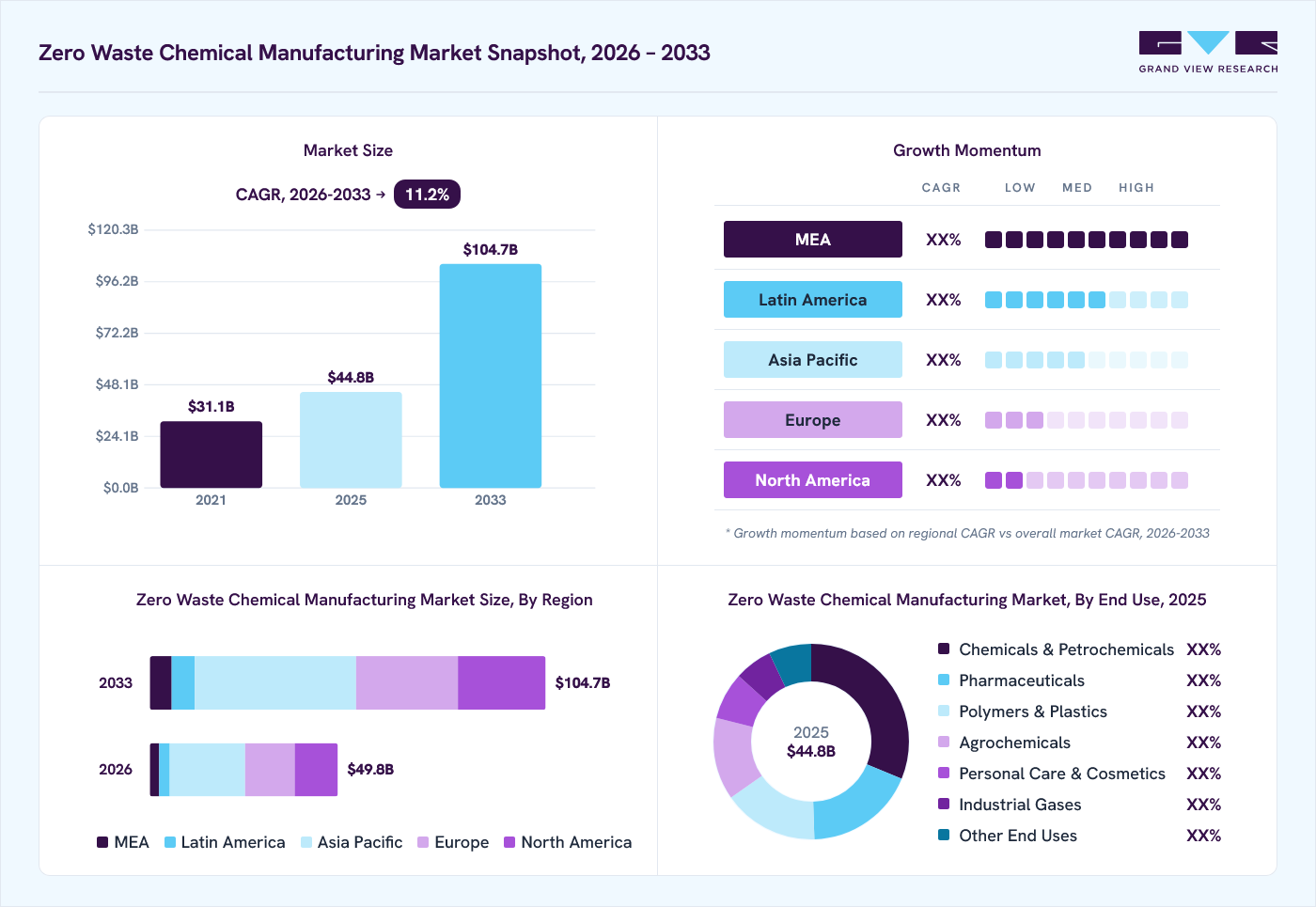
Market Size, 2025
$44.8B
Market Estimate, 2026
$49.8B
Market Forecast, 2033
$104.7B
CAGR, 2026–2033
11.2%
Zero Waste Chemical Manufacturing Market Summary
The global zero-waste chemical manufacturing market size was valued at USD 44.8 billion in 2025 and is projected to grow from USD 49.8 billion in 2026 to USD 104.7 billion by 2033, at a CAGR of 11.2% from 2026 to 2033. Asia Pacific dominated the market, accounting for a revenue share of 39.9% in 2025. Growing industrial focus on reducing material losses, treatment costs, and hazardous waste is encouraging chemical manufacturers to redesign production processes around resource efficiency. Companies are integrating process controls, recovery systems, and closed-loop material flows into manufacturing operations.
Key Market Trends & Insights
- By solution: Waste prevention & process optimization segment held the dominating revenue share of 27.6% in 2025.
- By end use: Chemicals & petrochemicals segment represented the largest application in the market, capturing a 31.2% share in 2025.
Regional Highlights
- Largest Regional Market: Asia Pacific (39.9% revenue share, 2025)
- Fastest-growing Regional Market: Middle East & Africa (highest CAGR, 2026-2033)
- By Country: China held the largest share in 2025
Market Size & Forecast
- Market size in 2025: USD 44.8 billion
- Estimated market size in 2026: USD 49.8 billion
- Projected market size by 2033: USD 104.7 billion
- CAGR (2026-2033): 11.2%
Three ways to get this report
Buy it, customize it, or ask a question.
Ask an Analyst
A direct answer, usually in 1 working day
- AccessReport author, directly
- Reply timeWithin 1 working day
- No sales callDirect answer only
- FormatEmail reply
- CostFree, no cost
Get the Full Report
What the study covers
- FormatsPDF · Excel · Dashboard
- Timeline2026–2033 annual, 2025 base
- Coverage20+ countries, 5 regions
- Companies10+ key players profiled
Customize the Report
20% free customization
- IncludeCountries, segments, points
- TailorTo your product definition
- ExtendDeeper competitor detail
- OrA fully bespoke study
- Turnaround5–10 working days
This shift is particularly relevant for large-volume chemical production, where small reductions in raw material consumption or waste generation can produce meaningful operating-cost benefits. The integration of digital process monitoring, advanced separation, solvent recovery, and industrial symbiosis creates opportunities to convert previously discarded streams into usable feedstocks.
Increasing availability of process data also allows manufacturers to identify waste-generation points and optimize material utilization continuously.
Market Dynamics
Zero-waste chemical manufacturing is moving from a waste-treatment approach toward waste avoidance and resource recovery at the production stage. Regulatory pressure, resource-security concerns, and decarbonization targets are strengthening adoption, while high retrofit costs and technology complexity remain key barriers. The market is therefore evolving through a combination of process optimization, recovery technologies, and circular feedstock integration.
Chemical producers are placing greater emphasis on maximizing raw-material conversion and minimizing yield losses because feedstock represents a significant component of manufacturing economics. Process intensification, automation, and real-time monitoring can improve conversion efficiency while reducing off-specification production. The commercial benefit extends beyond waste reduction. Lower material consumption, reduced wastewater treatment requirements, and improved production yields can strengthen plant economics and increase the attractiveness of zero-waste manufacturing investments.
Market Concentration & Characteristics
The industry remains moderately fragmented, with large chemical producers developing proprietary process-efficiency and circularity programs alongside specialist technology providers offering recovery, recycling, separation, and waste-minimization solutions.
Market characteristics vary significantly by manufacturing process. Adoption is generally stronger in integrated chemical clusters and large production facilities because these sites have sufficient waste volumes and infrastructure to support economically viable recovery systems.
Analyst Perspective
The market is shifting toward preventing waste at source rather than managing waste after generation. Process optimization is expected to remain commercially important, while higher-value recovery and circular technologies should gain traction as feedstock costs, regulatory requirements, and sustainability-linked investment criteria increasingly influence plant-level decisions.
Solution Insights
The waste prevention & process optimization segment accounted for 27.6% of the market in 2025, because manufacturers can capture immediate economic benefits by improving process yields, reducing raw-material losses, lowering off-specification output, and optimizing energy and water consumption. Existing plants can also adopt optimization measures without completely replacing their production infrastructure.
The chemical recycling & closed-loop reuse segment is the fastest-growing solution segment, with a projected CAGR of 11.9% from 2026 to 2033. These solutions can return difficult-to-recycle materials and production residues into higher-value chemical feedstocks. Regulatory developments around recycled-content accounting are also improving the investment case for chemical recycling.
End Use Insights
The chemicals & petrochemicals segment held the largest revenue share of 31.2% in 2025, supported by their large production volumes and continuous generation of solvents, intermediates, off-specification materials, process residues, and other recoverable streams. The scale of these operations provides a stronger economic justification for integrated waste-minimization systems.
The polymers & plastics segment is projected to grow with a CAGR of 11.9% from 2026 to 2033, as manufacturers face increasing pressure to incorporate recycled feedstocks and improve circular material flows. Chemical recycling is particularly relevant for polymer waste that is difficult to process through conventional mechanical recycling, creating additional demand for advanced recovery technologies.
Regional Insights
The Asia Pacific zero-waste chemical manufacturing market held the largest revenue share of 39.9% in 2025, due to its extensive chemical and petrochemical manufacturing base, high production volumes, and rapidly expanding industrial recycling infrastructure. Large manufacturing clusters provide favorable conditions for integrated resource recovery and industrial symbiosis.
China Zero-Waste Chemical Manufacturing Market Trends
The zero-waste chemical manufacturing market in China is growing as its large chemical manufacturing ecosystem, and government emphasis on waste-resource utilization, support widespread adoption of circular production practices. National policy targets also encourage higher utilization of industrial waste and secondary resources.
North America Zero-Waste Chemical Manufacturing Market Trends
The zero-waste chemical manufacturing market in North America benefits from established chemical infrastructure, strong process-engineering capabilities, and growing corporate investment in resource efficiency. Adoption is linked to operating-cost reduction and the commercial value of recovered feedstocks.
U.S. Zero-Waste Chemical Manufacturing Market Trends
The zero-waste chemical manufacturing market in the U.S. is expected to grow at a CAGR of 10.6% during the forecast period. The growth is supported by its large petrochemical base and increasing deployment of advanced recycling, carbon-management, and process-efficiency technologies. Large integrated plants provide a substantial addressable base for closed-loop manufacturing solutions.
Europe Zero-Waste Chemical Manufacturing Market Trends
The zero-waste chemical manufacturing market in Europe remains a technology- and regulation-driven market, with policies encouraging safer chemicals, circular material flows, recycled content, and resource efficiency. The EU’s chemicals and circular-economy initiatives are strengthening the commercial environment for zero-waste production technologies.
Latin America Zero-Waste Chemical Manufacturing Market Trends
The zero-waste chemical manufacturing market in Latin America presents emerging potential as chemical producers seek to reduce material losses and improve environmental performance while modernizing industrial infrastructure. Growth opportunities are strongest around major petrochemical and manufacturing clusters such as Brazil, Argentina, and Colombia.
Middle East & Africa Zero-Waste Chemical Manufacturing Market Trends
The zero-waste chemical manufacturing market in the Middle East & Africa is expected to grow at the fastest CAGR of 12.9% during the forecast period. The region offers significant potential through its large-scale petrochemical industry, particularly where integrated industrial complexes can connect waste recovery with feedstock and energy systems. Expansion of downstream chemical manufacturing can further increase demand for resource-efficient production technologies.
Key Zero-Waste Chemical Manufacturing Company Insights
The competitive landscape includes major environmental-services and resource-management companies that support chemical manufacturers through waste prevention, industrial waste treatment, resource recovery, recycling, and circular production solutions. Veolia and SUEZ are notable participants, with capabilities spanning industrial waste recovery and conversion of waste streams into secondary resources.
-
Veolia has a strong position in the ecosystem through its integrated water, waste, and energy management capabilities for chemical and petrochemical facilities. Its offering includes industrial waste optimization, hazardous-waste management, solvent recycling, and recovery of industrial by-products, enabling manufacturers to reduce disposal volumes while returning materials into productive use.
-
SUEZ participates through industrial waste management, recycling, resource recovery, and circular-economy solutions that help manufacturers convert waste streams into secondary materials and energy. Its capabilities increasingly combine waste prevention, advanced sorting, recycling, recovery, and digital technologies, supporting chemical producers in improving material utilization and reducing dependence on virgin resources.
Key Zero-Waste Chemical Manufacturing Companies
The following key companies have been profiled for the study on the global zero-waste chemical manufacturing market.
-
Veolia
-
SUEZ
-
BASF
-
Dow
-
Evonik Industries
-
Honeywell
-
Alfa Laval
-
Sulzer
-
Aquatech International
-
Eastman Chemical Company