Blockchain In Energy Market (2026 – 2033)
Blockchain In Energy Market Summary
The global blockchain in energy market size was valued at USD 2.7 billion in 2025 and is projected to grow from USD 3.2 billion in 2026 to USD 13.7 billion by 2033, at a CAGR of 23.0% from 2026 to 2033. North America market dominated the market, accounting for a revenue share of 37.6% in 2025. The increasing demand for transparent and secure energy transactions is driving the growth of the market.
Key Market Trends & Insights
- By type: Public Cloud type segment led the market and accounted for 48.1% of the global revenue in 2025.
- By offering: Platform segment led the market and accounted for 57.8% of the global revenue in 2025.
- By application: Energy trading segment accounted for the largest share of 36.7% in 2025.
- By end user: Utilities and grid operator segment accounted for the largest revenue share of 35.7% in 2025.
Regional Highlights
- Largest regional market: North America (37.6% revenue share, 2025)
- Fastest growing regional market: Asia Pacific (highest CAGR, 2026-2033)
- By country: The U.S. held the largest market share in 2025.
Market Size & Forecast
- Market Size in 2025: USD 2.7 Billion
- Estimated market size in 2026: USD 3.2 Billion
- Projected Market Size by 2033: USD 13.7 Billion
- CAGR (2026-2033): 23.0%
Rising electricity demand and the growing share of renewable power are creating a greater need for clear records of energy transactions. As more electricity is produced and traded across different sources, buyers and sellers need reliable information about the origin and movement of power. Blockchain can help maintain shared records, making transactions easier to track and verify. The regulator is also supporting the automatic issuance, tracking, and verification of renewable energy certificates. This growing focus on transparent energy records is supporting the use of blockchain across the energy sector.
The energy sector is increasingly using blockchain to record information about renewable electricity as it is generated and traded. This allows energy records to be updated more quickly and gives buyers clearer information about the source of electricity. The approach also facilitates easier tracking of renewable energy certificates and reduces the need for manual record checks. As renewable energy transactions become more frequent, real-time tracking is becoming increasingly important for maintaining clear and reliable records.
The regulatory landscape is significantly contributing to the growing adoption of blockchain in the energy sector. Governments and energy authorities are introducing requirements to improve the tracking and verification of renewable electricity and energy certificates. These requirements are encouraging energy participants to maintain clear, reliable, and easily accessible records of energy transactions. The growing focus on transparent renewable energy records is creating greater interest in blockchain-based solutions for managing energy information. As regulations continue to strengthen the need for accurate energy records, blockchain adoption is expected to gain further momentum.
The lack of common rules and standards is limiting the adoption of blockchain in the energy sector. Different countries follow different requirements for energy trading, data management, and digital records. These differences can make it difficult for companies to use the same blockchain solutions across markets. As a result, companies may face higher costs and uncertainty when expanding blockchain-based energy solutions.
Market Dynamics
The blockchain in energy market is being driven by the increasing digitalization of energy systems, the growth in renewable energy generation, the expansion of distributed energy resources, and the rising demand for transparent energy transactions. Energy markets are becoming more complex as utilities, generators, retailers, businesses, and consumers participate in multiple energy-related transactions. Blockchain is increasingly being considered to improve transaction records, renewable energy tracking, energy trading, grid coordination, and supply chain visibility.
The growing number of transactions between energy producers, utilities, retailers, businesses, and consumers is increasing the need for reliable and transparent transaction records. The expansion of renewable energy, distributed power generation, peer-to-peer electricity trading, and environmental markets has increased the number of participants involved in energy transactions. Traditional systems often require different parties to maintain and reconcile separate records, which can increase processing time and complicate the verification of transaction details.
Blockchain in energy solutions can provide a shared digital record that allows authorized participants to verify energy transactions without relying on multiple independent records. Blockchain can also support automated transaction settlement through predefined rules, helping reduce manual verification and improve transaction visibility. This is particularly relevant to renewable electricity trading, energy certificates, distributed energy transactions, and electricity settlement. As energy markets become more decentralized, the need for shared, verifiable transaction records is expected to drive blockchain adoption.
Market Concentration & Characteristics
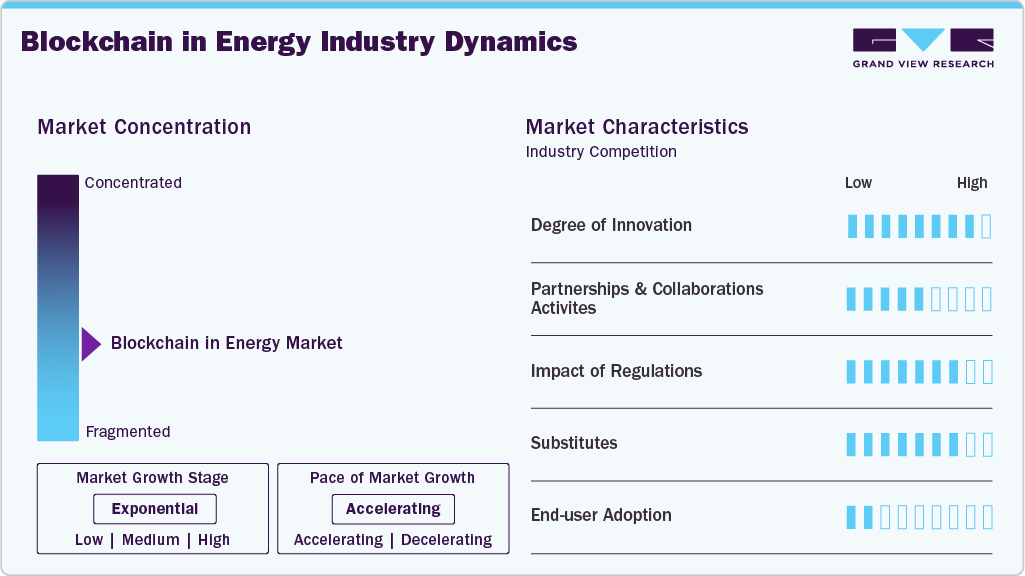
The blockchain in energy market is moderately fragmented, with participation spread across blockchain technology providers, energy companies, utilities, software developers, energy trading platforms, and specialized startups. The market does not have a small group of companies controlling a dominant share, as solutions are being developed for different applications such as peer-to-peer energy trading, renewable energy certificate management, energy transaction settlement, and decentralized energy management. The presence of both established technology and energy companies and smaller specialized providers creates a diverse competitive landscape. Companies are increasingly differentiating themselves through application-specific solutions, partnerships, platform capabilities, and integration with existing energy infrastructure.