
Biopellet Energy Market (2026 – 2033)
Biopellet Energy Market Summary
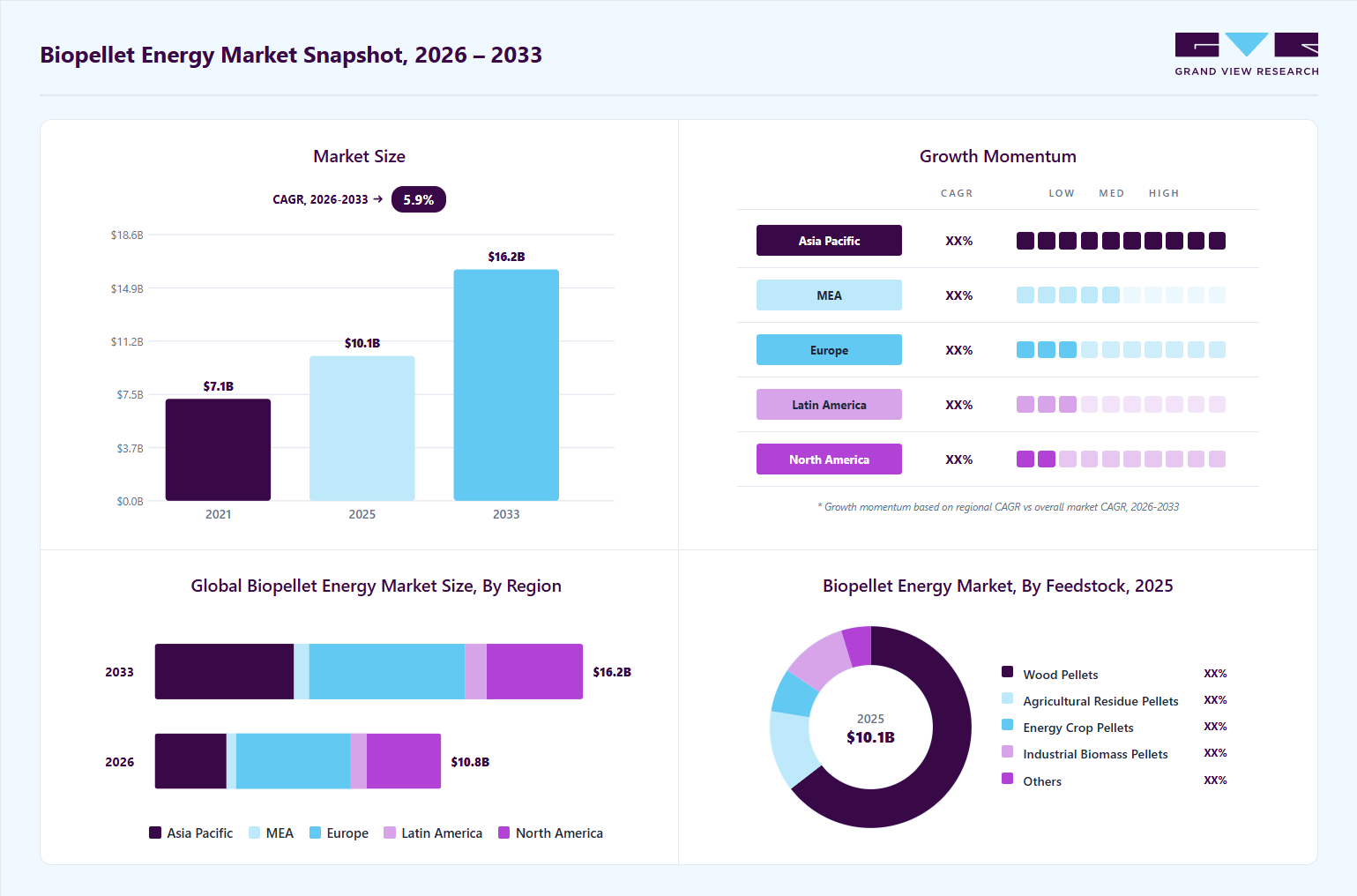
The global biopellet energy market size was valued at USD 10.1 billion in 2025 and is projected to grow from USD 10.8 billion in 2026 to USD 16.2 billion by 2033, at a CAGR of 5.9% from 2026 to 2033. Europe dominated the biopellet energy industry, accounting for the largest revenue share of 40.5% in 2025. The market is primarily driven by increasing adoption of renewable energy sources, growing demand for low-carbon alternatives to fossil fuels, and supportive government policies promoting biomass utilization.
Key Market Trends & Insights
- By feedstock: Wood pellets feedstock segment accounted for the largest revenue share of 64.50%.
- By end use: Industrial segment is expected to grow at the fastest CAGR of 10.2% from 2026 to 2033.
- By application: Power generation segment captured the largest revenue share of 37.0% in 2025.
Regional Highlights
- Largest regional market: Europe (40.5% revenue share, 2025)
- Fastest-growing regional market: Asia Pacific (highest CAGR, 2026-2033)
- By country: The market in France is expected to grow at a CAGR of 8.3% from 2026 to 2033.
Market Size & Forecast
- Market size in 2025: USD 10.1 Billion
- Estimated market size in 2026: USD 10.8 Billion
- Projected market size by 2033: USD 16.2 Billion
- CAGR (2026-2033): 5.9%
Rising investments in biomass power generation, expanding use of biopellets in heating and industrial energy applications, and increasing focus on carbon emission reduction and energy security are further supporting market growth. In addition, advancements in pellet production technologies and the growing availability of sustainable biomass feedstocks continue to strengthen long-term market expansion. The increasing adoption of biomass-based renewable energy presents a major growth opportunity for the market.
Biopellets are increasingly being utilized for power generation, residential and commercial heating, industrial energy applications, and combined heat & power (CHP) systems due to their lower carbon footprint and supportive renewable energy policies. Rising investments in pellet production capacity, expanding biomass supply chains, and growing demand for sustainable alternatives to fossil fuels are expected to create significant long-term revenue opportunities for market participants.
High capital investment requirements for pellet manufacturing, feedstock collection, processing, storage, and transportation infrastructure remain a key challenge for the market. In addition, fluctuations in biomass feedstock availability, supply chain constraints, and variability in raw material costs can affect production efficiency and profitability. Sustainability concerns, regulatory uncertainties, and competition from other renewable energy technologies in developing regions may further restrain market expansion.
Market Dynamics
Drivers: Rising Demand for Renewable Energy and Biomass-Based Decarbonization to Drive Market Growth
The rising demand for renewable energy and low-carbon fuel alternatives is a major market driver. Governments, utilities, and industrial sectors are increasingly adopting biomass-based energy solutions to support decarbonization targets, reduce greenhouse gas emissions, and lower dependence on conventional fossil fuels. This transition is accelerating investments in biopellet production, biomass processing infrastructure, and supply chain development to deliver sustainable solid fuels suitable for power generation, heating, and industrial energy applications. Supportive policy frameworks, including renewable energy mandates, carbon-reduction programs, biomass incentives, and emissions regulations, are further strengthening the commercial viability of biopellet projects globally.
The power generation and industrial sectors are witnessing growing adoption of biopellets as a substitute for coal and other carbon-intensive fuels due to their lower lifecycle emissions and compatibility with existing combustion infrastructure. Residential and commercial heating applications are also increasingly integrating biomass pellets to achieve sustainability objectives and improve energy efficiency. As a result, pellet producers and energy companies are expanding production capacity, strengthening feedstock procurement networks, and investing in advanced pellet technologies, driving significant growth across biomass processing, pellet manufacturing, storage, and distribution infrastructure.
Feedstock Insights
The wood pellets segment dominated the market with the largest revenue share of 64.50% in 2025 due to its widespread adoption across power generation, residential heating, and industrial energy applications, supported by established production infrastructure and strong feedstock availability. Wood pellets offer higher energy density, uniform combustion performance, lower moisture content, and easier storage and transportation compared to several alternative biomass fuels, making them the preferred choice for large-scale biomass energy generation. In addition, increasing coal-to-biomass conversion projects, particularly across Europe and the Asia Pacific, along with supportive renewable energy policies and long-term supply agreements, continued to strengthen demand for industrial and residential wood pellets globally.
The energy crop pellets segment is expected to grow at the fastest CAGR of 9.8% from 2026 to 2033, driven by increasing demand for dedicated renewable biomass feedstocks, growing focus on reducing dependence on forestry residues, and expanding adoption of low-carbon energy solutions across power and industrial sectors. Energy crops such as miscanthus, switchgrass, and sorghum offer advantages including predictable yield, shorter cultivation cycles, improved supply reliability, and lower environmental impact compared to conventional biomass sources. In addition, supportive government policies promoting sustainable biomass cultivation, rising investments in biomass supply chains, and increasing utilization of energy crops for power generation, heating, and combined heat & power (CHP) applications are expected to accelerate segment growth over the forecast period.