Consumer Electronics Sensors Market (2026 – 2033)
Consumer Electronics Sensors Market Summary
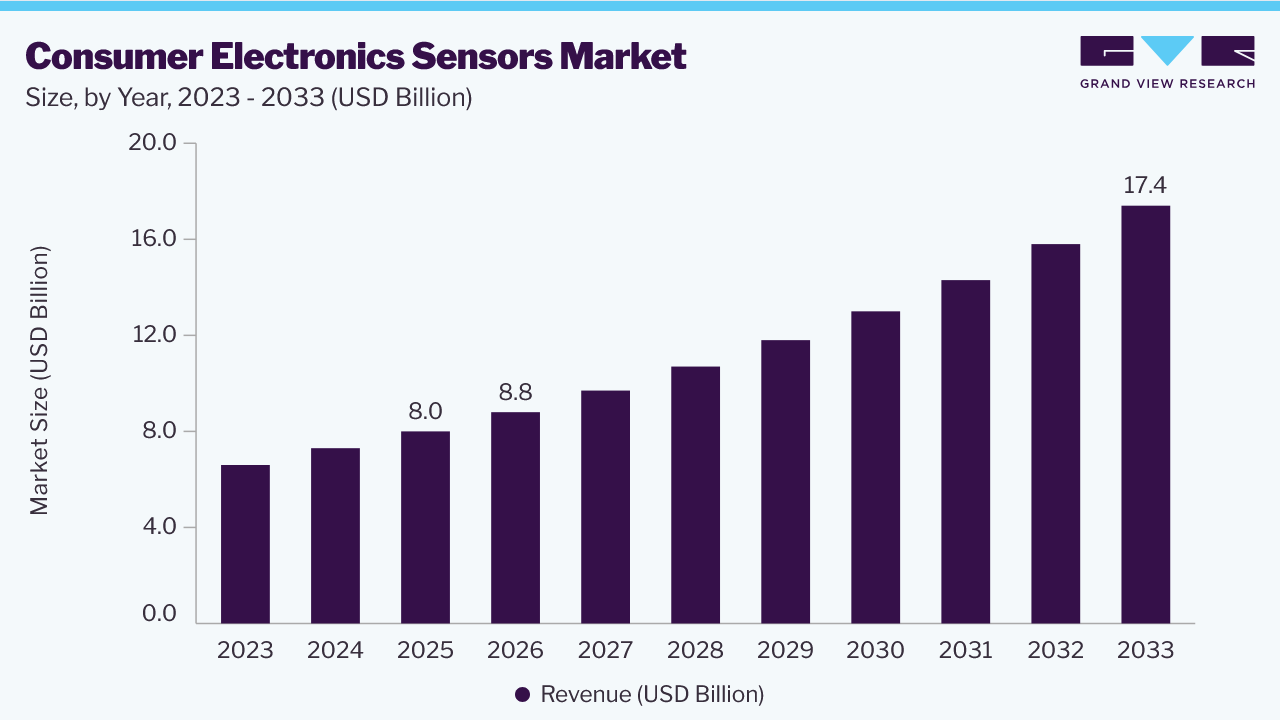
The global consumer electronics sensors market size was valued at USD 8.0 billion in 2025 and is projected to grow from USD 8.8 billion in 2026 to USD 17.4 billion in 2033, at a CAGR of 10.1% from 2026 to 2033. Asia Pacific dominated the market, accounting for a revenue share of 45.0% in 2025. This growth is primarily driven by increased investments in research and development, resulting in the continuous introduction of innovative products that attract and influence consumers. Intense market competition has spurred new consumer preferences, with increasing demand for compact devices, energy-efficient solutions, and wearable technologies. In response, manufacturers are developing products that align with these preferences, thereby supporting the overall growth of the market.
Key Market Trends & Insights
- By product: The image segment held the largest market share of around 40.0% in 2025.
- By applications: The communications segment held the largest market share of over 36.0% in 2025.
Regional Highlights
- Largest regional market: Asia Pacific (45.0% revenue share, 2025)
- Fastest-growing regional market: North America (highest CAGR, 2026-2033)
Market Size & Forecast
- Market size in 2025: USD 8.0 Billion
- Estimated market size in 2026: USD 8.8 Billion
- Projected market size by 2033: USD 17.4 Billion
- CAGR (2026-2033): 10.1%
The growth of digitization and technology across sectors has significantly driven market demand. In the manufacturing industry, the Internet of Things (IoT) is helping boost productivity. Similarly, the home appliances sector has experienced a surge in demand for IoT-enabled security solutions. The gaming and entertainment industry has evolved significantly over the last few years with the introduction of a wide variety of products, such as VR in gaming and 3D experiences in sound and visual effects in entertainment, leading to increased market growth.
The market is poised for growth as the demand for Micro Electro Mechanical Systems (MEMS) in communication, entertainment, and home appliances continues to rise. These devices are primarily integrated into smartphones and tablets due to their compact size and improved efficiency. MEMS contribute significantly to enhancing communication, visual, sound, navigation & control, and tactile interface experiences. Nevertheless, challenges such as a lack of product differentiation and price pressures could impede industry growth in the forecast period.
Analyst Perspective
The global consumer electronics sensors market is evolving toward miniaturized, low-power, and intelligent sensing technologies. Growth is driven by increasing adoption of sensors in smartphones, wearables, smart homes, and entertainment devices. Innovations in image, MEMS, Hall-effect, and AI-based sensors are enhancing device performance and functionality. Despite price competition and supply chain challenges, rising semiconductor investments and demand for next-generation sensing technologies are expected to support market growth.
Product Insights
The image segment held the largest market share of around 40.0% in 2025. Due to increased investment in research and development, companies are creating new sensors that are affordable, small, and low-energy. This has opened up fresh possibilities in the market, which has gotten more competitive. New companies are joining the fray with all sorts of products and unique marketing strategies. This competition is a major reason the market is booming. As the smartphone market continues to grow, it creates a positive ripple effect on the image sensor market. Furthermore, sensor manufacturers are increasingly introducing advanced imaging technologies to improve smartphone photography and support next-generation AI-enabled devices. For instance, in November 2025, Sony Semiconductor Solutions Corporation announced the launch of the LYTIA 901, an approximately 200-megapixel mobile image sensor with built-in AI processing, advanced HDR, and in-sensor zoom, designed for next-generation flagship smartphones. The innovation highlights the growing demand for high-resolution intelligent image sensors in consumer electronics applications.
The motion sensor segment is projected to grow steadily from 2026 to 2033. Motion sensors are now an integral part of various industries, including automotive, consumer electronics, aerospace, healthcare, and others. The growing trend toward the adoption of smart homes and advancements in home automation applications, including lighting, security, and access control systems, is driving the growth of the motion sensors market. Additionally, the increasing penetration of smartphones, tablets, and wearable devices such as smartwatches is expected to further support market expansion.
Applications Insights
The communications segment held the largest market share of over 36.0% in 2025. The rising demand for smart devices and IoT products has fueled the need for high-quality sensors. Also, the growing focus on user experience and interactivity in consumer electronics has necessitated the integration of advanced sensors. Lastly, the trend towards miniaturization in electronics has also played a crucial role, as smaller devices require compact yet powerful sensors.