Exotic Pets Market growing at a CAGR of 8.1% from 2026 to 2033
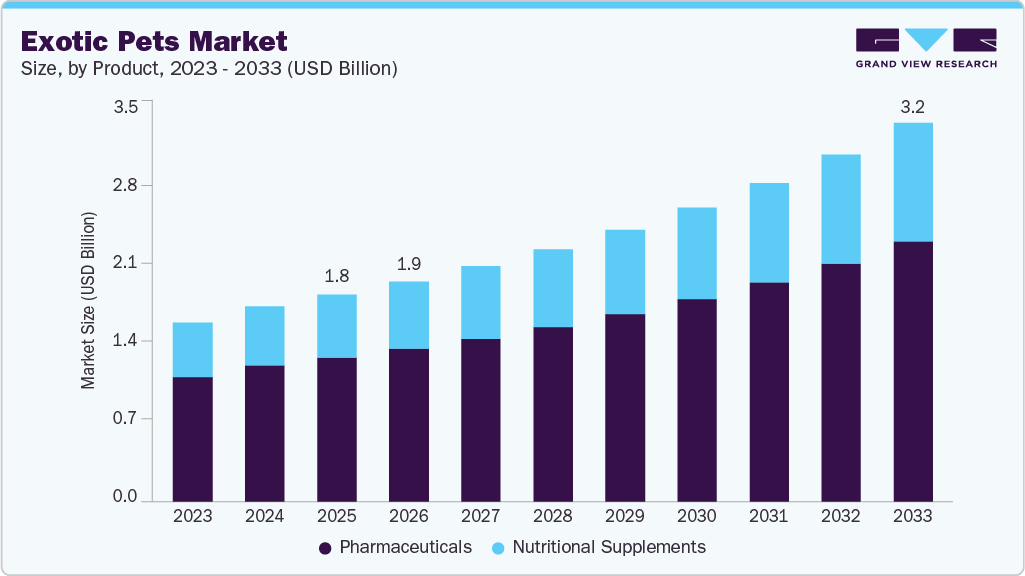
The global exotic pets market size was estimated at USD 1.75 billion in 2025 and is projected to reach USD 3.21 billion by 2033, growing at a CAGR of 8.1% from 2026 to 2033. The market is advancing due to expansion of specialized veterinary and pet care services, increasing exotic pet ownership and expenditure, rising adoption of exotic pet insurance and expansion of products availability.
Key Market Trends & Insights
- North America exotic pets market held the largest revenue share of 50.02% in 2025.
- U.S. dominated the North America region with the largest revenue share in 2025.
- By product, pharmaceuticals segment held the largest share of 69.51% of the market in 2025.
- By animal, small mammals segment held the largest market share in 2025.
- By route of administration, oral segment held the largest market share in 2025.
Market Size & Forecast
- 2025 Market Size: USD 1.75 Billion
- 2033 Projected Market Size: USD 3.21 Billion
- CAGR (2026-2033): 8.1%
- North America: Largest market in 2025
- Asia Pacific: Fastest growing in market
Request Free Sample Report: https://www.grandviewresearch.com/industry-analysis/exotic-pets-market-report/request/rs1
Growing availability of specialized pet care services drives the expansion of the market. As clinics hire veterinarians trained in reptile, avian, amphibian, and small mammal medicine, owners gain confidence in accessing reliable treatment for species that were considered difficult to care. This increased access to diagnostic tools, emergency services, and species-specific nutrition and wellness programs reduces perceived risk and encourages prospective owners to adopt exotic pets. Thus, this greater demand fuels further investment in specialty hospitals, mobile exotic vet services, and tele-veterinary care services.
In addition, growing exotic pet ownership directly increases overall market expenditure, reinforcing market expansion. According to a report of May 2025, approximately 9% of U.S. households own exotic pets, and among these owners, around 28% choose birds as their exotic species. Besides this, as consumers adopt reptiles, birds, amphibians, and small mammals their spending naturally increases on habitat setups, high-quality feed, supplements, enrichment, and medical care. This rising expenditure incentivizes manufacturers to introduce premium, species-specific products, further enhancing pet wellbeing and improving ownership experiences. Besides this, higher spending also highlights emotional value placed on these pets, encouraging owners to invest in advanced care solutions.
Furthermore, rising adoption of exotic pet insurance is accelerating market growth by reducing the financial risks associated with caring for exotic pets. As veterinary care for species such as parrots, reptiles, and ferrets can be specialized and expensive, insurance makes ownership more accessible. Besides this, companies such as Nationwide and Petcover are expanding coverage to meet rising demand. For instance, nationwide offers insurance for birds, rabbits, and reptiles, with bird plans covering a wide range of medical services from any licensed veterinarian and premiums starting below USD 21 per month. Similarly, Petcover provides insurance for reptiles, turtles, birds, and small mammals. These specialized, affordable plans boost owner confidence, support exotic bird care.
Moreover, product expansion is one of the key driver of the market, as growing availability of specialized supplies supports the unique needs of exotic animals. Some of the manufacturers and retailers are expanding their portfolios with species-specific nutrition, habitat enrichment tools, heating and lighting systems, grooming products, and health-related solutions such as supplements and medical care kits. This wider range of high-quality products across online and offline channels lowers barriers for new owners and improves long-term care. For instance, in March 2025, REMY expanded into exotic pet snacks with affordable, human-grade, vet-developed products for rodents, launching across Thailand and preparing for international markets. This expansion increased product accessibility, strengthened brand visibility and boosted demand for exotic pet care, influencing market growth through wider distribution and increasing consumer interest. Besides this, larger product variety also drives innovation, leading to more species-specific, welfare-focused solutions that enhance animal health and longevity. Thus, this expansion of accessible, high-quality supplies encourages more households to adopt exotic pets, directly expanding sustained market growth.
Market Concentration & Characteristics
The market is moderately concentrated and pace is accelerating, with a mix of niche specialty brands and a few expanding multinational players. In the market, no single company holds a dominant position; however, rising investments in specialized nutrition, habitat solutions, and healthcare products are enabling select innovators to capture increasing market share.
The exotic pet market demonstrates moderate innovation, especially in nutrition, habitat design, and veterinary care. Companies invest in specialized diets, smart enclosures, and species-specific medical solutions to meet diverse animal needs. Innovation is driven by consumer demand for better health and enrichment products for exotic species. Startups and niche brands often lead in introducing novel offerings, while larger firms follow with scalable solutions. However, limited research funding and species complexity slightly restrain the pace of breakthroughs.
Mergers and acquisitions in the exotic pet market remain relatively low compared to mainstream pet sectors. Most small- to mid-sized businesses focus on specific animal categories or regional markets. Larger pet care firms occasionally acquire niche players to diversify their portfolios or enter new segments. M&A activity tends to increase during heightened consumer interest or regulatory clarity periods. Overall, the market remains fragmented with limited consolidation.
Regulations strongly impact the exotic pet market, influencing species trade, breeding practices, and ownership laws. Many countries enforce strict import controls and welfare standards that directly affect product availability and market growth. Shifting legal frameworks can disrupt supply chains or limit the types of animals kept as pets. Businesses must stay agile and compliant with local and international wildlife protection laws. Regulatory complexity often acts as a barrier to entry for new players
Substitution risk is moderate, with some consumers opting for traditional pets such as dogs or cats over exotic animals. However, exotic species’ unique appeal and personality sustain a loyal niche customer base. In some cases, interactive robotic pets or advanced simulations also serve as partial substitutes. Depending on cost, maintenance, or ethical concerns, educational institutions and hobbyists may shift preferences. Despite this, emotional attachment and novelty keep demand steady in key segments.
Product Insights
Pharmaceuticals segment dominated the market with largest revenue share of 69.51% in 2025. The segment is comprised of anti-inflammatories, parasiticides, antibiotics, non-steroidal anti-inflammatory drugs (NSAIDs) and other drugs. The segment is driven by the rising ownership of these non-traditional pets and a growing awareness of their unique healthcare needs. Pharmaceuticals play a central role in managing a range of conditions in these species, including respiratory infections in birds and small mammals, parasitic infestations in reptiles, metabolic bone disease in lizards and tortoises, and dermatological issues in rodents and sugar gliders. These health challenges often require species-specific treatments, and the growing availability of tailored medications such as antibiotics, antiparasitics, anti-inflammatories, and supplements has improved treatment outcomes and quality of care.
The nutritional supplements segment is expected to grow at the fastest CAGR over the forecast period. The health of exotic companion animals is heavily influenced by their nutritional intake, with deficiencies commonly arising from poor diets and insufficient species-specific knowledge. Guinea pigs are prone to scurvy due to their inability to produce vitamin C, making supplementation essential to prevent symptoms such as lethargy and joint pain. Chinchillas need high dietary fiber and proper minerals to avoid digestive and dental problems. Parrots and cockatiels often experience vitamin A deficiency from seed-only diets, leading to respiratory issues and poor feather condition. Reptiles such as iguanas and tortoises are at risk of metabolic bone disease caused by calcium, phosphorus, and vitamin D3 imbalances. Ensuring balanced nutrition, proper supplementation, and routine veterinary care is vital for preventing nutritional disorders in these species
Exotic Pets Market Report Scope
|
Report Attribute |
Details |
|
Market size value in 2026 |
USD 1.86 billion |
|
Revenue forecast in 2033 |
USD 3.21 billion |
|
Growth rate |
CAGR of 8.1% from 2026 to 2033 |
|
Actual data |
2021 – 2025 |
|
Forecast period |
2026 – 2033 |
|
Quantitative units |
Revenue in USD Million/Billion and CAGR from 2026 to 2033 |
|
Report coverage |
Revenue forecast, company ranking, competitive landscape, growth factors, and trends |
|
Segments covered |
Product, animal, route of administration, indication, distribution channel and regional |
|
Regional scope |
North America; Europe; Asia Pacific; Latin America; MEA |
|
Country scope |
U.S.; Canada; Mexico; UK; Germany; France; Italy; Spain; Denmark; Sweden; Norway; Japan; China; India; Thailand; South Korea; Australia; Brazil; Argentina; South Africa; UAE; Saudi Arabia; Kuwait; Qatar; Oman |
|
Key companies profiled |
AdvaCare Pharma; VETARK (Candioli Srl); Vetafarm; Mazuri; Versele Laga; CROCdoc (a sister company of The Birdcare Company); Zoetis Inc.; Merck & Co., Inc.; Vetnil; Pet King Brands. |
|
Customization scope |
Free report customization (equivalent up to 8 analysts working days) with purchase. Addition or alteration to country, regional & segment scope. |
|
Pricing and purchase options |
Avail customized purchase options to meet your exact research needs. Explore purchase options |