Microcrystalline Cellulose Market growing at a CAGR of 7.8% from 2026 to 2033
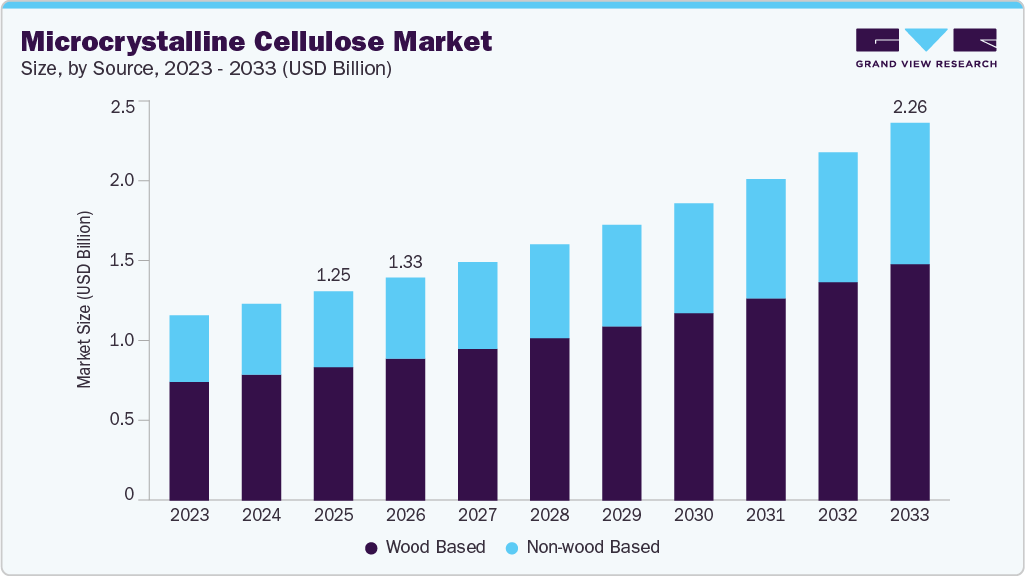
The global microcrystalline cellulose market size was estimated at USD 1,255.1 million in 2025 and is projected to reach USD 2,267.5 million by 2033, growing at a CAGR of 7.8% from 2026 to 2033. The microcrystalline cellulose (MCC) market represents a vital segment of the global excipient and specialty ingredient landscape, shaped by consistent demand from pharmaceuticals, food, and personal care industries.
Key Market Trends & Insights
- The Asia Pacific microcrystalline cellulose industry led the global market in 2025, accounting for 37.8% of total revenue.
- China held over 43.9% revenue share of the Asia Pacific microcrystalline cellulose market.
- By source, the wood based source segment dominated the market in 2025, accounting for 63.9% of total revenue, due to its established reliability and broad industrial acceptance.
- By form, the powdered form segment held the leading position in the market in 2025, capturing 60.3% of total revenue, due to its wide applicability and ease of handling.
- By end-use, the pharmaceutical segment dominated the market with the largest revenue share of 33.9% in 2025.
Market Size & Forecast
- 2025 Market Size: USD 1,255.1 Million
- 2033 Projected Market Size: USD 2,267.5 Million
- CAGR (2026-2033): 7.8%
- Asia Pacific: Largest market in 2025
Request Free Sample Report: https://www.grandviewresearch.com/industry-analysis/microcrystalline-cellulose-market-report/request/rs1
Its importance lies in functional versatility, regulatory acceptance, and reliability, making it a foundational material across diverse formulations worldwide today and long term. The market continues to expand as industries increasingly prioritize performance consistency, safety, and formulation efficiency. In pharmaceutical manufacturing, microcrystalline cellulose excipient market is widely used for its binding, disintegration, and compressibility properties, which support high volume solid dosage production. Growth in generic drug manufacturing, rising healthcare access, and increasing regulatory emphasis on quality excipients reinforce demand. In food and beverage applications, the food additives microcrystalline cellulose market benefits from its role in texture control, calorie reduction, and stability, aligning well with clean label preferences and plant based ingredient adoption. Personal care and cosmetics also contribute through its role as a stabilizer and sensory modifier, further strengthening overall consumption patterns. Additionally, emerging industrial uses, including niche applications associated with the microcrystalline cellulose motors market, contribute incremental volumes and broaden the material’s application base.
Supply stability depends on pulp quality and sustainable sourcing practices since microcrystalline cellulose is derived from natural cellulose sources. Regulatory approvals from authorities such as pharmacopeias and food safety agencies strongly shape supplier credibility and market entry. Pricing sensitivity is moderated by the critical functional role the product plays in formulations, which limits substitution risks. Regional production expansion in Asia, combined with established manufacturing bases in Europe and North America, has also improved supply chain resilience and competitive balance.
Market Concentration & Characteristics
The microcrystalline cellulose industry shows a moderately concentrated structure, shaped by the presence of established global manufacturers alongside a growing number of regional producers. Leading companies benefit from long standing customer relationships, regulatory approvals, and broad product portfolios that support multiple end use industries. At the same time, smaller manufacturers remain active by focusing on cost efficiency, regional supply, or specific application requirements, which sustains competitive pressure across the market.
Market characteristics are defined by high quality expectations, process consistency, and strong emphasis on compliance. Buyers prioritize reliability, traceability, and performance stability over frequent supplier switching, resulting in long term supply agreements. Product differentiation is based more on functionality and application fit than on branding alone. The market favors manufacturers with technical expertise, robust quality systems, and the ability to support customers through formulation guidance and dependable supply continuity.
Microcrystalline Cellulose Market Report Scope
|
Report Attribute |
Details |
|
Market size value in 2026 |
USD 1,338.1 million |
|
Revenue forecast in 2033 |
USD 2,267.5 million |
|
Growth rate |
CAGR of 7.8% from 2026 to 2033 |
|
Base year for estimation |
2025 |
|
Historical data |
2018 – 2024 |
|
Forecast period |
2026 – 2033 |
|
Quantitative units |
Revenue in USD million/billion, volume in kilotons, and CAGR from 2025 to 2033 |
|
Report coverage |
Revenue forecast, company ranking, competitive landscape, growth factors, and trends |
|
Segments covered |
Source, form, end-use, region |
|
Regional scope |
North America; Europe; Asia Pacific; Latin America; Middle East & Africa |
|
Country scope |
U.S.; Canada; Mexico; Brazil; Argentina; Germany; UK; Italy; Spain; France; China; Japan; South Korea; Saudi Arabia; South Africa |
|
Key companies profiled |
JRS Pharma; FMC BioPolymer; DFE Pharma GmbH & Co. KG; Asahi Kasei Corporation; Roquette Frères; International Flavors & Fragrances Inc. (IFF); Mingtai Chemical Co., Ltd.; Sigachi Industries Pvt. Ltd.; Anhui Sunhere Pharmaceutical Excipients Co., Ltd.; Accent Microcell Pvt. Ltd. |
|
Customization scope |
Free report customization (equivalent to up to 8 analysts’ working days) with purchase. Addition or alteration to country, regional & segment scope. |
|
Pricing and purchase options |
Avail customized purchase options to meet your exact research needs. Explore purchase options |