Fingerprint Sensor Market (2026 – 2033)
Fingerprint Sensor Market Summary
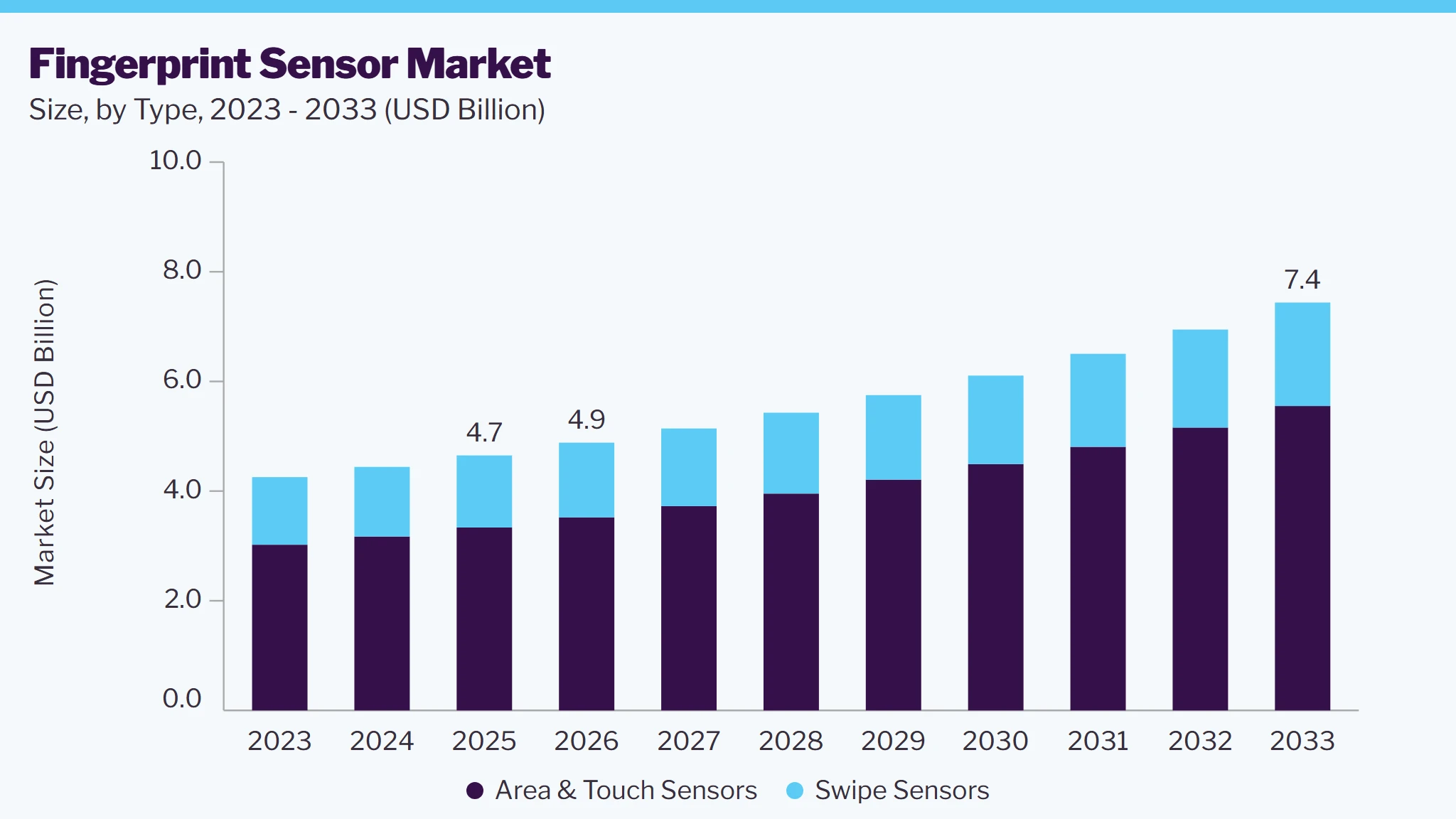
The global fingerprint sensor market size was valued at USD 4.7 billion in 2025 and is projected to grow from USD 4.9 billion in 2026 to USD 7.4 billion by 2033, at a CAGR of 6.2% from 2026 to 2033. Asia Pacific dominated the market, accounting for the largest revenue share of 34.0% in 2025. The market is driving the market due to the increasing deployment of fingerprint-based access control across offices, residential buildings, educational institutions, and industrial facilities, supporting demand for fingerprint sensors.
Key Market Trends & Insights
- By type: Area & touch sensors segment dominated the market, with a revenue share of 71.8% in 2025.
- By technology: Capacitive segment held the largest market share of 48.9% in 2025.
- By end use: Consumer electronics segment held the largest market share of 49.5% in 2025.
Regional Highlights
- Largest regional market: Asia Pacific (34.0% revenue share, 2025)
- By country: China held the largest market share in 2025
Market Size & Forecast
- Market size in 2025: USD 4.7 Billion
- Estimated market size in 2026: USD 4.9 Billion
- Projected market size by 2033: USD 7.4 Billion
- CAGR (2026-2033): 6.2%
Request a free sample copy or view report summary: https://www.grandviewresearch.com/industry-analysis/fingerprint-sensor-market-report/request/rs1
The increasing need for secure identity verification is driving the adoption of fingerprint sensors across consumer and enterprise applications. Fingerprint authentication provides a convenient method for verifying users without requiring passwords or PINs. Smartphone manufacturers continue to integrate fingerprint sensors into devices to support secure unlocking and application authentication. Financial institutions are also adopting biometric verification for digital banking and payment authentication. Government agencies use fingerprint-based identification for citizen registration, border management, and law enforcement. Enterprises are incorporating fingerprint authentication into access control and employee attendance systems.
Furthermore, the growth of digital banking and electronic payment services is increasing the need for secure user authentication. Financial institutions are integrating biometric verification into mobile banking, payment applications, and customer onboarding processes. Fingerprint authentication provides a rapid verification method for accessing financial accounts and authorizing transactions. The expansion of mobile wallets and fintech platforms is creating additional applications for biometric sensors. Banks and payment providers are also adopting multi-factor authentication to reduce risks associated with stolen credentials and unauthorized account access. Increasing smartphone-based financial activity supports the integration of fingerprint authentication into consumer devices.
Market Concentration & Characteristics
The market has a high degree of innovation, supported by continuous development in optical, capacitive, ultrasonic, and other sensing technologies. Companies are improving sensor resolution, authentication speed, power efficiency, anti-spoofing capabilities, and under-display integration. Innovation is also expanding fingerprint authentication beyond smartphones into automotive, access control, payment cards, and enterprise security applications.Regulations have a moderate to high impact on the fingerprint sensor industry because biometric data is subject to privacy, security, consent, and data-handling requirements across different jurisdictions. Regulations encourage manufacturers and solution providers to adopt secure data storage, on-device processing, and stronger protection of biometric templates. These requirements can also increase compliance and integration requirements for companies supplying government, financial, healthcare, and enterprise applications.
Type Insights
The area & touch sensors segment led the market in 2025, accounting for 71.8% of global revenue, driven by the increasing adoption of fingerprint authentication across smartphones, laptops, tablets, smart cards, access-control systems, and other connected devices. These sensors capture a larger portion of the fingerprint through a single touch, supporting faster and more consistent user authentication. Their compact form factors also support integration into side-mounted, rear-mounted, and under-display configurations, giving device manufacturers greater design flexibility. Rising demand for secure device access, digital payments, and passwordless authentication further supports adoption across consumer and commercial applications.
End Use Insights
The consumer electronics segment led the market with the largest revenue share of 49.5% in 2025, driven by the increasing integration of fingerprint authentication into smartphones, laptops, tablets, and wearable devices for secure and convenient user access. Rising use of mobile banking, digital wallets, and e-commerce further increases the need for biometric verification on personal devices. Advancements in under-display, compact, and low-power fingerprint sensors support integration without significantly affecting device design. Growing concerns around unauthorized access, identity theft, and the protection of personal data also encourage manufacturers to include biometric security features.
Regional Insights
Asia Pacific dominated the fingerprint sensor market with the largest revenue share of 34.0% in 2025, driven by the region’s large electronics manufacturing ecosystem and expanding production of connected devices. High-volume manufacturing of smartphones, tablets, laptops, wearables, and other electronic products creates substantial opportunities for fingerprint sensor integration. Device manufacturers increasingly require compact sensors with lower power consumption, higher resolution, and smaller form factors to accommodate evolving product designs. Advances in sensor miniaturization also support biometric authentication across a broader range of portable and connected devices. These manufacturing capabilities and expanding device categories support sustained fingerprint sensor demand across the region.
Fingerprint Sensor Market Report Scope
|
Report Attribute |
Details |
|
Market size in 2025 |
USD 4.7 billion |
|
Estimated market size in 2026 |
USD 4.9 billion |
|
Projected market size by 2033 |
USD 7.4 billion |
|
Growth rate |
CAGR of 6.2% from 2026 to 2033 |
|
Actual data |
2021 – 2025 |
|
Forecast period |
2026 – 2033 |
|
Quantitative units |
Revenue in USD billion and CAGR from 2026 to 2033 |
|
Report coverage |
Revenue forecast, company ranking, competitive landscape, growth factors, and trends |
|
Segments covered |
Type, technology, end use, region |
|
Regional scope |
North America; Europe; Asia Pacific; Latin America; MEA |
|
Country scope |
U.S.; Canada; Mexico; UK; Germany; France; China; India; Japan; South Korea; Australia; Brazil; Saudi Arabia; South Africa; UAE |
|
Key companies profiled |
Shenzhen Goodix Technology Co., Ltd.; Fingerprint Cards AB; Qualcomm Technologies, Inc.; Synaptics Incorporated; Egis Technology Inc.; IDEMIA; IDEX Biometrics ASA; NEXT Biometrics Group ASA; Apple Inc.; Suprema Inc. |
|
Customization scope |
Free report customization (equivalent up to 8 analysts working days) with purchase. Addition or alteration to country, regional & segment scope. |
|
Pricing and purchase options |
Avail customized purchase options to meet your exact research needs. Explore purchase options |